

The Ministry of Industry and Trade is currently seeking feedback on a draft decision regarding the pilot roadmap for a two-tiered electricity pricing system. The Ministry proposes applying this pricing mechanism in four phases.
Phase 1, from now until the end of June 2026, involves conducting surveys, updating data, and applying the policy initially to manufacturing customers participating in the direct electricity purchase and sale mechanism under Government Decree 57/2025 on direct electricity purchase and sale between renewable energy power generation units and large electricity consumers.
During this phase, authorities will collect all metering data such as peak electricity consumption, electricity production, and electricity usage characteristics according to typical load profiles of different customer groups. Based on this, they will propose a plan to adjust the two-component retail electricity price to reflect any fluctuations in input parameters.
Phase 2 involves communication and a paper-based pilot program, running from January to June 2026. Authorities will issue parallel invoices (without actual payment) to all customers as per regulations.
Phase 3 involves the two-component pricing mechanism being officially tested for one year, from July 2026 to July 2027. During this time, authorities will monitor and evaluate changes in load demand, electricity usage behavior, customer responses, and the impact of the new mechanism on electricity bills and sales revenue compared to the current pricing mechanism.
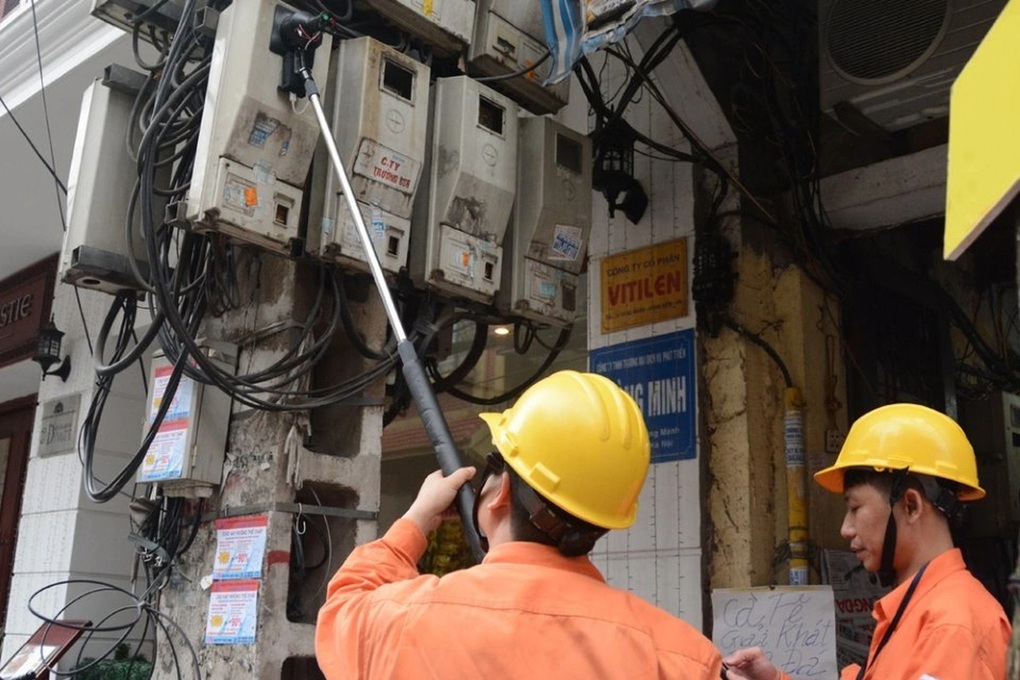
Electricity workers inspect electricity meters (Photo: EVN).
Phase 4 starts in August 2027. In this phase, the Ministry of Industry and Trade will evaluate and expand the application of the two-component electricity pricing system to different customer groups.
According to the draft, Vietnam Electricity Group (EVN) is responsible for developing, calculating, and proposing a two-component retail electricity price to submit to the Ministry of Industry and Trade and implement according to the above roadmap.
The two-component electricity pricing system consists of a portion of the price that electricity users pay for their registered power consumption and a portion of the price they pay for the amount of electricity consumed. Most countries around the world apply this system. Meanwhile, Vietnam maintains a single-component pricing mechanism based on electricity consumption, meaning it is calculated based on the actual amount of electricity used.
The two-component electricity pricing mechanism is considered to accurately reflect the costs incurred by the electricity sector to serve each customer, including the cost of transmission lines, substations, and electricity itself. The first impact is a reduction in cross-subsidization between customer groups, while also preventing the registration of large but unused power capacities.
Previously, in a report submitted to the Ministry of Industry and Trade in November 2024 regarding the two-component electricity pricing mechanism, the corporation proposed building a two-tier pricing system. Specifically, with the base price system, this two-tier electricity pricing system is based on long-term marginal costs and adjusted according to the characteristics of consumer households.
The corporation believes that the proposed plan fully reflects the operating costs of electricity production and business, covering only residential and non-residential customer groups.
Source: https://dantri.com.vn/kinh-doanh/gia-dien-2-thanh-phan-khi-nao-se-ap-dung-20250908181931139.htm

![[Image] Leaked images ahead of the 2025 Community Action Awards gala.](/_next/image?url=https%3A%2F%2Fvphoto.vietnam.vn%2Fthumb%2F1200x675%2Fvietnam%2Fresource%2FIMAGE%2F2025%2F12%2F16%2F1765882828720_ndo_br_thiet-ke-chua-co-ten-45-png.webp&w=3840&q=75)
![[Photo] Prime Minister Pham Minh Chinh receives Lao Minister of Education and Sports Thongsalith Mangnormek](/_next/image?url=https%3A%2F%2Fvphoto.vietnam.vn%2Fthumb%2F1200x675%2Fvietnam%2Fresource%2FIMAGE%2F2025%2F12%2F16%2F1765876834721_dsc-7519-jpg.webp&w=3840&q=75)

























































































Comment (0)