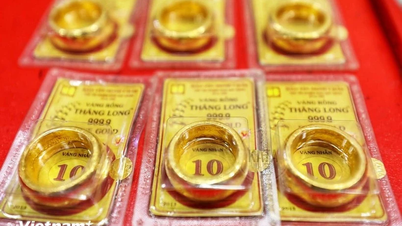
World oil prices plummeted last week despite massive production cuts by OPEC+ and the seventh consecutive decline in the number of active oil and gas rigs in the US.
Accordingly, the fact that both Brent and WTI crude oil prices fell by more than 3% last week is the reason why domestic gasoline and diesel prices are predicted to decrease in the price adjustment on July 1st.
Is it predicted that domestic gasoline prices will decrease?
Speaking to VTC News, a major petroleum distributor in the South predicted that if the regulatory agency does not intervene in the fuel price stabilization fund, domestic gasoline prices in the next price adjustment period (July 1st) are likely to decrease by about 200-500 VND/liter, and diesel prices could also decrease by 100-300 VND/liter.

Fuel prices are forecast to fall next week. (Photo: Cong Hieu)
Currently, domestic fuel prices are being applied according to the price adjustment session of June 21st by the Joint Ministry of Finance and Industry and Trade.
Specifically, the prices of E5 RON92 and RON95 gasoline remain unchanged compared to current prices, not exceeding 20,878 VND/liter and 22,015 VND/liter respectively.
Meanwhile, the price of diesel increased by 146 VND/liter compared to the current retail price, not exceeding 18,174 VND/liter; kerosene increased by 133 VND/liter, not exceeding 17,956 VND/liter; and the price of fuel oil decreased by 132 VND/kg, not exceeding 14,587 VND/kg.
In this price adjustment period, the authorities allocated funds to the fuel price stabilization fund for E5 RON92 gasoline at 191 VND/liter (previously 228 VND/liter), RON95 gasoline at 139 VND/liter (previously 180 VND/liter); diesel at 100 VND/liter (previously 200 VND/liter); kerosene at 100 VND/liter (previously 200 VND/liter); and mazut at 100 VND/kg (previously 200 VND/kg).



At the same time, no funds from the price stabilization fund will be used for any gasoline or diesel products.
Since the beginning of the year, gasoline prices have undergone 18 adjustments, including 9 increases, 6 decreases, and 3 times remaining unchanged.
How have world oil prices fluctuated?
Traders are concerned that rising interest rates could dampen demand despite signs of tighter supply, including lower US crude oil inventories. This has caused global crude oil prices to consistently fall this past week.
Oil prices have plummeted despite bullish factors such as massive OPEC+ production cuts and the seventh consecutive decline in the number of active US oil and gas rigs.
In the final trading session of the week, a slight drop in oil prices reinforced this week's decline. Both Brent and WTI crude experienced a week of price decreases.
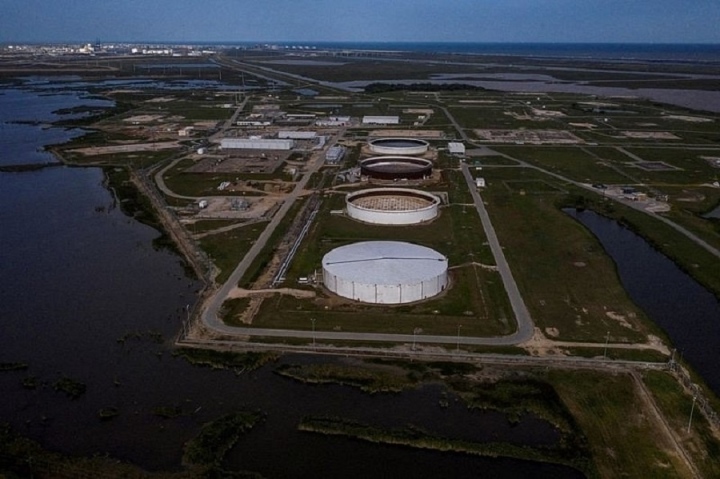
The Bryan Mound strategic oil reserve in Freeport, Texas, USA. (Photo: Reuters)
Accordingly, Brent crude fell to $73.85 per barrel, and WTI crude fell to $69.16 per barrel, equivalent to a decrease of more than 3% over the past week.
Also this past week, the U.S. Energy Information Agency (EIA) reported that U.S. crude oil inventories fell by 3.8 million barrels to 463.3 million barrels, contrary to analysts' expectations of a 300,000-barrel increase in a Reuters poll.



Meanwhile, U.S. gasoline inventories rose by approximately 480,000 barrels to 221.4 million barrels; along with the increase in gasoline inventories, U.S. inventories of refined products, including diesel and heating oil, also increased by approximately 430,000 barrels to 114.3 million barrels.
With traders currently buying WTI oil, Oilprice forecasts that oil prices may continue to fall next week.
Pham Duy
Beneficial
Emotion
Creative
Unique
Source



![[Photo] Prime Minister Le Minh Hung presides over the thematic session on promoting science and technology development and innovation.](https://vphoto.vietnam.vn/thumb/1200x675/vietnam/resource/IMAGE/2026/06/23/1782207872934_ndo_br_dsc-1724-jpg.webp)