

The scientific task "Research to determine the causes and extent of degradation of production forest land in Central Vietnam and propose technical solutions to manage and restore soil fertility" (code DTĐL.CN-29/23), chaired by Dr. Dang Thinh Trieu, has provided important scientific evidence, opening up effective solutions to improve soil quality and increase forest productivity.
The project belongs to the Basic Science Development Program for the period 2017-2025, chaired by the Institute of Silviculture Research, aiming at three key objectives: Identifying the causes and extent of land degradation; developing a set of monitoring indicators and a scale to assess the quality of planted forest land; and proposing technical solutions to limit degradation and restore fertility to planted forest land in the Central region.
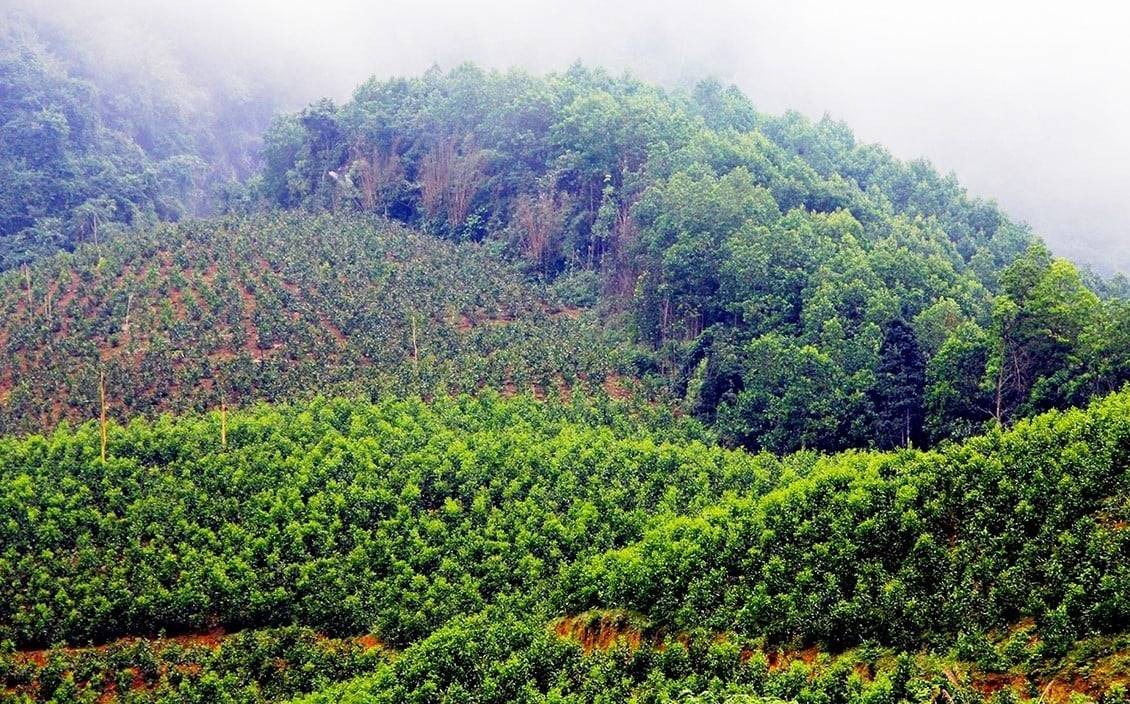
Central Vietnam is an area with large areas of production forests.
The surveys and analyses were carried out in 13 provinces in the Central region, where the climate is harsh, the land is easily washed away and eroded, and many areas of single-species, short-rotation forests quickly deplete the soil. The research results clearly identified the main causes of degradation such as loss of organic matter, reduced water retention capacity, decline in soil microorganisms, unreasonable intensification and negative impacts of climate change. The topic also pointed out the level of degradation according to each type of soil, each farming condition and direct impact on the growth and productivity of planted forests.
One of the important contributions of the mission is the development of a set of monitoring indexes and a soil quality assessment scale specifically for production forest land in the Central region. The index set includes groups of chemical, physical and biological parameters of the soil, helping people and management units easily monitor soil conditions and make appropriate decisions in planting, care and restoration techniques. This is a tool that has never been fully developed in Vietnam before and can be widely applied to many other forest plantation areas.
In addition, the project has proposed technical solutions to restore fertility and limit degradation, including: Organic supplementation suitable for each type of soil; applying mixed-species plantation models; improving soil preparation techniques; increasing vegetation cover; and using crop varieties suitable for degraded soil conditions. These recommendations are highly applicable, easy to implement and suitable for the production conditions of people in the Central region.
The research results have been accepted and applied by localities, becoming an important basis for forestry planning, improving productivity and quality of planted forests. Maintaining soil fertility not only helps forests develop sustainably but also contributes to protecting the soil, water and air environment, especially in the context of the Central region often affected by natural disasters.
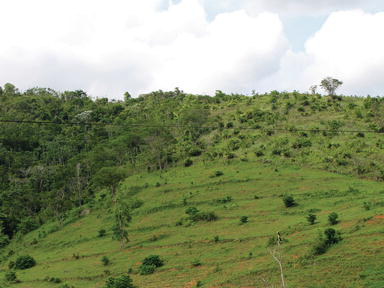
Fertility restoration and sustainable forestry development.
The task also brings great value in training and improving the research capacity of the scientific team. Through the project, the Institute of Silviculture and the Institute of Soil and Fertilizer have enhanced their capacity to analyze and monitor planted forest soil; at the same time, they have supported the training of 01 master and 01 doctoral student, contributing to the high-quality human resources in the field of silviculture and soil.
In terms of socio-economic efficiency, the study has provided a scientific basis for localities to develop long-term forest land quality management strategies. Improving soil fertility helps increase forest productivity, bringing higher economic value to thousands of hectares of production forests. At the same time, soil restoration solutions contribute to environmental protection, reduce erosion and increase the resilience of forest ecosystems to natural disasters.
With an interdisciplinary approach combining silviculture, soil, ecology and socio-economics, the task DTĐL.CN-29/23 not only solves the urgent problem of the Central region but also opens up a new research direction on sustainable forest land management. This is a research model that can be expanded to many other ecological regions, contributing to the goal of developing a modern, green and effective forestry industry.
Source: https://mst.gov.vn/giai-phap-phuc-hoi-do-phi-va-phat-trien-lam-nghiep-ben-vung-197251201104306294.htm


![[Photo] Prime Minister Pham Minh Chinh receives President of Cuba's Latin American News Agency](/_next/image?url=https%3A%2F%2Fvphoto.vietnam.vn%2Fthumb%2F1200x675%2Fvietnam%2Fresource%2FIMAGE%2F2025%2F12%2F01%2F1764569497815_dsc-2890-jpg.webp&w=3840&q=75)




































































Comment (0)