

The first meeting between Japanese Prime Minister Ishiba Shigeru and US President Donald Trump at the White House on February 7th was "warm." As a result, Tokyo avoided the "deadly tariffs" that Trump imposed on other US allies, at least in the short term.
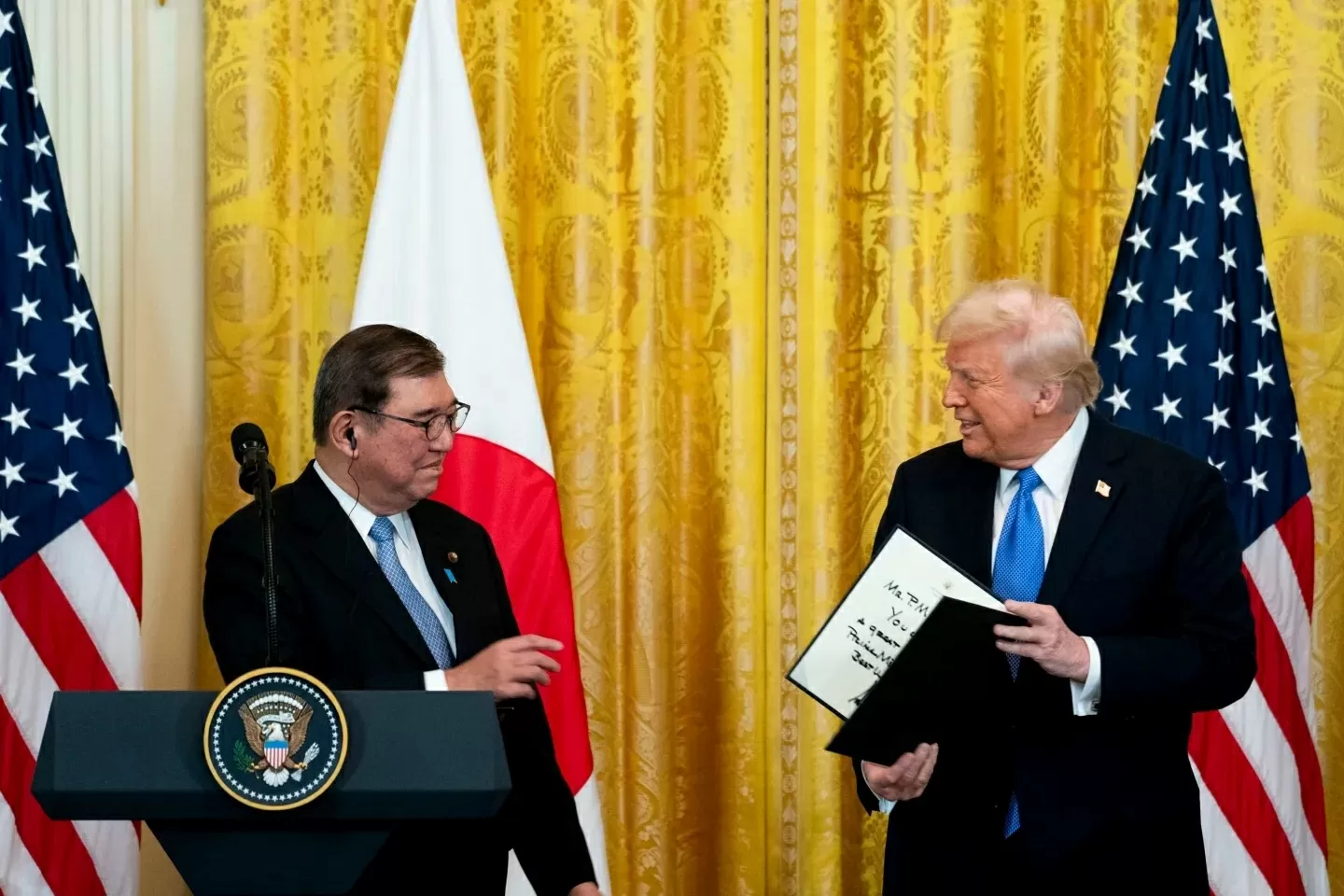 |
| Prime Minister Ishiba Shigeru and President Donald Trump at the White House on February 8. (Source: Fortune/Getty Images) |
Trade is the focus.
Prior to the meeting, observers believed that Mr. Ishiba's trip would be very difficult due to the issues on the negotiating table. These included the trade deficit, tariffs, the deadlock over North Korea's nuclear program, and the China factor.
However, the relatively mild atmosphere and mutual praise at the White House suggest that the two leaders have apparently reached a commitment to work together to find a satisfactory solution to trade conflicts, a top priority for Trump alongside other pressing issues in Northeast Asia.
However, alongside these "lenient" statements towards the visitor from a close ally in Northeast Asia, Trump also urged Ishiba to reduce the trade deficit with the US to zero and warned that Tokyo could still face high tariffs on its exports if this is not done.
Notably, in the dispute between Japan's Nippon Steel and the US Steel of the United States, Trump asserted that he would consider investing rather than acquiring, a stark contrast to his predecessor Joe Biden, who blocked Nippon Steel's expansion into US Steel due to fears of economic insecurity. In January, the administration of former US President Joe Biden ruled to block the $14.1 billion merger between the two steel companies to protect the domestic industry.
This move prompted the two corporations to warn they would take legal action against the US government for “violating due process and the law.” In the lawsuit, both Nippon Steel and US Steel are expected to exchange written arguments by the end of March, and full hearings will take place this summer. However, the agreement in principle between the leaders of the two countries on “investment” rather than “merger” is seen as opening up new avenues for future cooperation between the two companies.
Give and take.
Observers believe that to gain the support of the new White House occupant, the Japanese visitor promised a $1 trillion investment in the US and pledged to increase imports of defense equipment, natural gas, and other goods from Washington. Mr. Ishiba also affirmed that, although Japan is currently the largest investor in the US, Tokyo will continue to increase spending to gradually narrow the trade deficit with Washington.
To date, as stated during his campaign, Donald Trump has begun imposing tariffs on China, Mexico, and Canada, and unexpectedly announced a one-month pause on these tariffs for Mexico and Canada. The White House occupant also announced plans to impose tariffs on the European Union (EU) in a "reciprocal" manner, but has not yet confirmed when this will begin.
Immediately after the meeting between the two sides in Washington, the Japanese yen appreciated against the US dollar to an 8-week high on February 9th. Meanwhile, Fumio Matsumoto, chief strategist at Okasan Securities, suggested that Ishiba's handling of the meeting with Donald Trump could potentially help Japan's ruling Liberal Democratic Party (LDP) improve its approval ratings among voters.
In addition, Yonhap News Agency quoted Mr. Ishiba as saying that there had been "frank" discussions with President Donald Trump on a range of challenges facing both sides in the Indo-Pacific, including issues related to North Korea, the South China Sea, and the Taiwan Strait. Prime Minister Ishiba emphasized that both sides affirmed their determination not to allow unilateral attempts to change the status quo by force or coercion, and opposed such efforts in the East China Sea and the South China Sea to protect a "free and open" Indo-Pacific. Furthermore, the Japanese Prime Minister said the two leaders agreed to promote cooperation with "like-minded" nations, including through the trilateral partnership with South Korea as well as other US-led multilateral mechanisms such as the Quad (the US, India, Japan, and Australia).
Untie the knot
In a joint statement issued by President Trump and Prime Minister Ishiba following their talks, quoted by NHK : “The two leaders expressed their serious concerns and the need to address North Korea’s nuclear and missile programs, and reaffirmed their unwavering commitment to the complete denuclearization of North Korea.”
President Donald Trump also emphasized that his relationship with North Korean leader Kim Jong Un is a "huge asset to everyone" and stated, "I get along very well with him." Trump also claimed that he "is preventing war" and that if he hadn't won the recent presidential election, the world would have "ended up in a very bad situation." He seemed to be reiterating that, thanks to his relationship with Kim, cultivated through personal diplomacy during his first term, a serious conflict had not broken out.
Meanwhile, Prime Minister Ishiba wants to use talks with Trump to convey Tokyo's "strong sense of urgency" regarding the issue of Japanese citizens abducted by Pyongyang decades ago. Ishiba stressed to reporters that if we can move forward with resolving issues with North Korea, then that will be agreed upon. For us, that includes not only denuclearization but also resolving the abductee issue.
For its part, Pyongyang did not directly respond to President Trump's offer to resume contact with leader Kim Jong Un, instead emphasizing its intention to "strengthen" its nuclear forces. KCNA reported that Pyongyang declared on February 8th that its nuclear weapons are not for negotiation but are intended to strike enemies who threaten its people and world peace.
However, with the results achieved during his first trip to the US and being the second person to meet President Donald Trump at the White House after the Israeli Prime Minister – one of Washington's closest ally – the Japanese leader showed that the relationship between the two sides remains very special. Tokyo's avoidance of US tariffs, unlike what Trump did with China and his leading partners Mexico and Canada, demonstrates certain priorities and considerations in relations with Tokyo and with Mr. Ishiba personally, a man whose personality is considered distinctly different from that of the 47th President of the United States.
Source: https://baoquocte.vn/gio-doi-chieu-trong-quan-he-dong-minh-my-nhat-303825.html
![[Live] 2025 Community Action Awards Gala](/_next/image?url=https%3A%2F%2Fvphoto.vietnam.vn%2Fthumb%2F1200x675%2Fvietnam%2Fresource%2FIMAGE%2F2025%2F12%2F16%2F1765899631650_ndo_tr_z7334013144784-9f9fe10a6d63584c85aff40f2957c250-jpg.webp&w=3840&q=75)

![[Photo] Prime Minister Pham Minh Chinh receives the Governor of Tochigi Province (Japan)](/_next/image?url=https%3A%2F%2Fvphoto.vietnam.vn%2Fthumb%2F1200x675%2Fvietnam%2Fresource%2FIMAGE%2F2025%2F12%2F16%2F1765892133176_dsc-8082-6425-jpg.webp&w=3840&q=75)
![[Photo] Prime Minister Pham Minh Chinh receives Lao Minister of Education and Sports Thongsalith Mangnormek](/_next/image?url=https%3A%2F%2Fvphoto.vietnam.vn%2Fthumb%2F1200x675%2Fvietnam%2Fresource%2FIMAGE%2F2025%2F12%2F16%2F1765876834721_dsc-7519-jpg.webp&w=3840&q=75)

![[Image] Leaked images ahead of the 2025 Community Action Awards gala.](/_next/image?url=https%3A%2F%2Fvphoto.vietnam.vn%2Fthumb%2F1200x675%2Fvietnam%2Fresource%2FIMAGE%2F2025%2F12%2F16%2F1765882828720_ndo_br_thiet-ke-chua-co-ten-45-png.webp&w=3840&q=75)































![[Live] Closing Ceremony and Award Presentation for the "Impressive Vietnam Tourism" Video/Clip Creation Contest 2025](https://vphoto.vietnam.vn/thumb/402x226/vietnam/resource/IMAGE/2025/12/17/1765974650260_z7273498850699-00d2fd6b0972cb39494cfa2559bf85ac-1765959338756946072104-627-0-1338-1138-crop-1765959347256801551121.jpeg)

















Comment (0)