

Removing the mandatory requirement for businesses investing in commercial housing projects to allocate 20% of their land for social housing construction not only facilitates faster and more convenient project implementation for investors but can also accelerate the goal of social housing development for localities.
The draft amended Housing Law has removed this provision.
The Ministry of Construction has recently issued a document responding to a petition from voters in Thai Nguyen province regarding the requirement that commercial housing and urban development projects with a land area of 2 hectares or more in special and type I urban areas, or 5 hectares or more in type II and type III urban areas, must allocate 20% of the total residential land area in detailed planning schemes approved by competent authorities, where technical infrastructure has already been built, for the construction of social housing.
According to voters, based on this regulation, when developing detailed plans for certain projects in the area, localities must allocate land for the construction of social housing. However, surveys show that the demand for social housing in urban areas (within provinces) is still low, and a segment of the population does not have the means to buy or rent social housing, leading to land waste and difficulties in managing the land allocated for social housing construction. Therefore, voters propose that the Government be asked to revise the content of Decree No. 49/2021/ND-CP dated April 1, 2021, to be more flexible in allocating land for social housing construction, in accordance with the actual situation in localities.
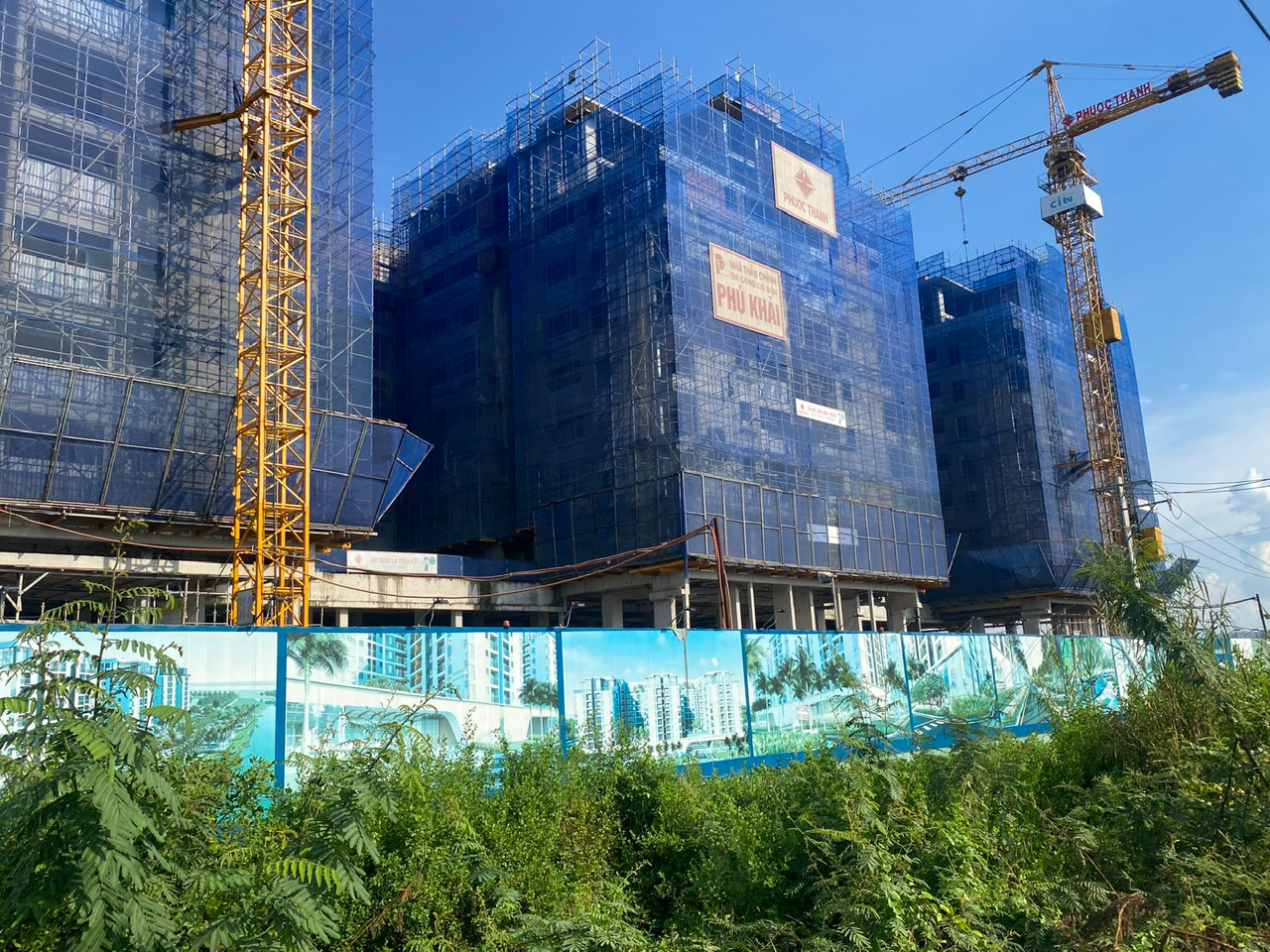
A social housing project for workers, comprising 1,040 apartments, is located in Thanh My Loi ward, Thu Duc City, Ho Chi Minh City. Photo: QUOC ANH
Regarding this issue, the Ministry of Construction stated that in the past, the ministry has studied and evaluated a number of shortcomings and inadequacies in the implementation of social housing development policies, including the regulation on allocating 20% of land for social housing development according to Article 5 of Government Decree No. 100/2015/ND-CP dated October 20, 2015. This served as the basis for research, development, and submission to the Government for promulgation of Decree No. 49/2021/ND-CP amending and supplementing some articles of Decree No. 100/2015/ND-CP, aiming to overcome some shortcomings and inadequacies of this regulation.
Besides the existing problems and obstacles in the regulations that have been amended and supplemented in the Decree under the Government's authority, to thoroughly overcome the aforementioned problems and inadequacies, it is also necessary to amend the Housing Law (under the authority of the National Assembly ).
Currently, the draft Law on Housing (amended) has been submitted by the Government to the 15th National Assembly for comments at the 5th session and is expected to be passed at the 6th session. Accordingly, Article 80 of the draft Law on Housing (amended) stipulates that land for social housing construction has been removed from the mandatory requirement for investors of commercial housing projects and urban areas to allocate 20% of the land for construction; and adds a provision that the allocation of land for social housing development is the responsibility of the provincial People's Committee. Specifically, when preparing and approving provincial planning, land use planning, construction planning, and urban planning, the provincial People's Committee must allocate sufficient land for social housing development according to the approved housing development program and plan.
It could lower house prices.
Mr. Nguyen Hong Luong, Chairman of the Board of Directors of Ho Chi Minh City Social Housing Investment and Development Joint Stock Company, believes that the previous regulation requiring businesses to allocate 20% of land for social housing projects is impractical. He argues that the management, investment, and operating costs for commercial housing, high-end apartments, and even ultra-high-end apartments are significantly higher than those for social housing, making it impossible to combine both types of housing in a single project.
Therefore, the draft amended Housing Law's exclusion of this provision is reasonable. Many developers will certainly choose to pay the state to proactively implement their projects. This will also provide a basis for implementing the government-approved plan to build 1 million social housing units. In that case, the construction cost of social housing for consumers could decrease to around 20 million VND/m2.
Mr. Le Hoang Chau, Chairman of the Ho Chi Minh City Real Estate Association (HoREA), also assessed that the Ministry of Construction's removal of the regulation requiring 20% of land to be allocated for social housing construction is very reasonable. However, he suggested adding regulations that allow investors to choose to build social housing within commercial housing projects, exchange land for equivalent social housing, or pay land use fees to the state from the outset to proactively implement projects. This would prevent local authorities and relevant agencies from being confused when granting permits and inspecting projects. If this choice remains solely with the state, project implementation will continue to be hampered and difficult as it has been in the past.
Currently, only a few mid-range urban development projects, such as Nam Long Investment Corporation, choose to build social housing. However, high-end projects cannot be implemented, so most developers choose to pay the government instead. With this option, the government gains an additional 20% revenue instead of paying land use fees as before.
Proposal to develop a centralized project.
In a recently published report on the implementation of social housing projects in Ho Chi Minh City from 2016 to 2025, the Department of Planning and Architecture of Ho Chi Minh City frankly pointed out that the requirement for all commercial housing construction projects in cities of type III and above to allocate 20% of land for social housing construction is not in line with reality and is not feasible because this land does not have the minimum area required to invest in an independent social housing block that meets standards.
On the other hand, developing social housing in the form of terraced houses within commercial urban development projects (often in prime locations) could potentially lead to negative consequences and unfairness. If low-income individuals move into social housing units within high-end or ultra-high-end commercial housing projects, the cost of building management and essential services alone would be unsuitable for their income.
Based on practical shortcomings, the Ho Chi Minh City Department of Planning and Architecture proposed that the Ministry of Construction establish specific regulations for Ho Chi Minh City, a special urban area with management requirements different from many provinces and cities with lower urbanization densities.
The Department of Planning and Architecture proposes that the Ministry of Construction study allowing an investor with multiple ongoing projects in the same district/county to exchange land areas to build social housing concentrated in one project, thereby facilitating the investor's business, exploitation, and operation; or to implement other regulations and solutions regarding policies and mechanisms to attract and encourage investment in social housing to serve workers and low-income groups.
Furthermore, the Department of Planning and Architecture also recommended that the People's Committee of Ho Chi Minh City assign the People's Committees of districts and Thu Duc City, based on actual conditions, needs, and the progress of reviewing and adjusting 1/2000 planning projects in their localities, to prepare revised 1/2000 planning project documents to update social housing projects and commercial housing development projects with social housing that have been approved by competent authorities in detailed planning into the zoning plans and allocate land for social housing construction accordingly.
Source


![[Photo] The General Secretary works with the Executive Committee of the Hai Phong City Party Committee.](https://vphoto.vietnam.vn/thumb/1200x675/vietnam/resource/IMAGE/2026/03/16/1773629925474_vna-potal-tong-bi-thu-lam-viec-voi-ban-chap-hanh-dang-bo-thanh-pho-hai-phong-8644445-332-jpg.webp)











































































Comment (0)