

In biology, symbiosis is a reciprocal relationship between two or more species of organisms, in which each species benefits. This symbiotic model provides a valuable lesson for the relationship between humans and artificial intelligence (AI).
Instead of being seen as a confrontation or replacement, AI should be viewed as a tool to support and complement human capabilities, creating superior synergy…
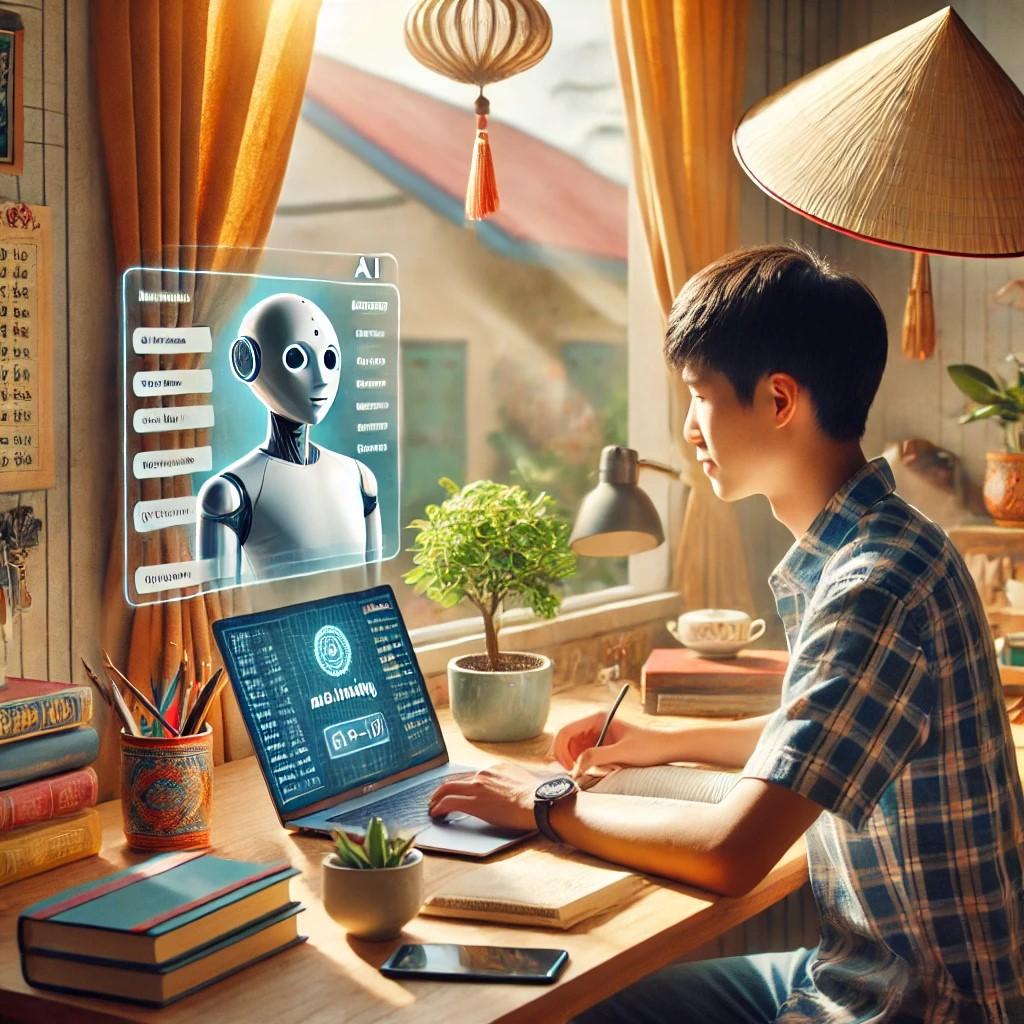
This image was created by AI at the user's request: Vietnamese students using AI in their studies.
The above is a portion of the content written by the Gemini AI chatbot when I entered the command: "Write an article of approximately 1,200 words on the topic of symbiosis with artificial intelligence (AI).
WHEN BOTH SIDES BENEFIT
Users of AI-generated applications can easily recognize that under each answer or "artwork" created by AI (drawings, songs, lines of code, poems, media scripts, stories, etc.) there are two icon buttons: "good answer" (a thumbs-up hand) and "bad answer" (a thumbs-down hand). Even more noteworthy is that when clicking the "good answer" icon in Gemini, users are then asked: "Why do you rate it that way?" with several suggested options. Similarly, if the "bad answer" icon is selected, Gemini also asks "Why do you rate it that way?" with suggested options. After choosing from the suggestions or writing their opinion, users will receive the message "Thank you for your feedback."
This is how AI applications create biology through user experience anytime, anywhere. As a result, the answers and products created by AI are becoming increasingly better for users, following the "win-win" principle of the symbiotic model.
AMAZED BY … WHO
When evaluating the capabilities of AI-generated applications using Bloom's Taxonomy of six levels (Remembering, Understanding, Applying, Analyzing, Evaluating, and Creating), the fear of AI-generated applications becoming more intelligent than humans is real.
"Who can read the alphabet backward from Z to A?" When I asked this question, almost 100% of the participants were hesitant to answer, including elementary school teachers. Therefore, everyone was amused to hear the answer from AI chatbots like Gemini and ChatGPT, with the command: "Read the alphabet backward from Z to A".
To test the knowledge retention capabilities of these applications, I suggested that teachers ask additional basic questions such as: the seven memorable algebraic identities, the three fundamental laws of physics, and the elements in the periodic table. After the science teachers confirmed that all the answers were correct, the social science teachers also acknowledged that the AIs' memory abilities were "exceptional!".
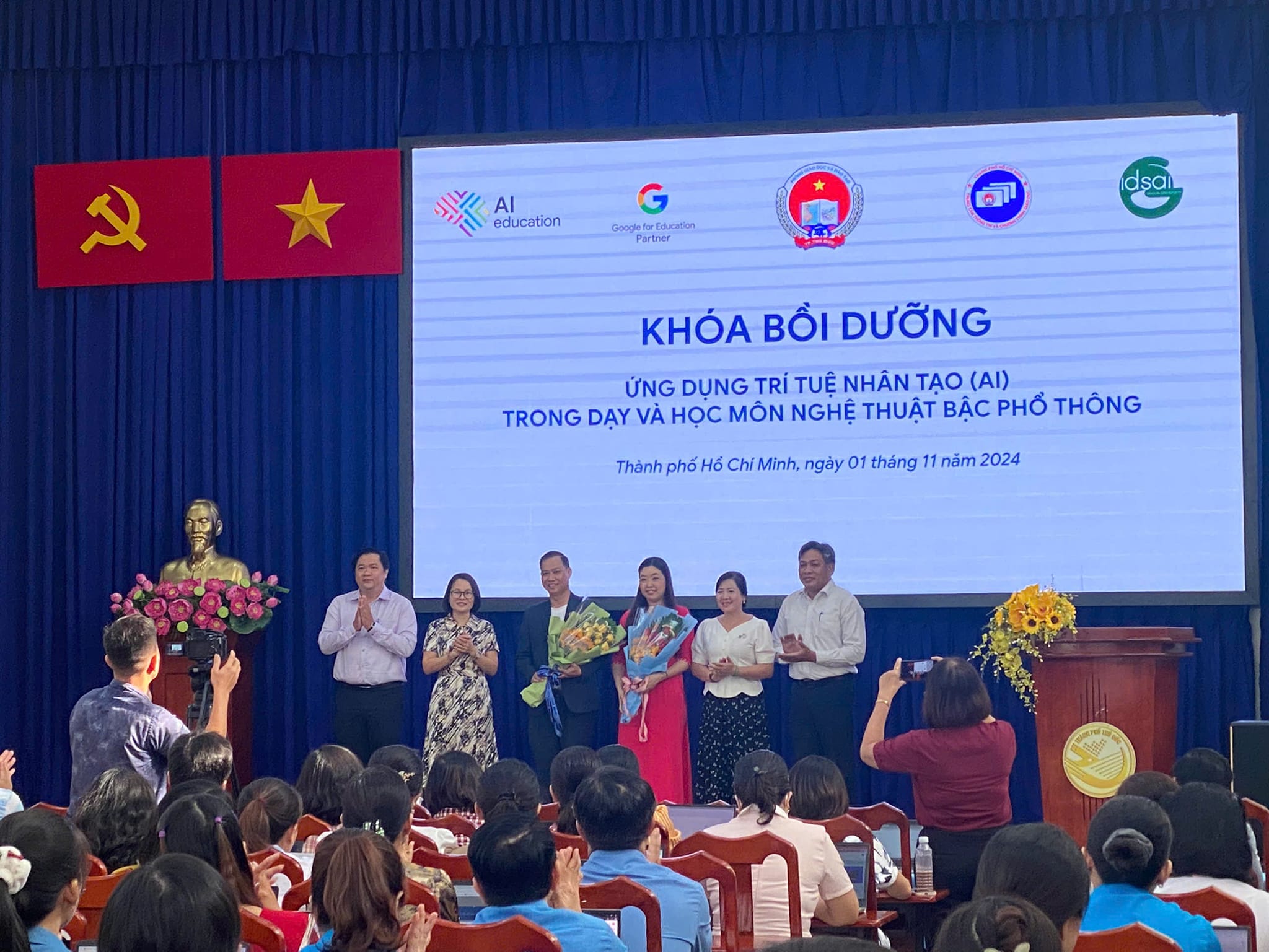
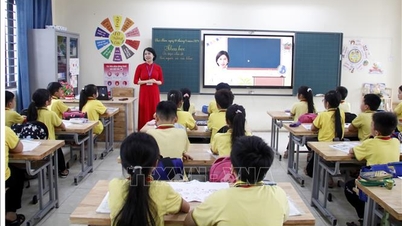
The Department of Education and Training of Thu Duc City (Ho Chi Minh City) is the first unit in the country to organize a separate program applying AI for art teachers.
In class, I often ask English teachers to translate the phrase "Canh gà Thọ Xương" into English. The answer they might give is "Thọ Xương Chicken Soup" (after a long pause). Meanwhile, the AI chatbot can provide an answer that fits the context of the folk verse: "The wind sways the bamboo branches, the bell of Trấn Vũ rings, the rooster crows at Thọ Xương": The crowing rooster of Thọ Xương (The rooster crows to signal the time in Thọ Xương village).
Recently, during a training program on "Applying AI in Teaching and Learning Based on Google Technology" for principals of preschools in District 10, Ho Chi Minh City, I instructed participants to input the following command: "I am the principal of a preschool in Ho Chi Minh City, Vietnam. Please give me 5 pieces of advice to help me lead my school successfully and happily in the age of artificial intelligence." In short, the 5 pieces of advice given were: Understand and selectively utilize AI in preschool education ; Apply AI to appropriate activities; Put people at the center – use AI as a supporting tool, use AI ethically and responsibly; Train and develop teachers who understand and have practical skills; Build good relationships with parents through the use of AI tools; Always learn and update on the development of AI. Most participants were satisfied with the incredibly quick and valuable answers provided by AI.
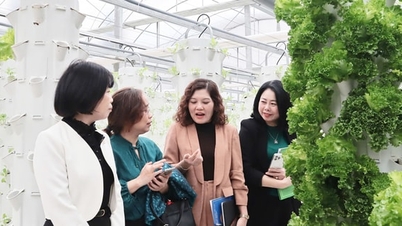
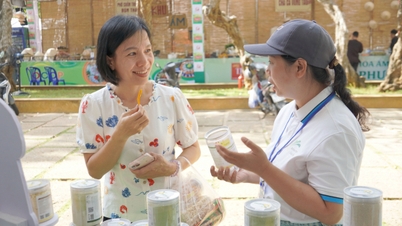
The continuous generation of AI applications is astonishing many learners in various fields and professions. Last week, the owner of a melon farm in An Giang province exclaimed with delight when the AI application Firefly.Adobe.Com created a picture of a golden melon harvest with farmers wearing conical hats in spring. A woman growing organic vegetables, planning to hire a marketing employee for her farm, was thrilled to find she could quickly compose poems, songs, and articles to promote her farm, almost immediately after learning how to write effective commands.
Teachers can quickly prepare lesson plans according to the 2018 General Education Program. Smartphone salespeople can use chatbots to write communication scripts for social media posts about new products, find out what features customers are interested in when buying a phone, and create scripts for conversations with customers about delayed deliveries, etc.
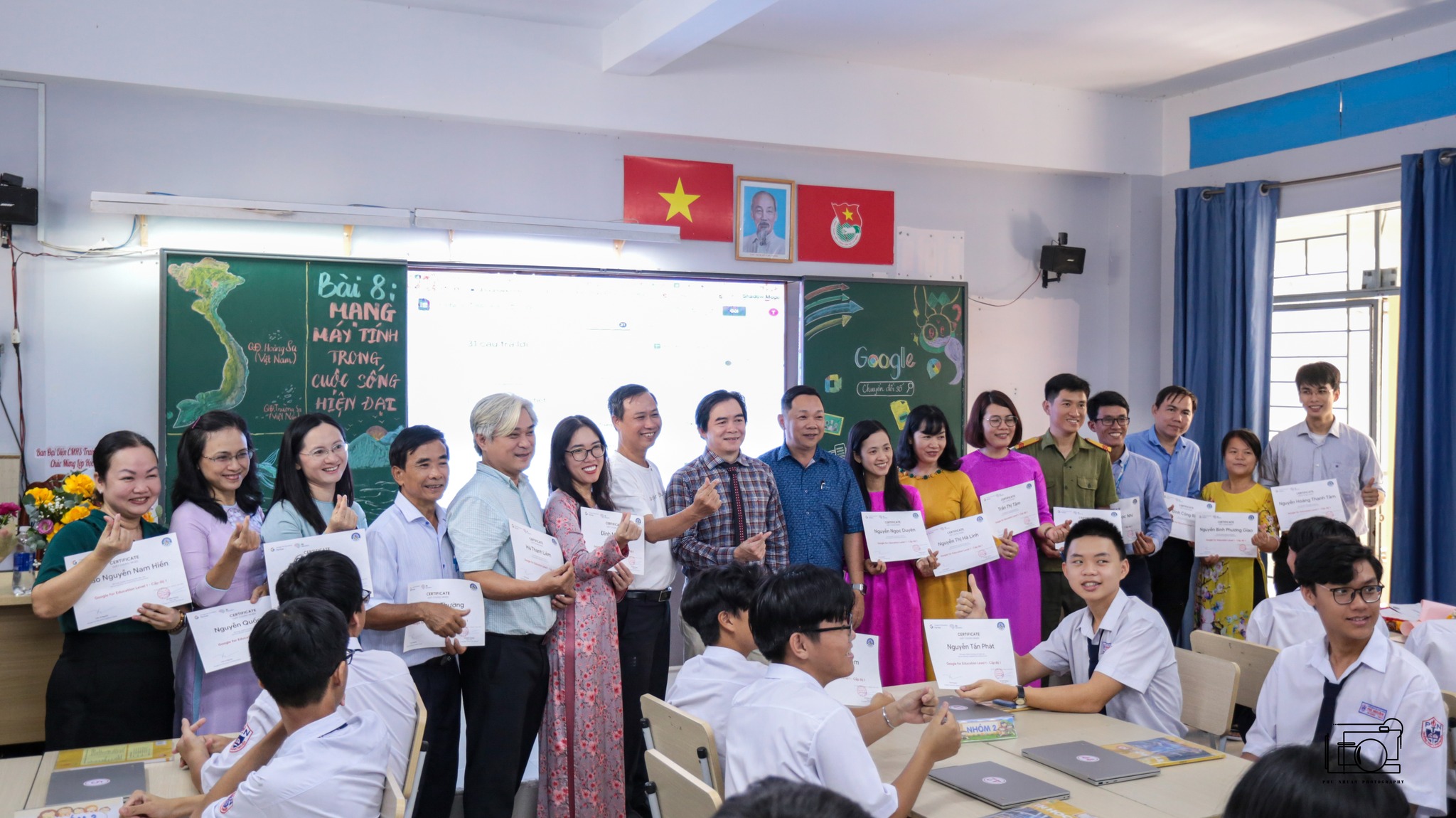
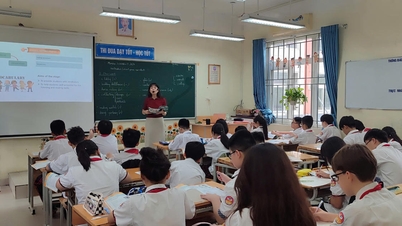
Phu Nhuan High School (Ho Chi Minh City) is implementing the use of AI for teachers and students in Google's digital lessons.
How to overcome fear with someone?
However, the fear that AI will be smarter than humans can be dispelled if we understand that there are aspects that AI cannot yet achieve, such as empathy for human problems, groundbreaking creativity, and dexterity in human caregiving activities. And most importantly, we need an open attitude to cooperate, learn, and coexist with AI applications.
In fact, the development of AI in recent years has shown that the symbiotic relationship between humans and AI brings countless benefits such as: increased productivity and work efficiency, improved decision-making ability, personalized experiences, solving complex problems such as weather forecasting, genetic data analysis, or new drug development, and creating new jobs such as AI engineers, data scientists , data analysts, and AI trainers.
Currently, the Ministry of Education and Training is seeking feedback on the draft Circular promulgating the digital competency framework applicable to learners in the national education system. Using AI for generation is one of the six competency domains in the proposed digital competency framework. The remaining competency domains are: Data and information mining; Communication and collaboration in the digital environment; Digital content creation; Safety; and Problem-solving. This is one of the important and necessary solutions to move towards a better future of symbiosis between AI and humans.
Some challenges
In the article suggested by the Gemini chatbot, I particularly liked the analysis of the challenges and solutions for a future of symbiosis with AI, as follows:
Despite its immense potential, the symbiotic relationship between humans and AI also presents several challenges:
Employment Issues: One of the biggest concerns is that AI will replace humans in many jobs. To mitigate this negative impact, policies are needed to retrain the workforce, helping them adapt to new AI-related jobs.
Ethical issues: The use of AI must adhere to ethical principles, ensuring transparency, fairness, and accountability. Clear legal regulations are needed to control the use of AI and prevent negative consequences.
Data security issues: AI operates based on data, therefore data security is extremely important. Strong security measures are needed to prevent the misuse of personal data.
To build a successful symbiotic future between humans and AI, close collaboration is needed among stakeholders, including governments, businesses, researchers, and the community. This includes equipping workers with the necessary skills to work with AI, establishing a clear legal framework, encouraging AI research and development, and raising public awareness.
Source: https://thanhnien.vn/huong-den-tuong-lai-cong-sinh-voi-ai-tao-sinh-185241231194456721.htm

![[Photo] Prime Minister Pham Minh Chinh receives the Governor of Tochigi Province (Japan)](/_next/image?url=https%3A%2F%2Fvphoto.vietnam.vn%2Fthumb%2F1200x675%2Fvietnam%2Fresource%2FIMAGE%2F2025%2F12%2F16%2F1765892133176_dsc-8082-6425-jpg.webp&w=3840&q=75)
![[Live] 2025 Community Action Awards Gala](/_next/image?url=https%3A%2F%2Fvphoto.vietnam.vn%2Fthumb%2F1200x675%2Fvietnam%2Fresource%2FIMAGE%2F2025%2F12%2F16%2F1765899631650_ndo_tr_z7334013144784-9f9fe10a6d63584c85aff40f2957c250-jpg.webp&w=3840&q=75)
![[Image] Leaked images ahead of the 2025 Community Action Awards gala.](/_next/image?url=https%3A%2F%2Fvphoto.vietnam.vn%2Fthumb%2F1200x675%2Fvietnam%2Fresource%2FIMAGE%2F2025%2F12%2F16%2F1765882828720_ndo_br_thiet-ke-chua-co-ten-45-png.webp&w=3840&q=75)
![[Photo] Prime Minister Pham Minh Chinh receives Lao Minister of Education and Sports Thongsalith Mangnormek](/_next/image?url=https%3A%2F%2Fvphoto.vietnam.vn%2Fthumb%2F1200x675%2Fvietnam%2Fresource%2FIMAGE%2F2025%2F12%2F16%2F1765876834721_dsc-7519-jpg.webp&w=3840&q=75)














































![[Live] Closing Ceremony and Award Presentation for the "Impressive Vietnam Tourism" Video/Clip Creation Contest 2025](https://vphoto.vietnam.vn/thumb/402x226/vietnam/resource/IMAGE/2025/12/17/1765974650260_z7273498850699-00d2fd6b0972cb39494cfa2559bf85ac-1765959338756946072104-627-0-1338-1138-crop-1765959347256801551121.jpeg)




















Comment (0)