

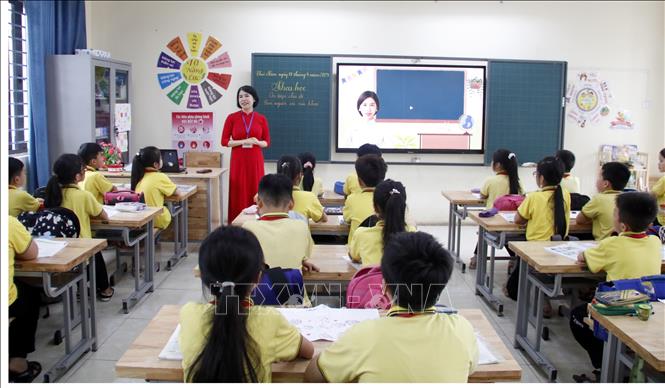
The AI education content framework is developed based on four main knowledge strands, corresponding to four competency domains, which are intertwined and complementary, including: Human-centered thinking, AI ethics, AI techniques and applications, and AI system design.
The curriculum framework is designed to correspond to two educational stages: the basic education stage (including primary and lower secondary levels) and the vocational education stage (upper secondary level).
At the primary school level, students primarily experience simple, intuitive AI applications to form initial concepts and recognize the role of AI in life. At the middle school level, students learn how to use AI tools to create digital products and solve academic problems. At the high school level, students are encouraged to explore, design, and improve simple AI tools through science projects.
In addition to core educational content, students can choose elective courses to enhance practical skills, gain deeper insights into AI application areas, or learn programming techniques and AI system development.
The AI education framework is built upon the perspectives, orientations, and competency-based approaches of the 2018 General Education Program, ensuring consistency and continuity with the guiding principles of the Party and State regarding the Digital Competency Framework for learners. It particularly emphasizes requirements for contributing to the development of five key qualities and three pairs of common competencies; consistency with the General Education Program for Informatics; leveraging AI education programs from advanced countries; scientific, modern, and pedagogical aspects; openness, flexibility, and regular updates; a human-centered approach, and a strong emphasis on ethics and responsibility.
According to the AI Education Framework, teachers should apply active teaching methods, focusing on experiential learning, practice, and projects. Project-based learning should be encouraged to cultivate collaborative, self-learning, and creative skills. Lessons should be organized flexibly, creating interest for students while ensuring safety and effectiveness.
Furthermore, teachers choose teaching methods that are appropriate to the lesson content. Some topics, such as AI ethics, risk identification, and policy analysis, can be taught through discussions, debates, and case studies without the need for computers. Simultaneously, they connect and link AI knowledge to practical issues in learning, daily life, production, and public services.
Students should not only propose solutions but also be able to verify and evaluate the effectiveness and ethical and humanistic aspects of those solutions; implementing differentiated and individualized teaching.
The AI education framework also sets out assessment criteria. Both regular and periodic assessments must closely adhere to AI competency components and core content areas. For topics focusing on AI applications, emphasis should be placed on assessing the ability to apply knowledge and skills to create useful applications. For topics related to AI principles and models, emphasis should be placed on assessing creative, logical, and systematic thinking. For content areas concerning ethics, data, and law, assessment should combine problem-solving with observing students' attitudes, behaviors, and responsibilities in a digital environment.
Teachers need to create learning profiles to store and regularly update each student's learning progress throughout the course. The assessment of each student's AI competence should be based on a synthesis of regular and periodic assessments, reflecting their progress and the required level of achievement according to the program.
Large-scale AI competency assessments should be based on the required learning outcomes of mandatory subjects; avoid developing assessment tools solely based on the content of elective subjects. Opportunities should be created for students to present and share their AI projects with peers, teachers, and parents to receive feedback, thereby improving and developing their products.
To ensure accuracy and objectivity, teachers organize presentations, debates, and exhibitions of AI products; encouraging students to discuss, debate, and evaluate each other, thereby fostering critical thinking, communication, and collaboration skills.
Source: https://baotintuc.vn/giao-duc/ban-hanh-khung-noi-dung-thi-diem-giao-duc-tri-tue-nhan-tao-ai-cho-hoc-sinh-20251216174951435.htm
![[Photo] Prime Minister Pham Minh Chinh receives the Governor of Tochigi Province (Japan)](/_next/image?url=https%3A%2F%2Fvphoto.vietnam.vn%2Fthumb%2F1200x675%2Fvietnam%2Fresource%2FIMAGE%2F2025%2F12%2F16%2F1765892133176_dsc-8082-6425-jpg.webp&w=3840&q=75)

![[Photo] Prime Minister Pham Minh Chinh receives Lao Minister of Education and Sports Thongsalith Mangnormek](/_next/image?url=https%3A%2F%2Fvphoto.vietnam.vn%2Fthumb%2F1200x675%2Fvietnam%2Fresource%2FIMAGE%2F2025%2F12%2F16%2F1765876834721_dsc-7519-jpg.webp&w=3840&q=75)
![[Image] Leaked images ahead of the 2025 Community Action Awards gala.](/_next/image?url=https%3A%2F%2Fvphoto.vietnam.vn%2Fthumb%2F1200x675%2Fvietnam%2Fresource%2FIMAGE%2F2025%2F12%2F16%2F1765882828720_ndo_br_thiet-ke-chua-co-ten-45-png.webp&w=3840&q=75)


























































![[Photo] Prime Minister Pham Minh Chinh attends the Vietnam Economic Forum 2025](https://vphoto.vietnam.vn/thumb/402x226/vietnam/resource/IMAGE/2025/12/16/1765893035503_ndo_br_dsc-8043-jpg.webp)
































Comment (0)