

From what we observed, this well was hidden at the foot of the hill, facing a lush green rice field and vegetable patch. The trees around the well had been cleared, the well's interior cleaned of mud, and the old laterite stones were gradually revealed. More than twenty households in the village, from elderly people with gray hair to young men, were shoveling earth, stacking stones, mixing mortar, and pouring concrete. Everyone lent a hand, and no one complained.
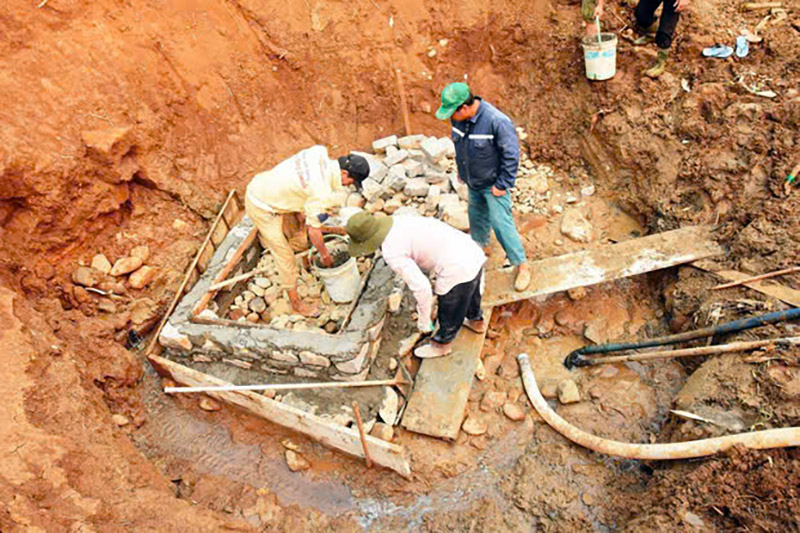
"The well is an heirloom passed down from our ancestors. In the past, the whole village used only this well water for cooking and washing clothes. The water was clear and refreshing, as if drawn from the heart of Mother Earth. Now that it's been restored, everyone is happy as if it were a major event in the village," Mrs. Nguyen Thi Lien said excitedly as she rearranged the laterite stones and recounted the old story.
Next to him, Mr. Nguyen Van Thuan, a son who has lived in the village since childhood, was diligently lifting each split stone slab: "They say this well is 800 or 900 years old. In recent years, it has been buried under rocks and soil, which has saddened the villagers. Therefore, as soon as the village road was upgraded, we immediately held a meeting, each household contributed one million dong, and those living far from home sent money back to help. Everyone wants the old well to once again flow with fresh water like it used to."
The most unique aspect of the Cay Dau well lies not only in its age, but also in its ancient yet extraordinarily durable construction techniques. The well is lined with ironwood and teak, types of wood that can withstand being submerged in water for hundreds of years without deteriorating. The well walls are made of laterite stone joined together with mortise and tenon joints, requiring no mortar yet remaining incredibly sturdy. The wooden planks, salvaged from the bottom of the well, are black, shiny, and as strong as if they were just laid yesterday. They are being washed and dried in the sun, ready to be placed back in their original spot later.
The atmosphere was like a miniature village festival. An old man stood by, reminding everyone how to arrange the stones correctly, while a group of women prepared pots of green tea and a few hot rice cakes for everyone to enjoy during their break. The children from the neighborhood ran around excitedly, as if they had just discovered a hidden treasure buried underground.
Not far away, in Cay Da hamlet, Mai Loc 2 village, the Cay Dinh well has just been renovated. Every afternoon, after working in the fields, people gather here to wash their faces and rest in the shade of the ancient trees. "When I was little, I often went to the well to fetch water. My mother said that the water from the Dinh well could be left for a week without smelling bad or settling. Now that the well has been renovated, it's clean and beautiful, and everyone appreciates it even more," said Ho Trung Dung, a local resident, while happily scooping up water from the well and drinking it.
Since 2020, the movement to restore ancient wells has spread throughout Cam Chinh and Cam Nghia communes. Many wells, such as Cay Thi well, Ong Cay well, and Gai well, have been restored to their original state thanks to the efforts and dedication of the local people. The most valuable aspect of each well is the story and memory it holds for the village.
Ms. Tran Thi Anh, Head of the Culture, Science and Information Department of Cam Lo District, said that the district currently has 14 ancient wells, mostly of the Cham type, characterized by laterite stone and precious wood. "The people are the most important stakeholders in preserving these ancient wells. They not only live alongside the wells but also pass on stories, rituals, and memories associated with each well to future generations."
According to Ms. Anh, preserving ancient wells is not just about maintaining a structure, but about preserving the lifeblood and cultural identity of the village that is gradually fading away. Local authorities are actively surveying, documenting, and planning the area around the ancient wells to better protect them, while also linking this preservation with community tourism development and the construction of new rural areas.
Source: https://cand.com.vn/doi-song/khoi-gieng-xua-giu-mach-lang-i766978/
![[Image] Leaked images ahead of the 2025 Community Action Awards gala.](/_next/image?url=https%3A%2F%2Fvphoto.vietnam.vn%2Fthumb%2F1200x675%2Fvietnam%2Fresource%2FIMAGE%2F2025%2F12%2F16%2F1765882828720_ndo_br_thiet-ke-chua-co-ten-45-png.webp&w=3840&q=75)

![[Photo] Prime Minister Pham Minh Chinh receives the Governor of Tochigi Province (Japan)](/_next/image?url=https%3A%2F%2Fvphoto.vietnam.vn%2Fthumb%2F1200x675%2Fvietnam%2Fresource%2FIMAGE%2F2025%2F12%2F16%2F1765892133176_dsc-8082-6425-jpg.webp&w=3840&q=75)
![[Live] 2025 Community Action Awards Gala](/_next/image?url=https%3A%2F%2Fvphoto.vietnam.vn%2Fthumb%2F1200x675%2Fvietnam%2Fresource%2FIMAGE%2F2025%2F12%2F16%2F1765899631650_ndo_tr_z7334013144784-9f9fe10a6d63584c85aff40f2957c250-jpg.webp&w=3840&q=75)

![[Photo] Prime Minister Pham Minh Chinh receives Lao Minister of Education and Sports Thongsalith Mangnormek](/_next/image?url=https%3A%2F%2Fvphoto.vietnam.vn%2Fthumb%2F1200x675%2Fvietnam%2Fresource%2FIMAGE%2F2025%2F12%2F16%2F1765876834721_dsc-7519-jpg.webp&w=3840&q=75)











































































Comment (0)