

Preserving folk painting traditions
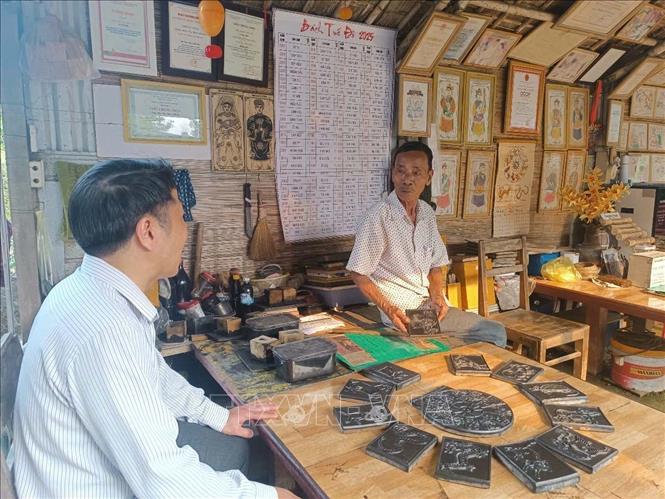
Artisan Ky Huu Phuoc introduces the folk paintings of Sinh Village to tourists. Photo: Hai Au/TTXVN.
In late March and early April, the city of Hue was bustling with preparations for the National Tourism Year – Hue 2025, themed “Ancient Capital – New Opportunities.” We visited Sinh village, Duong No ward, at the confluence of the Perfume River and the Bo River, a land rich in cultural and historical values.
Artisan Ky Huu Phuoc (78 years old, residing in Sinh Village, Duong No Ward, Hue City) is of average height, has a dark complexion, and speaks with the gentle and deep voice of a Hue resident. He recounts the profound history of Sinh Village folk paintings, which his family has preserved for nine generations.
“In the past, creating folk paintings was very difficult. The elders had to climb the highest peaks of the Bach Ma mountain range to find the vang tree to make the most beautiful red color; they had to wade into the narrowest and deepest ravines to find the danh tree to make the green color. The danh tree only flowers in April, so the artisans had to dig up the entire tree with roots, trunk, branches, leaves, and even flowers to create the most beautiful green color,” Mr. Phuoc recounted.
Sình Village paintings are created using five main colors: red from the roots of the vang tree; green from parts of the dành tree; yellow from the leaves of the dung tree; purple from the fruit of the spinach plant; and orange from broken or damaged ancient tiles.
Those materials alone are not enough to create a Lang Sinh painting; to print it, you need a mold. To obtain the best printing mold, Mr. Phuoc's ancestors had to travel many times to the mountainous region of Nam Tra My ( Quang Nam ) to find the wood of the long mum tree (also known as sapodilla) to bring back and use as molds. The paper used for Lang Sinh paintings was initially do paper, but gradually changed, using many different types of paper.
By examining ancient texts and the family genealogy of the Ky clan, artisan Ky Huu Phuoc traced back to his origins, discovering that Lang Sinh paintings have their roots in Dong Ho folk paintings (Bac Ninh). Both villages still worship the same patron saint, "Quy Cong." More than 400 years ago, Mr. Phuoc's ninth-generation ancestor brought his family's traditional craft from Dong Ho to settle at this vibrant river confluence.
Recalling those difficult times with a heavy heart, Mr. Phuoc recounted that after reunification, the country was still struggling, students lacked textbooks, and the paintings of Lang Sinh village, made of paper and colored, were used for religious ceremonies and then burned, which was considered a great waste. As a result, the craft was restricted and eventually stopped.
"Back then, I had to go to houses in the village to ask for or buy discarded painting tools to hide away...", artist Ky Huu Phuoc recounted.
By 1986, Mr. Phuoc's family quietly gathered their tools from underground and resumed making paintings to earn a living. He, his wife, and their five children all made paintings. Mr. Phuoc took his paintings to sell, knocking on every door. "When people learned I was selling paintings, they were happy because it had been so long since we'd seen paintings from Lang Sinh village."
Through those difficult times, when Hue was preparing to organize the Traditional Craft Village Festival, people realized that the only remaining practitioner of the Lang Sinh painting craft was Mr. Phuoc's family. Lang Sinh painting was proposed for restoration, creating a traditional craft village, which is now an experiential destination in the tourist routes of the former imperial capital.
The power supply is still working.
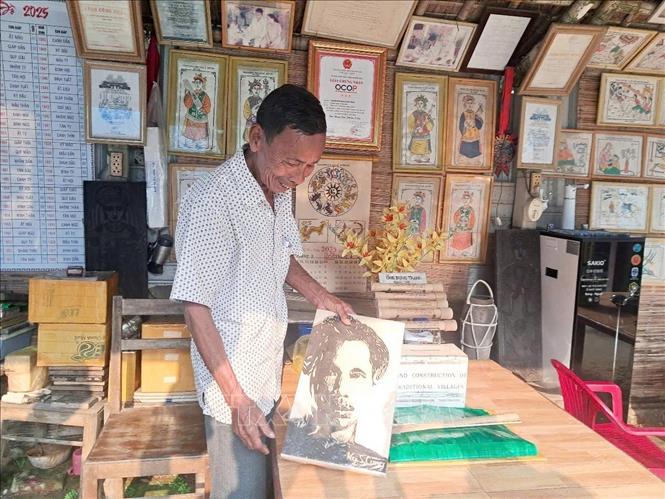
Artisan Ky Huu Phuoc introduces folk paintings from Sinh Village. Photo: Hai Au/TTXVN.
The Sình junction, a riverside area bearing many historical imprints on the Nguyễn lords' expansionist journey, has seen this folk painting style blend with the customs and beliefs of the local people, creating a unique cultural and religious identity. From its initial purpose of being used for worship and funerals, the content of Sình Village paintings has gradually expanded, creating a folk painting style with many distinct characteristics.
Artisan Ky Huu Phuoc recounted: During the first Hue Traditional Craft Village Festival in 2002, he went to work on paintings in the Imperial Citadel and saw the eight-tone music of the royal court. Afterward, he returned home and created a set of stencils for these eight-tone paintings. When he went to watch the wrestling festival in Sinh and Thu Le villages, he also carved a set of stencils depicting the four wrestling stances of Sinh village… Over time, the content of Sinh village paintings has become increasingly diverse, encompassing children, the 12 zodiac animals, the "Tet Chuong" (a festival, a day dedicated to the profession of raising animals like buffalo, pigs, and chickens…), the "Mr. and Mrs. Chuong" motifs, firecracker paintings, rural Tet, family, and prosperity…
Mr. Duong Van Kinh, from the Culture, Science and Information Department of Phu Xuan District (Hue City), and a member of the Organizing Committee of the Hue Traditional Craft Village Festival, said that the initial phase of restoring the craft village was truly arduous. Fortunately, the village had a key figure like Mr. Phuoc. To date, the craft of making folk paintings in Sinh Village has trained hundreds of workers. Every year-end, Sinh Village becomes bustling, with numerous households producing folk paintings and selling them throughout the country. Even on ordinary days, Mr. Phuoc's house remains a destination for tourists from all over the world, as well as students and children from within Vietnam, to experience the craft. In 2014, Mr. Phuoc was awarded the Certificate of Honor for Vietnamese Talent by the Central Association for the Development of Human Resources and Talents; Sinh Village folk paintings were awarded the OCOP 3-star product certification, along with many other titles and certifications.
Artist Dang Mau Tuu, former member of the Executive Committee of the Vietnam Fine Arts Association and former Chairman of the Thua Thien - Hue Union of Literature and Arts Associations, said: "Sin Village paintings originate from Dong Ho paintings but are more rustic, simple, and down-to-earth. The uniqueness, the naivety, and the folk quality in Sinh Village paintings are not easy to create; without skill, one cannot create that folk quality. Through many ups and downs, Mr. Phuoc wanted to give up the profession many times, but his fellow artists encouraged his family to preserve the craft and pass it on to the community."
The people of Sinh Village now commonly refer to artisan Ky Huu Phuoc as "Phuoc Cong," considering him the founder of the craft and the person who has made the greatest contribution to the preservation and development of Sinh Village folk painting, a tradition that continues to flow silently, blending into the cultural river of Hue.
Source: https://baoangiang.com.vn/khoi-mach-nguon-tranh-dan-gian-lang-sinh-a418118.html
![[Photo] Prime Minister Pham Minh Chinh receives the Governor of Tochigi Province (Japan)](/_next/image?url=https%3A%2F%2Fvphoto.vietnam.vn%2Fthumb%2F1200x675%2Fvietnam%2Fresource%2FIMAGE%2F2025%2F12%2F16%2F1765892133176_dsc-8082-6425-jpg.webp&w=3840&q=75)
![[Image] Leaked images ahead of the 2025 Community Action Awards gala.](/_next/image?url=https%3A%2F%2Fvphoto.vietnam.vn%2Fthumb%2F1200x675%2Fvietnam%2Fresource%2FIMAGE%2F2025%2F12%2F16%2F1765882828720_ndo_br_thiet-ke-chua-co-ten-45-png.webp&w=3840&q=75)
![[Photo] Prime Minister Pham Minh Chinh receives Lao Minister of Education and Sports Thongsalith Mangnormek](/_next/image?url=https%3A%2F%2Fvphoto.vietnam.vn%2Fthumb%2F1200x675%2Fvietnam%2Fresource%2FIMAGE%2F2025%2F12%2F16%2F1765876834721_dsc-7519-jpg.webp&w=3840&q=75)






























![[Photo] Prime Minister Pham Minh Chinh attends the Vietnam Economic Forum 2025](https://vphoto.vietnam.vn/thumb/402x226/vietnam/resource/IMAGE/2025/12/16/1765893035503_ndo_br_dsc-8043-jpg.webp)






















Comment (0)