

These dashing student soldiers dedicated their youth to the battlefield. Many fell, their lives cut short at the young age of 20… They wrote a heroic epic with the dreams and ideals of their youth.
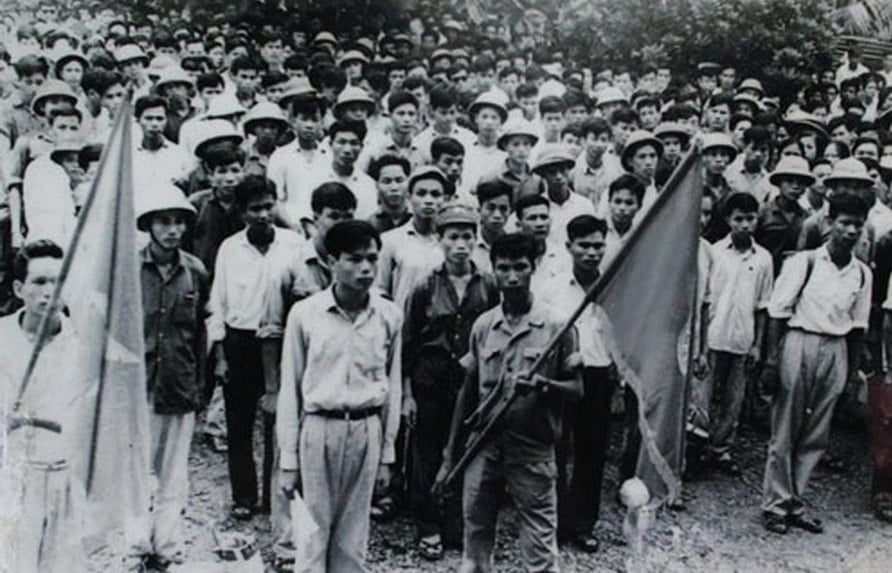
Putting aside pen and ink, they set off to the battlefield.
1970 marked a critical and intense period in the resistance war against the US, making the need for support in the South extremely urgent. Following the State's general mobilization order, localities simultaneously called on young people and students to undergo medical examinations for military service. In the spirit of "marching across the Truong Son Mountains to save the country," thousands of students from the North, as well as from Hanoi, were ready to "put aside their studies and go to the battlefield."
On September 6, 1971, nearly 4,000 students from universities, colleges, and vocational schools in the North attended a send-off ceremony before heading to the battlefield. They all made a promise to return to the lecture halls after the country was unified, to further their education, and to contribute to the development of their homeland. Their baggage for the battlefield included not only weapons and ammunition, but also the dreams and aspirations of youth, along with hopes and faith in a peaceful and unified future. In their backpacks, besides military equipment, many did not forget to bring a few books and notebooks as diaries… as mementos, cherished memories of their student life.
Leaving behind their alma mater, these student soldiers, accustomed only to books and studying, had to familiarize themselves with guns, bullets, and nights of marching... At that time, journalist and veteran Phung Huy Thinh, then a second-year student in the Faculty of Literature at the University, eagerly set off.
Mr. Phung Huy Thinh recalled those heroic years: “That day, we set off, bringing our knowledge to the battlefield to serve the fighting. The largest group consisted of students from universities such as: the Polytechnic University, the University of Science and Technology, the University of Agriculture, the University of Construction, the University of Economics and Planning (now the National University of Economics), the University of Education, the University of Mining and Geology, the University of Medicine and Pharmacy... Most were assigned to technical branches of the military, requiring high academic qualifications, in order to immediately meet the needs of our army in using modern weapons on the battlefields. I became an artillery reconnaissance officer in the 325th Division…”
As for Mr. Dao Chi Thanh, he was only a first-year student in the Mathematics Department at Hanoi Pedagogical University when he enlisted. Although not yet 18 years old, Mr. Thanh already had a clear understanding that, being young, he had to contribute; when the country called, he was ready to go and fulfill his duty.
“After three months of intensive training, in December 1971, I was assigned to Company 14, Regiment 95, Division 325. By the end of April 1972, we went to Quang Binh, where we trained while also defending Central Vietnam. A month later, my unit marched into Quang Tri, stationed at the East Gate of the ancient citadel, fighting continuously during those fiery summer days…,” Mr. Dao Chi Thanh recalled.
Volunteering for the battlefield while still a student at the University of Economics and Planning (now the National University of Economics), Mr. Nguyen Chi Tue recounted: “Back then, 100% of the students at the university applied to join the army. I was assigned to Regiment 95, Division 325. The first battle was the attack on Quang Tri Citadel in 1972. It lasted 81 days and nights, extremely difficult and fierce. The enemy bombarded relentlessly. At that time, we only ate dried rations and drank water from the Thach Han River.” After the battle of Quang Tri Citadel in December 1972, Mr. Nguyen Chi Tue had the great honor of joining the ranks of the Party.
“The enemy shelled the Citadel continuously, and we fought back fiercely. Our troops only had infantry and artillery, while the enemy had aircraft, artillery, tanks... We, the young men at that time, fought not only with youthful strength, but also with intelligence and a patriotic heart. We defended the Fatherland, defended our comrades, and defended our own hearts,” Mr. Phung Huy Thinh continued.
Those courageous Hanoi students were present on the most brutal fronts, from the Quang Tri Citadel to the Southeast battlefield, participating in the liberation of Buon Ma Thuot, and then advancing into Saigon. Along the march, letters were regularly sent back to their teachers and friends at university. After combat, they also took the time to write battlefield diaries. These dashing young men from Hanoi left behind an incredibly beautiful image of soldiers in their twenties, full of life, intelligence, quick wit, courage, and enthusiasm on the fierce battlefield.
After the country was reunified, the student soldiers returned to the lecture halls to continue their studies. Many became scientists, teachers, key officials, military generals, poets, and writers... But not a few also perished in the sacred land at the prime of their lives...
Deep and heartfelt affection
Although there are no precise statistics, some documents suggest that among the more than 10,000 students who "put aside their studies to go to war," thousands became martyrs in their early twenties. Some fell right at the gates of Saigon, like martyr Nguyen Van Tu (a student of the Polytechnic University), who died on the morning of April 30, 1975, less than two hours before the moment of victory.
Or consider the case of martyr Nguyen Kim Duyet (a student at Hanoi University of Agriculture), who carried only English and French books in his backpack. During the war, this talented soldier always dreamed of returning to university after the country was unified, but that wish remained unfulfilled because he fell just before the great victory… Thus, the promise of “returning” could never be realized. As veteran Phung Huy Thinh said, returning home is a legitimate dream for everyone, but not everyone gets to experience that day…
“After the country achieved peace and reunification, with the attention of the Board of Directors, several universities built ‘Memorial Monuments for Cadres and Students Who Participated in Military Service and Defended the Fatherland.’ These included Hanoi University of Science and Technology, Hanoi National Economics University, Hanoi Academy of Agriculture, Hanoi University of Natural Sciences, and Hanoi University of Social Sciences and Humanities (formerly Hanoi University). The memorial monuments are places where former student-soldiers pay tribute to the spirits of the martyrs and comrades who bravely sacrificed their lives,” shared veteran Phung Huy Thinh.
After peace was restored, veteran Nguyen Chi Tue continued his studies and worked at the National Economics University until his retirement. He advised the Party Committee and the Board of Directors of the university on building a memorial room for 61 student martyrs and regularly organized programs for historical witness exchanges with students.
“Our wish is that future generations will know about the great sacrifices and contributions of the students who ‘put aside their pens and went to war.’ Especially on July 27th every year, the school maintains the tradition of sending letters of condolence to the families of fallen soldiers as a token of gratitude and support. The families of the fallen soldiers are deeply moved,” Mr. Tue shared.
Those former students who were fortunate enough to return home are now over 70 years old, their hair streaked with gray, but for them, camaraderie remains the most sacred and precious thing. That's why they sought each other out, establishing the 6971 Student-Soldier Association, connecting friends and fellow soldiers living throughout the country. For over 10 years, the association has not only organized reunions on major holidays but also collaborated with the liaison committees of the 6971 Student-Soldier Association at various universities and colleges to honor fallen comrades, visit and encourage the families of martyrs; and work with local authorities and families to locate the graves of their comrades and bring them back to be interred in the martyrs' cemeteries of their hometowns…
“We, the former student soldiers, are preparing for the program “Quang Tri Ancient Citadel – Your Heart and Mine,” on the occasion of the 50th anniversary of the reunification of the country. Approximately 400 former students will gather in Quang Tri from April 24th to 28th, 2025, with activities such as revisiting the battlefield, offering incense to commemorate fallen comrades... Especially the Phung Nghia ceremony on the evening of April 26th, to pay tribute to those who perished at the young age of twenty,” shared veteran Phung Huy Thinh.
For half a century, the nation has been filled with joy, and those soldiers who "put aside their pens and books to go fight the Americans," who left their university classrooms back then, dedicated their beautiful youth to the battlefield. Though only a part of it, it was the most exquisite and proudest part of their lives. They contributed to the glorious and heroic epic of Hanoi's students and young people of today and tomorrow.
(To be continued)
Source: https://hanoimoi.vn/ky-niem-50-nam-ngay-giai-phong-mien-nam-thong-nhat-dat-nuoc-30-4-1975-30-4-2025-thu-do-ha-noi-hau-phuong-lon-tron-nghia-ven-tinh-bai-7-khuc-trang-ca-kieu-hung-thoi-hoa-lua-700139.html


Comment (0)