

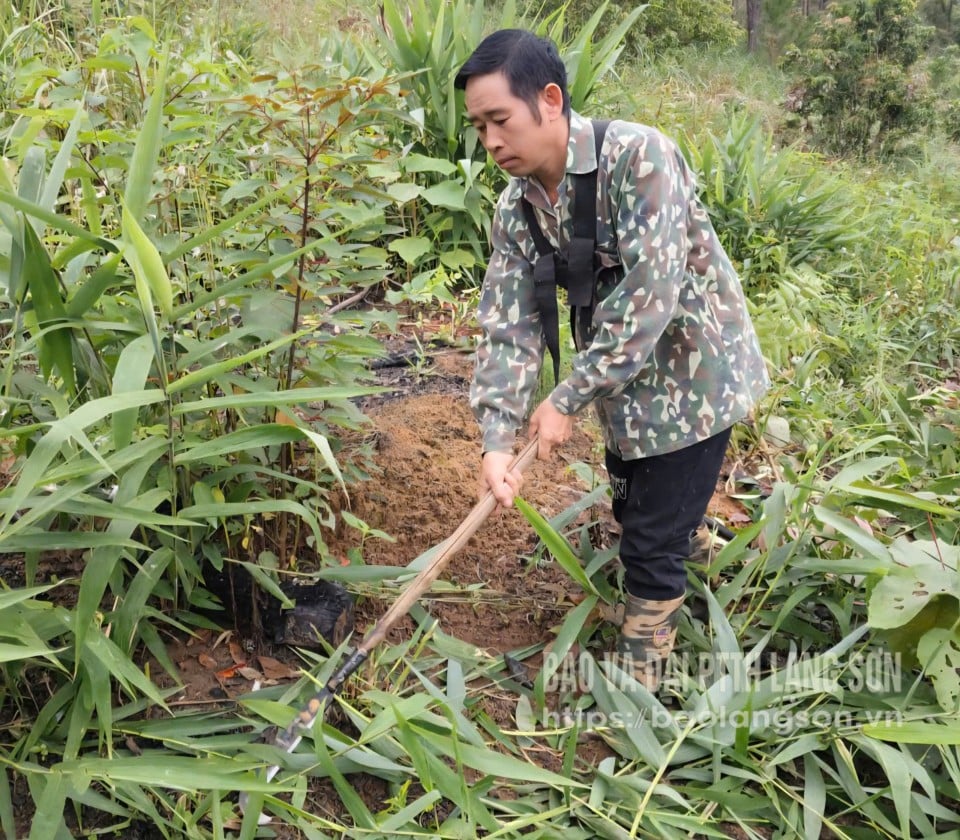
Kien Moc commune currently has 1,721 households, whose livelihoods mainly depend on agricultural and forestry production.
Ms. Nong Thi Hau, Party Secretary and Head of Na Tang village, said: The village currently has 50 households with 212 inhabitants. Since 1998, with the guidance and direction of the Party Committee and the commune government, the villagers have developed pine tree planting. In addition, for about the last four years, people have invested in developing the planting of acacia and eucalyptus trees. As a result, currently 100% of the households in the village are involved in forest planting with an area of over 100 hectares of pine, nearly 40 hectares of acacia and eucalyptus, and more than 10 hectares of anise. From harvesting pine resin, anise, and timber from planted forests, the villagers earn an income of 60 to over 250 million VND per household per year.
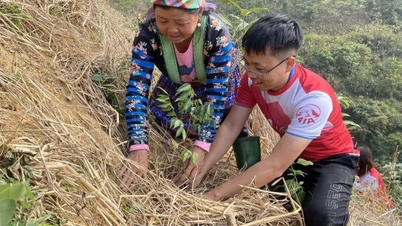
Similar to Na Tang village, Ban Quay is also a thriving area for hill and forest-based economic development. The village currently has 15 households, all of whom earn high incomes from forestry. Some households cultivate 5 to 6 hectares, while others manage 60 to 80 hectares of forest. Ms. To Thi Son, from Ban Quay village, said: "Since around 2000, my family has planted over 2.5 hectares of pine trees. After planting, we regularly inspect, care for, and control pests and diseases, as well as prune and clear undergrowth. With suitable climate and soil conditions, our pine forest has developed very well, and we expand the planting area every year. As a result, we now have over 65 hectares of pine trees, yielding more than 50 tons of resin per year. In addition, my family also cultivates about 10 hectares of anise, yielding 2 to 3 tons per year." From developing forest plantations, the family earns between 500 and 600 million VND per year.
Visiting Kien Moc commune today, it's easy to witness the vast green expanse of forests stretching along the border. According to statistics, the commune currently has 23,524 hectares of pine trees, of which 17,000 hectares are already producing resin, yielding between 6,000 and 13,000 tons per year. In addition, the commune has over 977 hectares of anise trees, producing approximately 600 tons of fresh anise per year. Furthermore, there are about 1,390 hectares of eucalyptus and 2,842 hectares of acacia trees... This commune has the largest area of planted forest in the former Dinh Lap district.
To achieve these results, over the years, the Party Committee, the commune government, the Bac Xa Border Guard Post, and the 461 Forestry Farm under the 338th Economic and National Defense Group have guided and supported the people with seedlings and cultivation techniques. With the active propaganda and mobilization efforts of the commune Party Committee, the commune government, and the soldiers stationed in the area, the people have recognized that afforestation is a sustainable path. Accordingly, every year, the entire commune plants over 700 hectares of new forest, mainly pine and acacia trees.
Mr. Hoang Van Hoi, Chairman of the People's Committee of Kien Moc commune, said: Identifying forestry development as the main direction and key solution to improve people's lives, in recent years, the commune's Party committee and government have focused on guiding and educating people on sustainable forest development. Commune organizations and associations have actively supported and guided people in accessing preferential loans. Currently, the entire commune has 761 households borrowing from the Social Policy Bank with a total outstanding loan of 60 billion VND, of which over 80% is borrowed by people for forest planting and development.
Forest planting has contributed to increasing people's income and reducing the poverty rate in the area. According to a review and assessment, the average per capita income in the commune currently reaches 39.74 million VND/person/year; the poverty rate in the entire commune is only 1.57%, a decrease of 27.6% compared to 2021. Over 90% of households in the commune are involved in forest planting. Of these, approximately 50% of forest-planting households earn 100 million VND/household/year or more; households managing large areas of forest earn between 500 and 700 million VND/year; and the material and spiritual lives of the people are increasingly improving.
Source: https://baolangson.vn/kien-moc-phat-huy-the-manh-trong-rung-5064539.html

![[Photo] Conference on the transfer and reception of Party organizations and Party members between the Party Committee of the Government and the Party Committees of the Central Party Agencies](https://vphoto.vietnam.vn/thumb/1200x675/vietnam/resource/IMAGE/2026/04/01/1775036784472_ndo_br_bnd-2620-jpg.webp)

![[Photo] Conference announcing the Politburo's Decision on organizational and personnel matters](https://vphoto.vietnam.vn/thumb/1200x675/vietnam/resource/IMAGE/2026/04/01/1775017881825_bnd-2410-1472-jpg.webp)










































![[Photo] Prime Minister Pham Minh Chinh receives the Ambassador of the Russian Federation to Vietnam](https://vphoto.vietnam.vn/thumb/402x226/vietnam/resource/IMAGE/2026/04/01/1775046774818_anh-man-hinh-2026-04-01-luc-19-32-33.png)

















Comment (0)