

At the discussion session on November 21, the agenda of the 10th Session of the 15th National Assembly, delegates all agreed that the Law on Technology Transfer (amended) when issued will create a solid legal corridor, strongly promote technology transfer activities, serving the country's economic and social development.
Proposal to supplement the content of technology transfer from Vietnam to foreign countries
Contributing comments to the draft law, delegate Duong Khac Mai, National Assembly Delegation of Lam Dong province, said that regarding the concept of "new technology" in Clause 4, Article 2, the draft mainly describes qualitatively, lacking a basis for specific assessment.

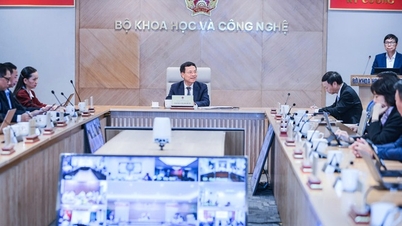
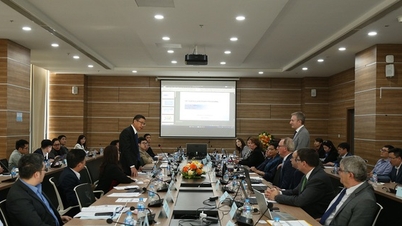
Panorama of the hall discussing the Draft Law on amending and supplementing a number of articles of the Law on Technology Transfer, 10th Session, 15th National Assembly , October 21.
Delegates proposed to add identification criteria such as: the level of difference in principles, processes or economic-technical indicators compared to the technology currently in common use; the level of popularity globally and domestically.
"At the same time, the Government should specify criteria and methods for classifying new technologies in each field. This will help state agencies and businesses have a unified basis when determining priority and support subjects," the delegate suggested.
Pointing out shortcomings in the draft Law, delegate Pham Trong Nhan, National Assembly Delegation of Ho Chi Minh City, said that the draft Law does not have a mechanism for compulsory technology transfer in FDI - an issue that has been discussed a lot in recent times.

Delegate Pham Trong Nhan, Ho Chi Minh City National Assembly Delegation.
The audit report clearly pointed out the technology diffusion policy in technology transfer, but this policy only stopped at the level of attention and did not create any real change.
After reviewing the draft Law, delegates recommended: First, FDI incentives are only applied when there is a clear commitment and roadmap for technology transfer, especially for strategic technology. Second, FDI projects that want to enjoy maximum incentives must have Vietnamese partners in research and development or in mastering core technology. Third, the transferred technology must meet advanced standards, not outdated equipment.
According to the delegate, the draft Law is still lacking in terms of technology export policies for Vietnamese enterprises. "We need to conduct research to promote this content, support intellectual property protection abroad, provide credit guarantee policies for technology trade, and especially support mechanisms for negotiating international contracts."
Delegates proposed adding new contents or a new section related to technology transfer from Vietnam to foreign countries to clarify the conditions for international technology transfer; intellectual property protection mechanism; tax and credit incentives for Vietnamese enterprises exporting technology; and especially the national program to support the commercialization of Vietnam's technology.
Giving specific comments on the provisions of the draft Law, delegate Nguyen Tam Hung, National Assembly Delegation of Ho Chi Minh City, found it necessary to add the concepts of new technology and green technology in Clause 2, Article 1.

Delegate Nguyen Tam Hung, Ho Chi Minh City National Assembly Delegation, spoke.
However, the definition of new technology as "not yet widely applied in Vietnam" risks creating legal loopholes for the import of outdated technology from around the world.
Delegate Nguyen Tam Hung also found that Point c, Clause 2 and Clause 3, Article 14, assigning the authority to preside over and give opinions on technology to the specialized agency managing the industry and field at the provincial level, instead of the specialized agency of science and technology, is unreasonable.
This leads to risks in the quality of technical expertise for technology with restricted transfer and technology with potential negative impacts on the environment.
According to delegates, it is necessary to adjust in the direction that the Department of Science and Technology at the provincial level is the agency that presides or co-presides over giving opinions on technology, ensuring scientific and strict control of technology investment in the locality.
Localities will appraise technology according to unified criteria.
Explaining the issues raised by delegates, Minister of Science and Technology Nguyen Manh Hung emphasized that the main goal of amending the Law on Technology Transfer this time is to form a substantive technology market.
"We are shifting from controlling transfer to promoting innovation. The law reduces administrative procedures, shifts from pre-control to post-control, and creates an open mechanism. The law develops intermediary organizations so that businesses can quickly receive new technology, master and innovate technology, and shift from thinking about technology as machines and equipment to technology as knowledge, data, algorithms, software, and artificial intelligence (AI). All are considered equal transfer objects," the Minister emphasized.
Minister Nguyen Manh Hung said that in addition to ownership and usage rights, the law expands to include derivative technologies, co-developed technologies, temporary technology transfers and results-based transfers.
At the same time, the Law will also allow a "sandbox" on technology transfer; Add new technology objects such as design, algorithms, models, data, AI; Have a new approach to invisible technology objects. In addition, the decentralization of technology appraisal to localities must be accompanied by the design of a unified national criterion.
Minister Nguyen Manh Hung affirmed: "The State always reserves the right to review technology with strong sanctions. This is to avoid inflating technology prices and bringing outdated, environmentally harmful technology into Vietnam."
Source: https://mst.gov.vn/kien-nghi-ho-tro-doanh-nghiep-viet-bao-ho-cong-nghe-o-nuoc-ngoai-197251130203455679.htm

![[Photo] Prime Minister Pham Minh Chinh receives President of Cuba's Latin American News Agency](/_next/image?url=https%3A%2F%2Fvphoto.vietnam.vn%2Fthumb%2F1200x675%2Fvietnam%2Fresource%2FIMAGE%2F2025%2F12%2F01%2F1764569497815_dsc-2890-jpg.webp&w=3840&q=75)





































































Comment (0)