

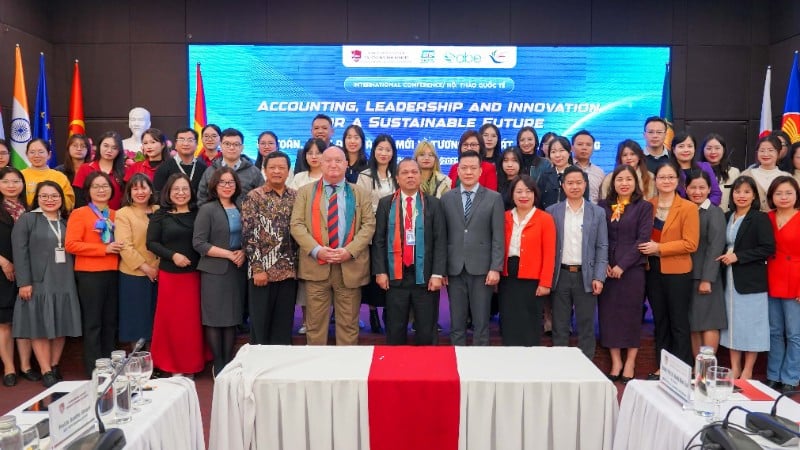
The world is entering a period of profound transformation, where two major drivers—digital transformation and sustainable development—are occurring simultaneously and profoundly impacting all sectors. This not only creates pressure for change but also opens up new opportunities for the accounting, finance, and management industries. Organizational leaders are forced to rethink strategies, processes, and decision-making tools; while the accounting and finance profession must undergo a dramatic transformation to meet the demands of both digitalization, automation, and sustainable reporting according to global standards.
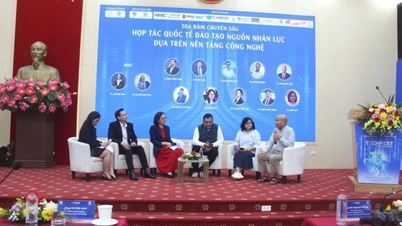
In this context, the workshop was organized to discuss the role of accounting, innovation leadership, and technological knowledge in shaping modern organizational models, helping businesses effectively respond to global challenges and create sustainable value for the future.
In his opening remarks at the conference, Associate Professor, Dr. Hoang Khac Lich, Vice Rector of the University of Economics, Vietnam National University, Hanoi, affirmed: Today's world is shaped by a "double transformation," where the revolutionary power of digital technology and artificial intelligence (AI) is coupled with the irreconcilable imperative of sustainable development and green growth. Growth is fundamentally shifting towards being driven by knowledge and high-value innovation. This places the fields of "accounting, leadership, and innovation"—the focus of this conference—at the heart of the national strategy.
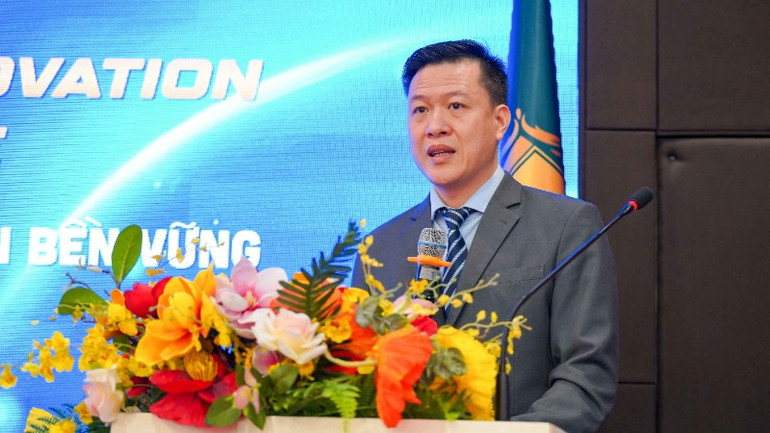
Under the theme “Accounting, Leadership, and Innovation for a Sustainable Future,” speakers discussed how digital technology, innovative leadership models, and modern accounting and financial systems can drive sustainable transformation. Professor Dr. Baldric Siregar, Director of the Graduate School of STIE YKPN Business School, Indonesia, analyzed the factors impacting the level of implementation of Sustainable Development Goals (SDGs) in the public sector and their relationship to public governance effectiveness.
The speaker emphasized that the SDGs only truly deliver value when integrated into the strategies, operational mechanisms, and monitoring systems of government agencies, rather than remaining merely formal declarations or reports.

Emphasizing the role of leadership, Robert William Kindness, Business Director of the Association of Corporate Governance, UK, argued that leadership is a core foundation for driving transformation in education and training, especially in the context of organizations implementing digital learning strategies. According to the speaker, modern leadership is not just about managing resources or operating processes, but about inspiring, guiding action, and driving change based on a clear, long-term goal that aligns with social values.
Also at the seminar, Associate Professor Dr. Robin Chen from National Taipei University analyzed the relationship between corporate misconduct, environmental performance, and reputational resilience in the context of increasing pressure for sustainable development. The speaker emphasized that in an era of information transparency and strong social oversight, corporate misconduct, including environmental violations, fraud, or poor governance, not only causes financial losses but also severely erodes the trust of stakeholders.
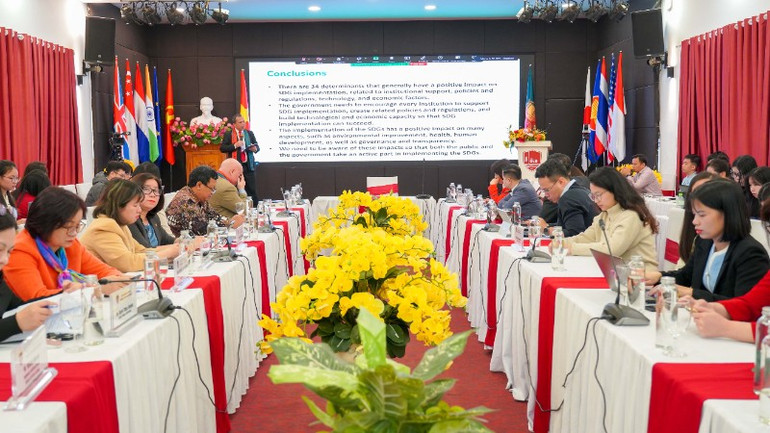
The workshop not only shared expertise in digital accounting, data analytics, and sustainable finance, but also aimed to develop new leadership models and mindsets suitable for the AI era. Discussions emphasized the application of AI, blockchain, integrated environmental-social-governance (ESG) reporting, and innovative solutions to help accounting and finance systems simultaneously meet digitalization requirements and sustainable development standards.
Source: https://nhandan.vn/kien-tao-gia-tri-ben-vung-tu-cuoc-chuyen-doi-kep-trong-ke-toan-va-lanh-dao-post930666.html
![[Photo] Prime Minister Pham Minh Chinh receives Lao Minister of Education and Sports Thongsalith Mangnormek](/_next/image?url=https%3A%2F%2Fvphoto.vietnam.vn%2Fthumb%2F1200x675%2Fvietnam%2Fresource%2FIMAGE%2F2025%2F12%2F16%2F1765876834721_dsc-7519-jpg.webp&w=3840&q=75)
![[Image] Leaked images ahead of the 2025 Community Action Awards gala.](/_next/image?url=https%3A%2F%2Fvphoto.vietnam.vn%2Fthumb%2F1200x675%2Fvietnam%2Fresource%2FIMAGE%2F2025%2F12%2F16%2F1765882828720_ndo_br_thiet-ke-chua-co-ten-45-png.webp&w=3840&q=75)
![[Live] 2025 Community Action Awards Gala](/_next/image?url=https%3A%2F%2Fvphoto.vietnam.vn%2Fthumb%2F1200x675%2Fvietnam%2Fresource%2FIMAGE%2F2025%2F12%2F16%2F1765899631650_ndo_tr_z7334013144784-9f9fe10a6d63584c85aff40f2957c250-jpg.webp&w=3840&q=75)


![[Photo] Prime Minister Pham Minh Chinh receives the Governor of Tochigi Province (Japan)](/_next/image?url=https%3A%2F%2Fvphoto.vietnam.vn%2Fthumb%2F1200x675%2Fvietnam%2Fresource%2FIMAGE%2F2025%2F12%2F16%2F1765892133176_dsc-8082-6425-jpg.webp&w=3840&q=75)


































![[Photo] Prime Minister Pham Minh Chinh attends the Vietnam Economic Forum 2025](https://vphoto.vietnam.vn/thumb/402x226/vietnam/resource/IMAGE/2025/12/16/1765893035503_ndo_br_dsc-8043-jpg.webp)


















Comment (0)