

Currently, many fish farmers in Hiep Hoa Ward (Bien Hoa City) are worried because of low selling prices, slow sales, and the risk of mass fish deaths from periods of intense heat and heavy rain.
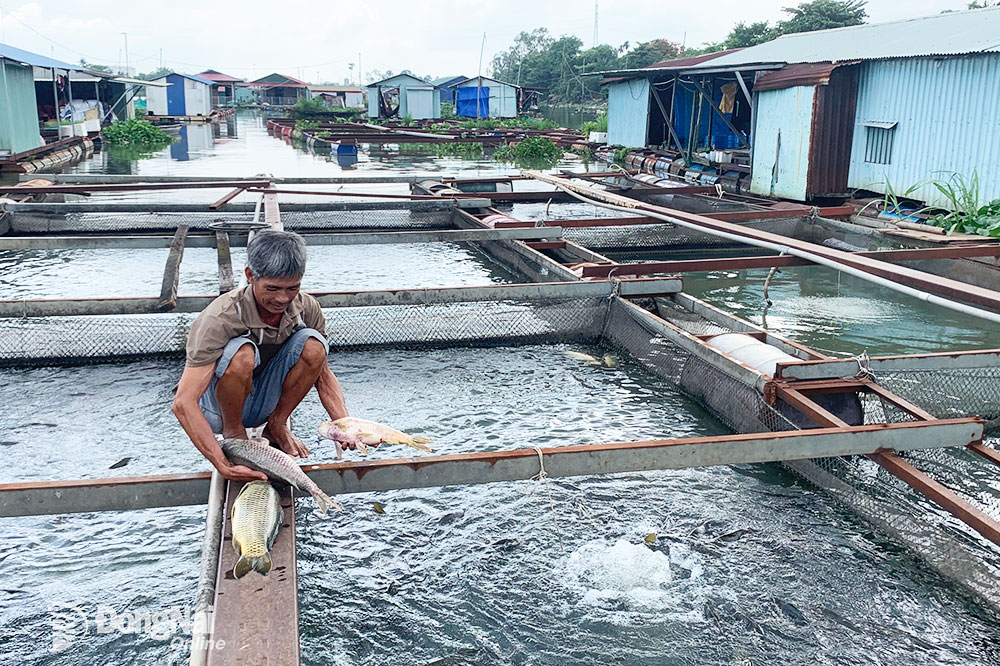 |
| Fish farmers in Hiep Hoa Ward (Bien Hoa City) are worried because the number of dead fish is increasing rapidly. Photo: B. NGUYEN |
Since the beginning of the year, the selling price of fish has consistently been below the production cost. Fish farmers are struggling to cope with losses, and many fish remain unsold beyond their harvest time. Many households are also losing sleep and appetite due to the onset of fish deaths.
* Anxious over dead fish
According to fish farmers, for nearly a month, fish in the cages have been refusing to eat; at many times, the water is stagnant or shallow, causing fish to surface, followed by scattered fish deaths. In the last few days, the mortality rate has increased in some cages. The fish deaths mainly occur among larger fish and are concentrated in some cages near the shore, in shallow water, or in the middle of the farming area.
Mr. Nguyen Hong Vy, both a fish trader and a fish farmer in Hiep Hoa Ward, said that for the past 20 days, his fish cages have started to experience scattered fish deaths throughout the day, and the death rate is increasing daily. In the last few days, his cages have lost more than 100 kg of fish per day.
Sharing the same concern, fish farmer Hoang Van Hong, who still has about 30 tons of grass carp and common carp ready for harvest, said: “For the past few nights, I’ve been practically sleepless running the oxygen pumps and watching over the fish. In the last few days, my fish farm has lost 500-600 kg of fish per day, mostly large fish. To date, my fish farm has suffered losses of more than 1 ton of fish.”
In recent years, during the transitional seasons, fish deaths have also occurred in Hiep Hoa floating village, but the number was not large. This year, due to low fish prices, a large quantity of unsold fish remains in the fish farms. With the hot weather, heavy rains, and wastewater from rivers and streams, the changing water environment poses a risk of mass fish deaths. Farmers are very worried because previously, fish only surfaced when the water was still or shallow, but now, even when the water is flowing, the fish are surfacing due to lack of oxygen.
Mr. Pham Khac Binh (from Hiep Hoa floating village) recounted that the carp in his raft weigh 4-5 kg each. Currently, traders are buying them at 70,000 VND/kg, but the fish suffocate and die, so he can only sell them for 20-30,000 VND/kg. However, he often throws them away because the fish are dying sporadically, and his family is short-staffed. Currently, his raft is running an oxygen pump continuously to minimize fish deaths.
Following an inspection of the fish kill situation in the Hiep Hoa fish farming area, the head of the Dong Nai Fisheries Department, Chau Thanh An, announced that the results of on-site rapid water sample testing showed that the dissolved oxygen content of the surface water inside and outside the fish cages was much lower than the permitted standard. Mr. An advised that to reduce fish deaths, fish farmers should equip and increase aeration to raise the dissolved oxygen content in the water, especially during periods of stagnant water. He emphasized the need for even placement of aeration nozzles and consistent aeration intensity. He also recommended leveling the fish cages to reduce the stocking density.
* Farmers are struggling to bear the losses.
Before the transitional season, fish farmers usually proactively harvest mature fish to minimize the risk of fish mortality. However, since the Lunar New Year in 2023, the market has been slow, so most fish farms in Hiep Hoa Ward are facing a situation where the fish are past their optimal age but cannot be harvested, even though they are selling them below production costs.
Mr. Nguyen Hong Van (a fish farmer in Hiep Hoa Ward) currently has about 30 tons of overgrown grass carp and common carp left over for harvest. He expressed his concern: “When the market was good, traders would come to buy immediately, but now I have to wait a whole month. Each time, traders only buy in small quantities, not all at once like before. I'm worried because the fish are overgrown; the longer I raise them, the more I lose, especially with the risk of losing everything due to fish deaths like now.”
Mr. Nguyen Hong Vy added that his family is currently raising fish in 30 cages, with a harvest yield of 5-7 tons per cage. He still has about 50 tons of large carp and grass carp that need harvesting, but he is forced to keep them in the cages because he has to prioritize buying fish from long-time fish farmers. Before the Covid-19 pandemic, he bought an average of 4-5 tons of fish per day; after the pandemic, he only bought just over 1 ton per day due to slow market demand. Currently, a large quantity of freshwater fish from the Southwestern region is being exported to the market, making competition for sales even more difficult.
Currently, the fish farming area in Hiep Hoa ward has over 1,000 tons of fish remaining, with a significant amount of large fish. Fish farmers are feeling anxious due to the risk of mass fish deaths caused by changes in the water environment.
| Some fish farmers in Hiep Hoa Ward are using dead fish to cook as feed or disposing of them directly into the environment, increasing the risk of local pollution. According to the Dong Nai Fisheries Department, farmers need to collect dead fish, treat them with lime, remove garbage, and clean the cages to ensure good ventilation, thereby protecting the environment and reducing disease and fish deaths. |
Plains
.
Source link


















![[Photo] Prime Minister Pham Minh Chinh receives the Chinese Ambassador to Vietnam](https://vphoto.vietnam.vn/thumb/1200x675/vietnam/resource/IMAGE/2026/04/05/1775397481797_ndo_br_dsc-5512-jpg.webp)
























































Comment (0)