

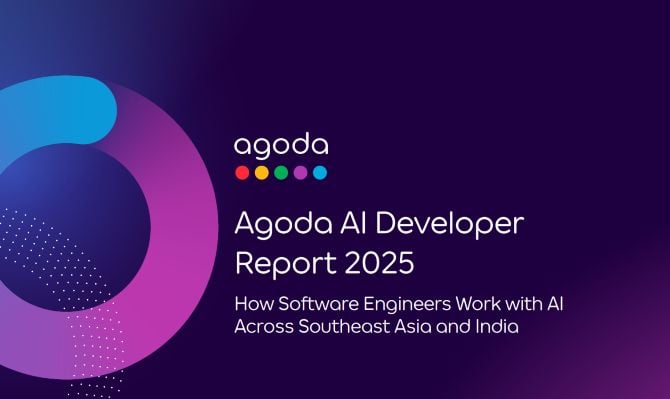
A report on how software engineers are working with AI in Southeast Asia and India. Photo: Agoda.
In Vietnam, the programming community demonstrates outstanding proactiveness in integrating AI at every stage of software development and testing. Specifically, 94.3% of Vietnamese programmers use AI when writing code, 70% use this tool for documentation, and 62.9% apply AI in software testing and verification.
One notable difference is the trend towards diversifying AI tools among Vietnamese programmers. With 41% of Vietnamese engineers having used the Claude Code platform in the past six months, Vietnam currently leads the region in terms of diversity in AI tool choices.
This rate is the highest among the markets surveyed, and far surpasses other popular tools like Copilot and ChatGPT, which are dominant elsewhere.
AI boosts productivity - a top driver for programmers.
The desire to increase productivity is the main driving force behind the widespread application of AI.
Approximately 80% of survey participants in the region stated that speed and automation were the reasons they integrated AI into their workflows. Currently, 56% of programmers always keep AI assistant tools enabled during their work, viewing them as indispensable "helpers."
According to the data collected, 37% of engineers saved between 4 and 6 hours per week using AI, reflecting a significant improvement in time and productivity. Notably, 72% reported a substantial improvement in their performance and code quality when AI was operated within a properly controlled framework.
Nevertheless, AI is still primarily seen as a productivity tool rather than a true innovation partner. Only 22% of programmers use AI to solve new problems, and 43% believe that AI can achieve capabilities equivalent to a mid-level engineer.
Responsible app usage – a mandatory requirement in the age of AI.
While AI helps speed up and increase work efficiency, accountability and reliability remain core fundamentals. Approximately 79% of programmers in the region believe that inconsistent or unreliable output is a major barrier to further expanding AI adoption.
To ensure product quality, monitoring and verifying AI-generated results has become an indispensable step. 70% of programmers regularly edit output to ensure accuracy, and 67% test all AI-generated code before integrating it into a project.
In reality, focusing on verification does not slow down innovation; on the contrary, it strengthens creativity, ensures high quality, and maintains a stable pace of development. Therefore, the role of human oversight remains central to a responsible AI application strategy.
A notable finding from the survey is the difference in access to formal AI training between countries. Programmers in Singapore are nearly twice as likely to receive formal training as those in Vietnam, reflecting a significant resource gap. Nevertheless, the self-learning spirit of programmers in the region remains very strong. The majority – 71% – learn AI through tutorials, personal projects, or online communities, demonstrating a high level of proactiveness in updating their skills. Significantly, 87% of programmers have adjusted their study or work plans to seize opportunities arising from AI.
This trend of self-directed learning shows that the engineering workforce is progressing faster than organizations can train, while also demonstrating a spirit of experimentation, ambition, and an increasingly deep understanding of AI.
Idan Zalzberg, Agoda's Chief Technology Officer, stated that AI is fundamentally changing how programmers build, learn, and collaborate. According to him, AI has shifted from a role supporting code writing and testing to becoming a central component in the entire software development lifecycle.
Currently, AI in Southeast Asia and India is developing in a pragmatic direction, focusing on improving productivity rather than replacing humans. The true value of this technology lies in building responsible and sustainable usage processes, thereby transforming the current high level of application into stable, long-term capabilities.
Source: https://doanhnghiepvn.vn/chuyen-doi-so/lap-trinh-vien-viet-nam-trong-nhom-dan-dau-dong-nam-a-ve-ung-dung-ai/20251105094711709





































































































Comment (0)