

 |
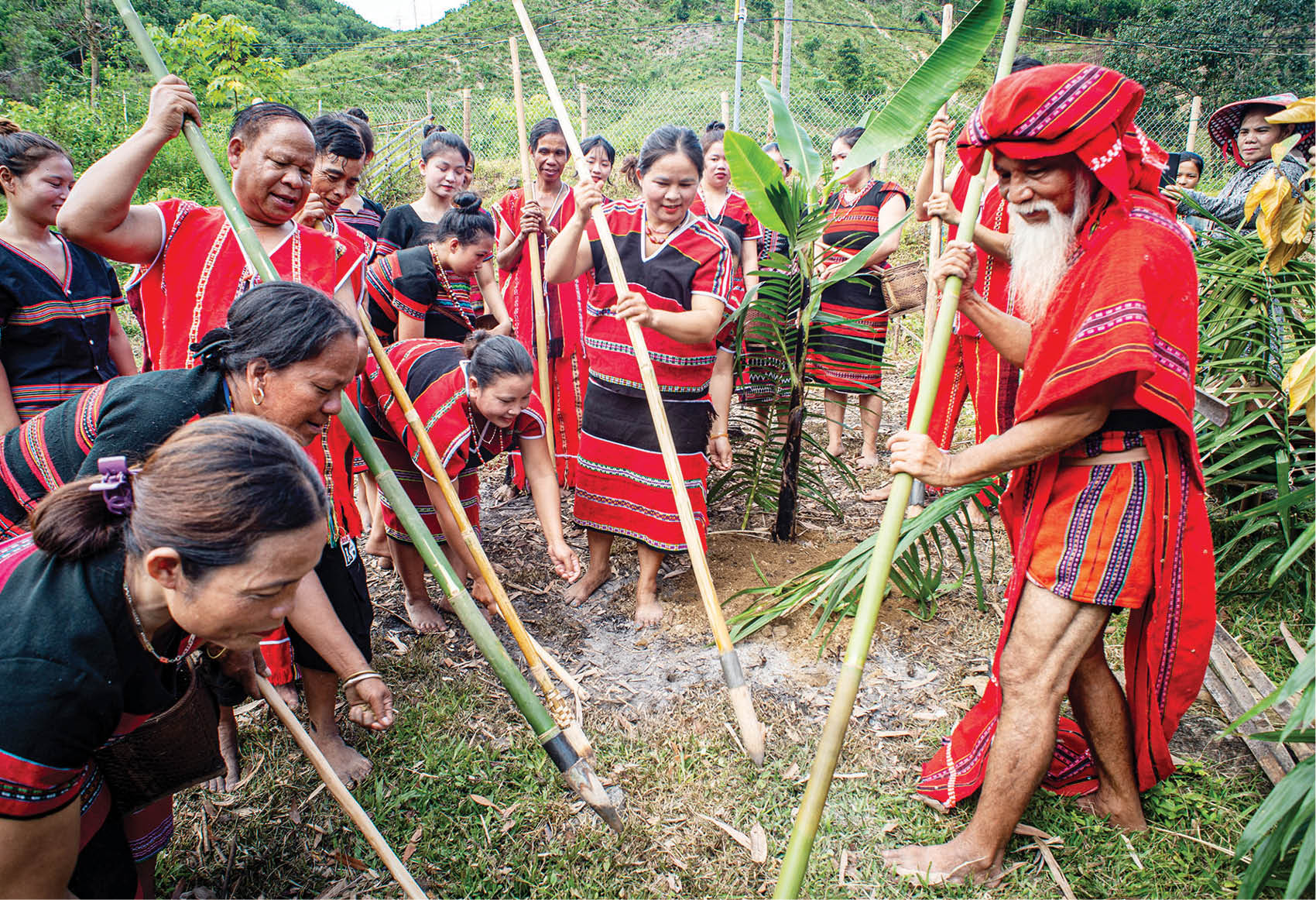
| As long as farming continues, A Pier will continue to exist. Photo: Pham Tuyet |
Festival of faith and hope
The A Pier Festival is one of the most important traditional ceremonies of the Pa Co people, usually held at the beginning of the rice planting season, when the mountains and forests begin to transform to welcome the spring sunshine. According to custom, the festival is organized with six main rituals, closely linked to the agricultural life, spirituality, and long-standing beliefs of the community.
From early morning, village elder Ho Van Hanh, an outstanding artisan and guardian of Pa Co culture, was present in the village square to preside over the ceremony. Amidst a circle of villagers, he wore traditional brocade clothing, held a bunch of rice seeds in his hand, and walked slowly and majestically.
“Our ancestors taught us that to have a bountiful harvest, we must begin with respect for heaven and earth. The A Pier ceremony is not just about offering rice, but also about unity and gratitude,” said old Hanh, his voice deep and warm like an underground stream in the vast forest.
The ceremony begins with a meeting of clan leaders, a ritualistic gathering. The village elder and representatives from each clan choose an auspicious day (according to the traditional Klang and Tam Prang calendars) and assign people to prepare the offerings, usually chicken, pork, black sticky rice, and rice wine.
Next comes the sacred field-opening ceremony, where the village elder chooses a symbolic plot of land as a "sample field" to sow the first rice seeds. The elder holds a gong to sift the seeds, praying as he does so, hoping the rice grains will be golden and plump, just like the resonant sound of the gong.
The official rice planting ceremony takes place right on the fields of each family. To the melodious sound of the bamboo flute, the Pa Cô women gently drop each rice grain into the "A Pật" hole, humming a lullaby for the fields: "Mother rice, let me grow green and healthy, let me have long ears of grain, let the fields and villages be abundant."
The ritual of awakening the rice seed is one of the most symbolic highlights. The Pa Co people believe that for the seed to "awaken," it must be "startled." The village elder uses a bamboo stick to strike forcefully against a stone, creating a resounding explosion that echoes through the mountains and forests, like a call sent into the earth.
Next comes the fence-building ceremony, a ritual that is both practical and symbolic of protecting the fruits of labor, shielding the rice plants from wild animals and natural disasters.
Finally, there is the "Washing of the Caria" ritual. The women of the village go to the stream, wash their farming tools, and sing prayers for favorable weather and a bountiful harvest. As they sing, they scoop up water to wash each basket and each hoe blade, as if cleansing themselves of worries and misfortunes to prepare for a successful new harvest.
When the ceremony concludes, the villagers gather around the campfire, sharing rice cooked in bamboo tubes, drinking rice wine, and performing traditional dances to the lively sounds of gongs and drums. Pa Co boys and girls link arms and dance to pray for a bountiful harvest.
Old Man Hanh shouted: "As long as we still cultivate the land, A Pier will remain. Our descendants must cherish the seeds, the fields, and our fellow countrymen."
Unique tourism products
Currently, the A Lưới district government has preserved and developed the cultural value of the A Pier festival in the direction of community tourism. Ms. Tar Dư Tư, Deputy Head of the Culture, Science and Information Department of A Lưới district, shared: “We are coordinating with artisans and village elders to develop a standardized script for the A Pier festival. On the one hand, we want to preserve the essence of the tradition, and on the other hand, we want to incorporate it into experiential tours for tourists.”
According to Ms. Tu, activities such as participating in seed planting, folk dancing, drinking rice wine, and learning to make traditional farming tools have been integrated into ecotourism programs in A Luoi. With its majestic mountains and unique local culture, the area is very popular with both domestic and international tourists.
"Going forward, we will organize seasonal reenactments of A Pier, combining it with other festivals such as A Da Koonh, Âr Pục…, to create a series of unique cultural and tourism products of the Pa Cô people," Ms. Tư said.
The A Pier Festival – a festival of nature and the faith of the Pa Co people – continues to quietly spread through the fields, echoing in the prayers of the village elders and vibrant in every step of the visitors. Those who seek out the villages will surely find it hard to forget the stories of the harvest told through dances, firelight, and the joyful laughter of the Pa Co people amidst the Truong Son mountains.
Source: https://huengaynay.vn/van-hoa-nghe-thuat/le-hoi-a-pier-khuc-hat-tria-lua-153870.html

![[Photo] Portraits of the 19 members of the Politburo of the 14th Party Congress](/_next/image?url=https%3A%2F%2Fvphoto.vietnam.vn%2Fthumb%2F1200x675%2Fvietnam%2Fresource%2FIMAGE%2F2026%2F01%2F23%2F1769161873355_z7460119485980-304d85fe10d12298f1db614b0d2aa6bc-jpg.webp&w=3840&q=75)


![[Photo] The Politburo, the Secretariat, and the Central Committee are introduced at the Congress.](/_next/image?url=https%3A%2F%2Fvphoto.vietnam.vn%2Fthumb%2F1200x675%2Fvietnam%2Fresource%2FIMAGE%2F2026%2F01%2F23%2F1769156522913_11.jpeg&w=3840&q=75)


![[E-Magazine]: Fragrances that remain "pristine"...](/_next/image?url=https%3A%2F%2Fvphoto.vietnam.vn%2Fthumb%2F402x226%2Fvietnam%2Fresource%2FIMAGE%2F2026%2F01%2F23%2F1769174174439_e-magazine-huon-w1200t0-di2603d199d5163627t11920l1-hmmtn-018.webp&w=3840&q=75)



Comment (0)