

In child education , adults modeling for children to copy and imitate is the simplest and most accessible way to transmit knowledge, skills, and values. However, modeling should only occur in the initial stages when introducing ideas or providing examples of writing styles. Overuse of modeling can stifle creativity and foster dependence on adults in children.
Living in the digital world , everything we do can be made public. Using other people's ideas and products and claiming them as your own, or failing to disclose the source, is considered taboo and carries ethical risks.
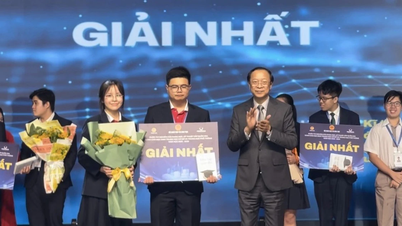
The plagiarism incident in the Genius Olympiad, which led to the organizers revoking the student's award and banning the teacher who supervised the student from participating in supervision until the end of 2024, serves as a lesson about how adults' obsession with achievement inadvertently dragged students into a spiral of dishonesty, disrespect for others and themselves, and damage to children's self-esteem due to cheating and unprofessionalism. It also deprived the student of any future opportunities to study in the US, even if their application was qualified, simply because of the "scar" of academic integrity that was publicly exposed in the media.
 |
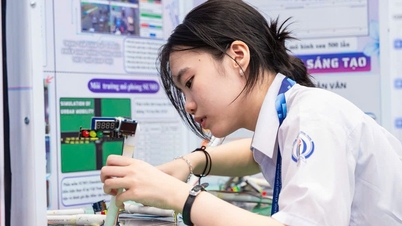
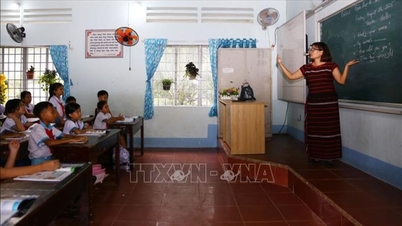
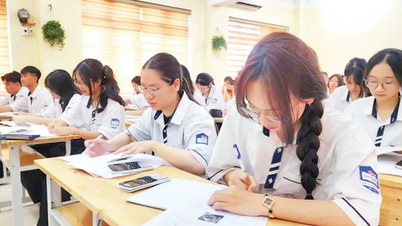
| Illustrative photo: VNA |
Let's be honest with each other. How many parents have used, are using, or will use their financial resources and social standing to influence their children's academic achievements, giving them an edge over their actual abilities? How many teachers still carelessly stifle independent thinking and creativity in young children by instilling ideas, providing models, or even doing everything for them to help their students win awards and build their own personal brand?
The essence of paid-entry competitions like the Genius Olympiad, where participants only receive a title, is simply an opportunity for children to connect, experience, and broaden their horizons. However, adults have distorted its meaning, turning it into a race for achievement, a superficial polish to enhance the outward appearance of talent profiles that parents lack confidence in.
There's nothing wrong with wanting your child to study at top schools around the world. If students set their own goals, have aspirations, commitment, and motivation to meet all the requirements regarding GPA, IELTS scores, extracurricular activities, scientific research, etc., then there's nothing to discuss. However, many parents have to pay tens, even hundreds of millions of VND to study abroad consulting centers to have them create templates and enhance their applications, while the students simply wait for their departure date. This is a completely different story.
The immediate consequence is that many students are accepted into excellent schools in the US, UK, and Australia, but they cannot keep up with the studies, becoming insecure, withdrawn, losing motivation and willpower, falling into depression, and even having suicidal thoughts...
Therefore, adults need to learn that the goal for their children is not just about titles and achievements. The bigger goal is to help them develop well-rounded personalities, excel in knowledge, maintain strong mental health, and master the skills to adapt to life's changes.
Build self-confidence in your children, encourage independence, self-reliance in thinking, and creativity in their approach. Teach them about the importance of honesty, respect for others, and self-respect. Parents themselves need to set a good example of academic integrity, as it is a crucial element in building a sustainable future for their children.
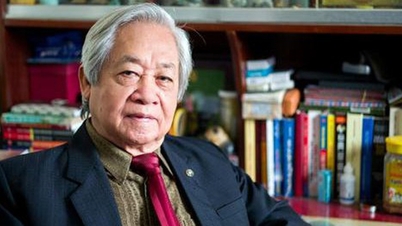
Associate Professor, Dr. Tran Thanh Nam, Head of the Faculty of Educational Sciences, University of Education - Vietnam National University, Hanoi
*Please visit the Science Education section to view related news and articles.
Source
![[Photo] National Assembly Chairman Tran Thanh Man arrives in Türkiye to attend IPU-152](https://vphoto.vietnam.vn/thumb/1200x675/vietnam/resource/IMAGE/2026/04/15/1776261003665_tnk10-jpg.webp)
![[Photo] My Son at night: A thousand-year-old heritage site amidst the Milky Way](https://vphoto.vietnam.vn/thumb/1200x675/vietnam/resource/IMAGE/2026/04/15/1776261039184_ndo_br_chon6-jpg.webp)
![[Photo] The General Secretary, President and his wife meet with Vietnamese-Chinese friendship leaders.](https://vphoto.vietnam.vn/thumb/1200x675/vietnam/resource/IMAGE/2026/04/15/1776264829725_vna-potal-tong-bi-thu-chu-tich-nuoc-to-lam-gap-mat-nhan-sy-huu-nghi-viet-nam-trung-quoc-8703641-3130-jpg.webp)
![[Photo] National Assembly Chairman Tran Thanh Man attends the opening session of IPU-152](https://vphoto.vietnam.vn/thumb/1200x675/vietnam/resource/IMAGE/2026/04/16/1776277863731_ctqh5-jpg.webp)
![[Photo] Mrs. Ngo Phuong Ly meets and exchanges views with Mrs. Peng Li Yuan](https://vphoto.vietnam.vn/thumb/1200x675/vietnam/resource/IMAGE/2026/04/16/1776277858080_phu-nhan-1-jpg.webp)











































Comment (0)