

Having risen through the ranks from a mining background, Mr. Hoang Tuan Duong, former Head of the Propaganda Department of the Quang Ninh Coal Party Committee, has devoted much effort to collecting documents and writing books about his second homeland, the mining region, and about the miners who were his colleagues. On the occasion of the 88th anniversary of the Traditional Day of Miners in the Mining Region - the Tradition of the Coal Industry (November 12, 1936-2024), a reporter from the Quang Ninh Provincial Media Center interviewed him about the cultural traditions of the miners.

- Sir, regarding the events that took place 88 years ago, I understand you published a memoir titled "Searching for Witnesses in 1936"?
Nearly 30 years ago, I began searching for witnesses who participated in the 1936 strike. I eventually gathered a total of 47 of them. I can't remember how many times I searched or how many kilometers I traveled. I used motorbike taxis, and I also walked, climbing mountains and wading through streams. I even searched in places where they had previously taken refuge.
It so happened that I met Mr. Pham Ngoc Hoa, who used to be the Chairman of the Provincial Fatherland Front Committee, and he suggested that I record the memories of those who participated in the 1936 events. After that, I started searching and found the following individuals: Ngo Huu Tinh, Nguyen Dinh Luong, Pham Van Khang, Nguyen Van Ty, Pham Thi Moc, Le Van Dan, Nguyen Van Ban, Ha Quang Y, Pham Van Thinh, Nguyen Van Xuan, and Pham Thi That. Notably, Mr. Xuan and Mrs. That are a married couple. They are living witnesses who were present in this heroic coal mining region.
- What are your feelings when you think back to the people who participated in the 1936 general strike?
+ I remember one of the elders, with an excellent memory, sketched a reenactment of the events that took place in the mining region in 1936. He even urged me to recount it so that future generations wouldn't forget this event. It was all the blood and sweat of the miners. Now, they have all passed away. Remembering them still brings tears to my eyes. I would like to light a candle at their graves once more. Following their example, today's miners will never forget what they fought for and sacrificed to reclaim. And today's miners are striving to continue what they couldn't accomplish in the past. From the depths of my heart, I wish their souls rest in peace and find eternal liberation.
- Was it perhaps out of a desire to tell the story to future generations that he devoted his efforts to writing the two-volume set, "History of Vietnamese Coal Workers"?
+ It truly stems from the old woman's message. It also originates from the resilient tradition of Quang Ninh, the cradle of the Vietnamese workers' movement. I had the advantage of 20 years as a propaganda officer in the coal industry, collecting documents, optimizing the collected events, and refining them to write about the continuous growth and development of the coal miners' movement. And above all, I am passionate about mines and coal. I rose through the ranks as a miner at Lo Tri mine, now Thong Nhat Coal Company, and despite holding various positions, I always chose to stay in the coal industry. I was transferred to other jobs three times, but each time I requested to remain in the coal industry. That connection kept me involved with the coal industry from my youth until retirement. I've cherished the idea of writing a book about coal miners since very early on. That idea began to take shape from my first days working in the mine and continued until much later.
- What messages did you want to convey to your readers through the books you wrote?
Throughout my working life, I've had access to many documents and been fortunate enough to meet many historical witnesses. They are part of the history of the mining region, contributing to glorious chapters of history, but also chapters stained with the blood and tears of miners before the August Revolution. Then there were the years of tenacious struggle, the efforts to build and develop, mastering science and technology, and the strong development in the years that followed. The miners always upheld the banner of discipline and unity, starting from the 1936 strike. I write books with my personal passion and with the intention of contributing a small part of my efforts to the coal industry. Hopefully, my books will provide some useful information for the study of the history and culture of coal miners.
- Sir, how has the coal industry developed compared to the time you worked at the Lo Tri mine?
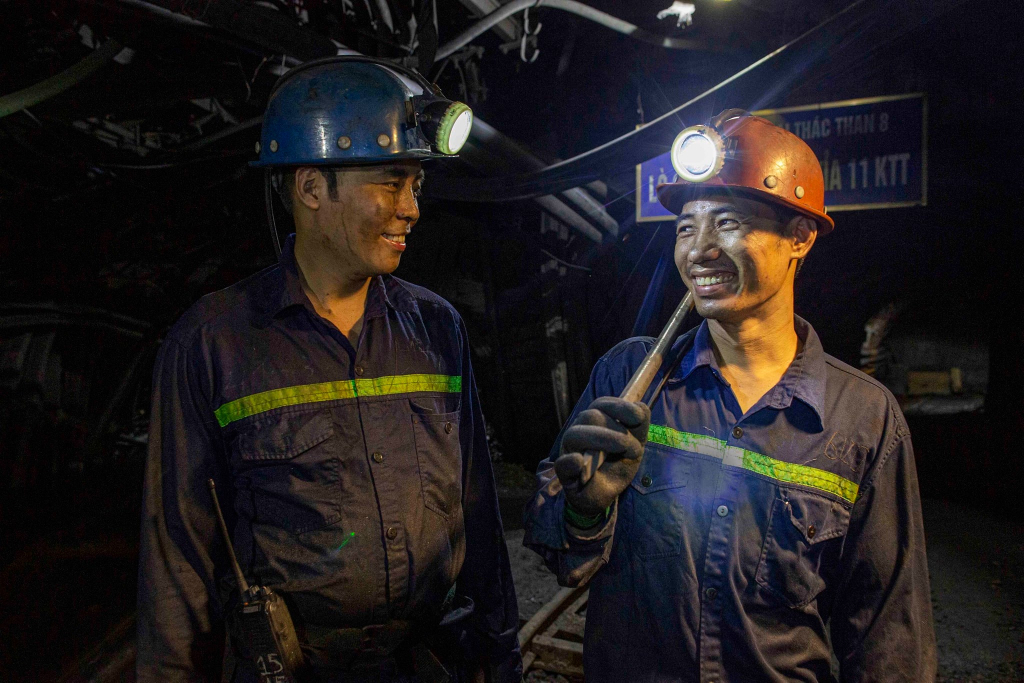
When we took over, coal mining was mostly manual. Coal production was only 3-4 million tons. Workers wore whatever clothes they had, and in the freezing cold, they were covered in coal dust, and even bathing was only possible with cold water. The cooks only prepared two pots of rice and provided drinking water; meals were shared, and each person brought their own food… Gradually, the furnaces, factories, ports, and roads were improved and expanded, and modern coal mining equipment was invested in…
Compared to the past, miners now have a much better life, with many advantages. They have modern equipment and machinery. Workers get to shower with hot water, travel in air-conditioned vehicles, and eat meals. Monthly salaries are over 10 million dong. They receive bonuses during Tet (Lunar New Year), are driven home by car, and are transported back after Tet. They also go on sightseeing trips every year. Miners today are incomparable to those of the past; many things are far superior, which is very encouraging and inspiring. Even I, having worked in the mines myself, am sometimes surprised by the remarkable growth and development of the industry I once worked in.

- The miners not only enriched their lives but also beautified the place where they lived. What are your thoughts on this story?
I realize that environmental issues were less valued in our time than they are now. Nowadays, tens of thousands of miners are fully aware of environmental protection because they live and work daily, facing the heat, dust, noise, air pollution, and dirty water. Frankly, many of these are man-made and have existed for many years, so miners feel a responsibility to reduce pollution and protect the environment.
In reality, in the coal industry today, every economic and technical feasibility study is required to include an environmental impact assessment. Generally, miners are striving to improve the environment in the coal mining areas where they live, making it cleaner and healthier, and contributing to the prosperity and beauty of their homeland, Quang Ninh.
Thank you for the interview!
Mr. Hoang Tuan Duong, born in 1941, is a member of the Quang Ninh Association of Literature and Arts, and the Quang Ninh Association of Historical Sciences. He was formerly a miner at Thong Nhat Coal Company, Secretary of the Youth Union, Head of the Emulation Committee of the Hon Gai Coal Union, and Head of the Propaganda Department of the Quang Ninh Coal Party Committee. He has made significant contributions to the coal industry in both propaganda and literary works. He has published several books, including: White Mulberry Flowers, Hien Den, The Mark of Time, First Love, Two People Standing in the Air, Orchid Branch by the Hammock, Anthology of Stories and Poems, Searching for Witnesses in 1936, and History of the Vietnamese Coal Industry (2 volumes)... |
Source
















![[Video] The craft of making Dong Ho folk paintings has been inscribed by UNESCO on the List of Crafts in Need of Urgent Safeguarding.](https://vphoto.vietnam.vn/thumb/402x226/vietnam/resource/IMAGE/2025/12/10/1765350246533_tranh-dong-ho-734-jpg.webp)


















































Comment (0)