

Not all the fish are sold at the market; many people select the freshest and tastiest to make fish sauce – a long-term preservation method that is convenient for use during the rainy season and floods, and also creates a renowned specialty of this region.
Just a visit to a rural market during the flood season is enough to awaken all the senses with the rich aroma of fermented fish sauce. Jars of golden-yellow fermented snakehead fish, bright red fermented catfish with salt and chili, and diced snakehead fish soaked in roasted rice and roasted rice flour... are neatly arranged on stalls, both rustic and strangely alluring.
Making fish sauce seems easy but it's actually quite difficult. People in the Mekong Delta have their own secrets. The fish are cleaned immediately after being caught, salted according to a precise ratio, and left to ferment naturally. Each type of fish requires a different salting method: snakehead fish sauce must be salted while still fresh, fermented for a few days, then mixed with roasted rice flour to give the fish a beautiful color. Usually, after more than a month of fermentation, the fish sauce begins to develop its aroma. People can let the fish sauce ferment for longer, up to three months, to achieve the rich, savory flavor. Good fish sauce has a shimmering golden-brown color, a strong but not overpowering aroma, and a harmonious blend of salty, sweet, and fatty flavors that you can eat again and again without getting tired of it.
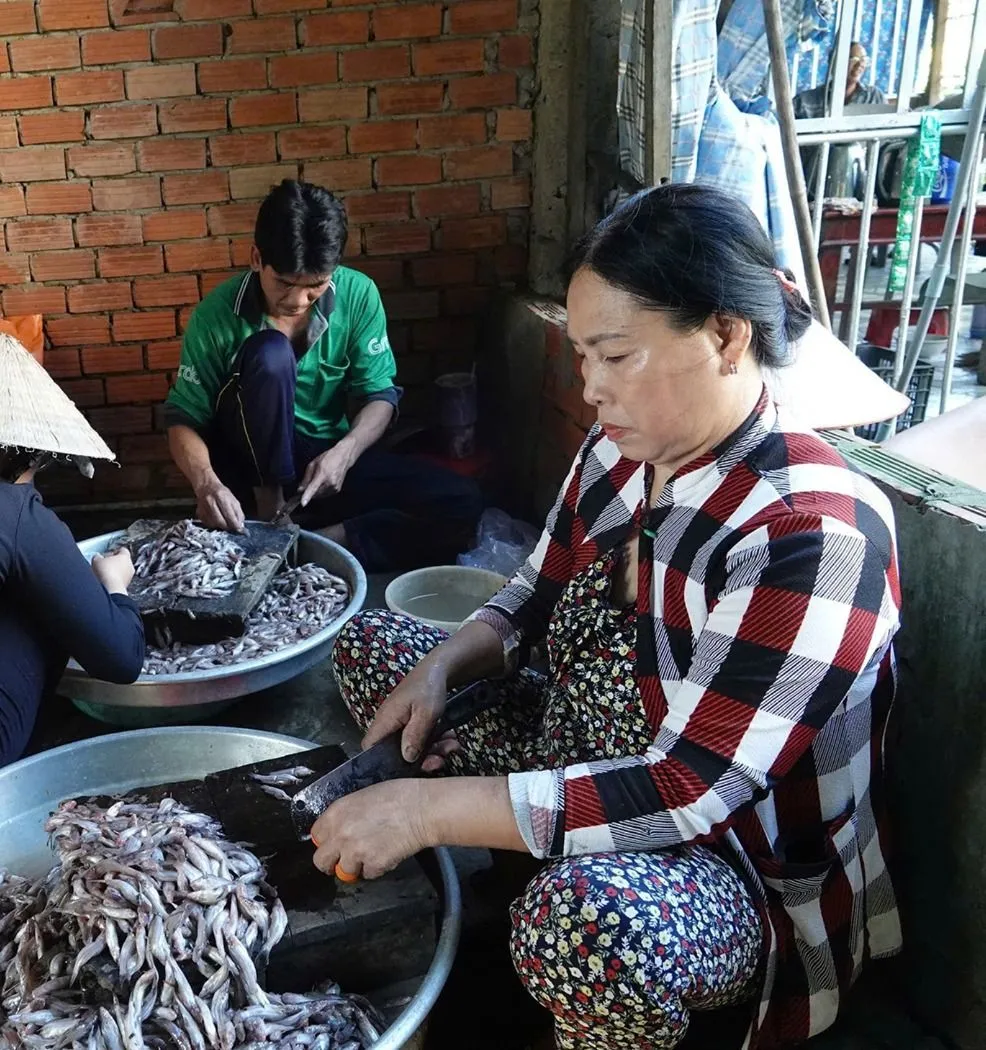
Fermented fish paste is not only for later consumption but also a key ingredient in many specialties of the Mekong Delta. The most notable is fermented fish paste hotpot, a rustic dish that has captured the hearts of diners everywhere. The steaming hotpot, with its broth made from fermented snakehead fish and other fish, blended with lemongrass, chili, and eggplant, is served with various wild vegetables such as water lilies, water spinach, water morning glory, and water chives... making anyone who tastes it exclaim in delight. In addition, fermented fish paste is also used in steamed or braised dishes, or simply eaten raw with unripe mangoes, cucumbers, and unripe bananas – a seemingly simple dish that evokes fond memories for those far from home.
More than just a food item, fish sauce is a memory, the soul of the countryside for generations of people in the Mekong Delta. In the small kitchen, a tightly sealed jar of fish sauce, neatly placed on the kitchen shelf, is a "reserve" for the lean months ahead. The strong aroma of fish sauce when the lid is opened evokes images of mothers meticulously mixing the rice flour, and fathers lighting the charcoal stove to simmer the fish sauce for the whole family.
People in the Mekong Delta often joke, "Without fish sauce, rice doesn't taste complete." In a traditional rural meal, a plate of fish sauce, a few slices of cucumber, unripe banana, and a chili pepper are enough to create a warm, comforting, and delicious meal. For those living far from home, fish sauce is a gift that carries the memories of their homeland – even a small jar of fish sauce is enough to soothe the heart of someone far away.
Fermented fish paste is a dish of time – requiring patience to wait for the fish to ferment, so that its flavor is at its fullest. It's also a dish of human connection – each jar contains the effort, meticulousness, and love of the homeland. When the flood season ends and the water recedes, the jars of fish paste are opened again during the dry season, preserving the flavor of those days filled with fertile soil. Amidst modern life, fish paste still holds its unique place – simple yet profound, rustic yet captivating, just like the kind, generous, and sincere people of the Mekong Delta.
Source: https://www.sggp.org.vn/mam-ca-huong-vi-mua-nuoc-noi-mien-tay-post823683.html

![[Photo] Capturing the moment the tide recedes at Yen Binh Son rapids - a million-year-old scenic spot in Quang Ngai.](https://vphoto.vietnam.vn/thumb/1200x675/vietnam/resource/IMAGE/2026/05/19/1779175463885_yen9-1199-jpg.webp)
![[Photo] National Assembly Chairman Tran Thanh Man attends the groundbreaking ceremony for the National Highway 1A spatial axis project.](https://vphoto.vietnam.vn/thumb/1200x675/vietnam/resource/IMAGE/2026/05/19/1779161360398_ndo_br_bnd-1412-jpg.webp)





































![[Photo] General Secretary and President To Lam receives Indian Defense Minister Rajnath Singh](https://vphoto.vietnam.vn/thumb/402x226/vietnam/resource/IMAGE/2026/05/19/1779184046302_anh-man-hinh-2026-05-19-luc-16-46-58.png)

















Comment (0)