

On the morning of December 16th, the Nghe An Department of Health, in coordination with the Nghe An Eye Hospital, organized a conference to summarize the Blindness Prevention Program for the period 2022-2025.
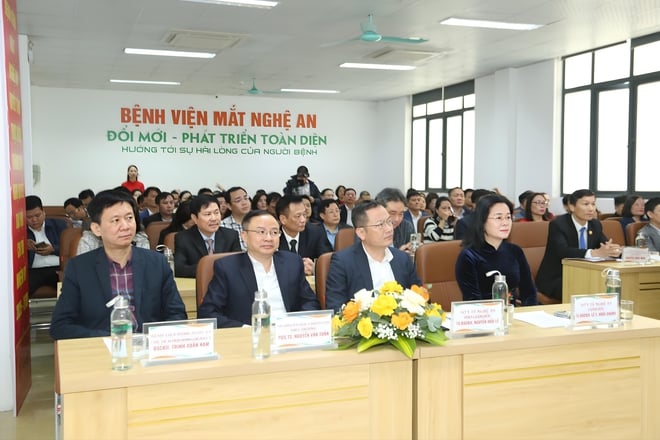

Delegates attending the conference.
The conference was attended by Mr. Hoang Phu Hien, Vice Chairman of the Provincial People's Committee, Ms. Le Thi Hoai Chung, Director of the Department of Health, and representatives from hospitals and medical universities inside and outside the province.
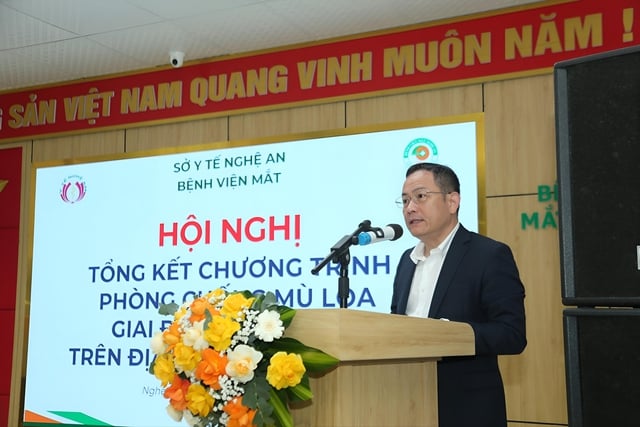
Dr. Nguyen Huu Le, Deputy Director of the Department of Health, delivered a speech at the conference.
According to the report, Nghe An province controls the blindness rate among people aged 50 and over at 1.46%, achieving the set target (below 1.5%). Cataract surgery capacity continues to be a highlight with over 24,000 cases per year; the CSR index reaches 62 cases per 10,000 people, higher than the national average. The blindness prevention network has been strengthened from the provincial to the grassroots level, with regular screening activities in approximately 130 communes and wards each year and more than 3,500 grassroots health workers receiving training.
Notably, Nghe An is one of the pioneering localities in applying artificial intelligence (AI) in retinal disease screening. Thanks to AI, people in mountainous communes such as Quy Chau and Que Phong... are able to detect retinal lesions early, reducing reliance on referrals to higher-level facilities, shortening diagnosis time, and lowering travel costs.
Speaking at the conference, Mr. Nguyen Huu Le, Deputy Director of the Nghe An Department of Health, highly appreciated the achievements while frankly pointing out the remaining bottlenecks. Specifically, the management of chronic eye diseases such as glaucoma and diabetic retinopathy is still limited; the glaucoma management rate is only 30.6% compared to the actual disease prevalence in the community. School refraction screening has not met expectations, with only about 54% of students in the province being screened; inter-specialty and inter-sectoral coordination in some localities remains largely superficial.
"The challenge in the next phase lies not in the number of surgeries, but in the ability to manage chronic eye diseases in the community over the long term," said Mr. Nguyen Huu Le. The head of the Department of Health requested that the entire sector shift its focus from treatment to early, continuous, and sustainable management and monitoring.
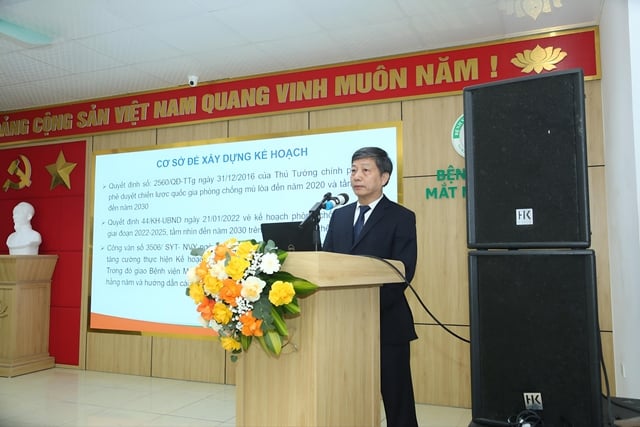
Associate Professor, Doctor Tran Tat Thang, Director of the Eye Hospital, outlined the direction and action plan for blindness prevention and control in the period 2026-2030.
For the period 2026-2030, the Nghe An Health sector has identified key tasks including: consolidating the Provincial Steering Committee for Blindness Prevention; developing Nghe An Eye Hospital into a specialized center in the North Central region; expanding the management of chronic diseases using electronic health records; promoting digital transformation, AI application, and telemedicine to narrow the regional gap; strengthening coordination with the education sector in controlling refractive errors in schools; and leveraging support from international organizations such as Orbis and Fred Hollows.


Leaders of the Nghe An Provincial People's Committee and the Department of Health commended collectives and individuals who achieved outstanding results in the implementation of the Blindness Prevention Program for the period 2022-2025.
At the conference, Mr. Hoang Phu Hien presented certificates of commendation from the Chairman of the Provincial People's Committee to 3 collectives and 5 individuals for their outstanding achievements in blindness prevention and control during the 2022-2025 period. The Director of the Nghe An Department of Health also presented certificates of merit to outstanding collectives and individuals in the sector.
Besides the summary report, the conference dedicated time to four in-depth presentations, fully reflecting the links in the blindness prevention program from the grassroots to the provincial level. The Dien Chau Health Center shared the effectiveness of mobile screening models and the difficulties faced at the grassroots level; Yen Thanh General Hospital analyzed the current situation of detection, treatment, and referral of eye diseases; the Provincial Association of the Elderly emphasized the role of communication and mobilization of the elderly to proactively undergo regular eye examinations; and Nghe An Friendship General Hospital pointed out shortcomings in interdisciplinary coordination and recommended strengthening connections to improve the effectiveness of blindness prevention.
Source: https://suckhoedoisong.vn/nghe-an-chuyen-trong-tam-phong-chong-mu-loa-sang-quan-ly-benh-man-tinh-ung-dung-manh-ai-16925121610542443.htm

![[Photo] Prime Minister Pham Minh Chinh receives Lao Minister of Education and Sports Thongsalith Mangnormek](/_next/image?url=https%3A%2F%2Fvphoto.vietnam.vn%2Fthumb%2F1200x675%2Fvietnam%2Fresource%2FIMAGE%2F2025%2F12%2F16%2F1765876834721_dsc-7519-jpg.webp&w=3840&q=75)
![[Photo] Prime Minister Pham Minh Chinh receives the Governor of Tochigi Province (Japan)](/_next/image?url=https%3A%2F%2Fvphoto.vietnam.vn%2Fthumb%2F1200x675%2Fvietnam%2Fresource%2FIMAGE%2F2025%2F12%2F16%2F1765892133176_dsc-8082-6425-jpg.webp&w=3840&q=75)
![[Live] 2025 Community Action Awards Gala](/_next/image?url=https%3A%2F%2Fvphoto.vietnam.vn%2Fthumb%2F1200x675%2Fvietnam%2Fresource%2FIMAGE%2F2025%2F12%2F16%2F1765899631650_ndo_tr_z7334013144784-9f9fe10a6d63584c85aff40f2957c250-jpg.webp&w=3840&q=75)

![[Image] Leaked images ahead of the 2025 Community Action Awards gala.](/_next/image?url=https%3A%2F%2Fvphoto.vietnam.vn%2Fthumb%2F1200x675%2Fvietnam%2Fresource%2FIMAGE%2F2025%2F12%2F16%2F1765882828720_ndo_br_thiet-ke-chua-co-ten-45-png.webp&w=3840&q=75)
























































![[Photo] Prime Minister Pham Minh Chinh attends the Vietnam Economic Forum 2025](https://vphoto.vietnam.vn/thumb/402x226/vietnam/resource/IMAGE/2025/12/16/1765893035503_ndo_br_dsc-8043-jpg.webp)





























Comment (0)