

 |
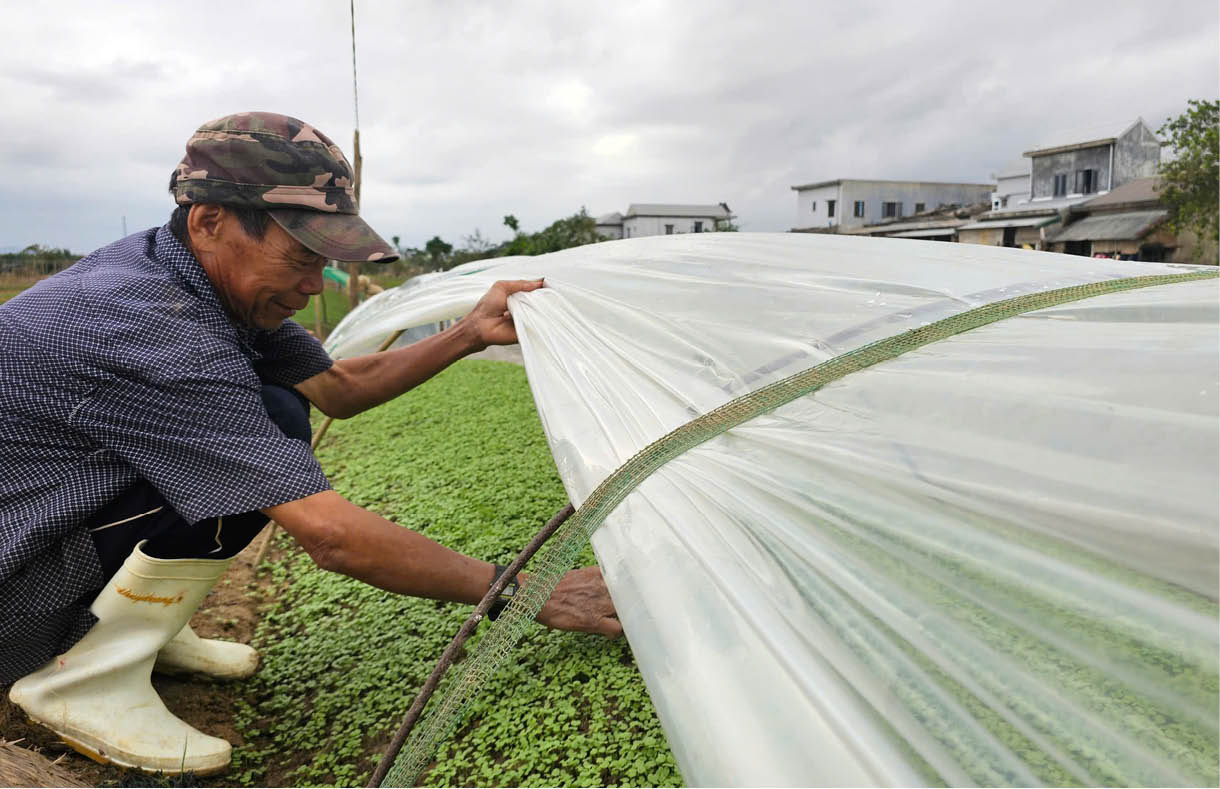
| Mr. Le Hai takes care of the young vegetable patch after the flood. |
The color green is back.
On his 750-square-meter field, 60-year-old Le Hai from Tay Thanh village diligently tills the soil and covers the newly sown vegetable rows with plastic sheeting. For Mr. Hai, this field is his entire livelihood. The flood at the end of October caused deep water, sweeping away more than a dozen rows of unharvested vegetables, resulting in a total loss. “The weather forecast says it’s going to rain again, but I’m anxious. Leaving the land uncultivated for so long makes me restless. These past few days, I’ve been taking advantage of the receding water to get back to work. I sowed these cabbage rows five days ago. If the weather is favorable, I’ll be able to sell them in about half a month,” he said, adjusting the plastic sheeting.
Mr. Hai said that the vegetables are only completely destroyed during major floods, but on days with stable weather, the vegetable fields always provide an income to support his family. "As long as the weather is calm, the vegetables grow very well, the income is steady, and my whole family can live off these vegetable plots," he said, his eyes following the new sprouts of cabbage as if they were his most precious possessions.
Without complaining, Mr. Hai remained calm, reflecting the rhythm of life of a farmer who had weathered many flood seasons. Within that serenity lay the belief that after the mudslides, the green patches would return to the fields.
Late in the afternoon, only a few people could be seen in the fields. Many households here chose to plant their crops but were still monitoring the weather, waiting for the water to recede completely. “People are taking advantage of the time to work in their gardens first. Because there are forecasts of heavy rain again, many are still hesitant and haven’t planted their crops en masse. When the weather stabilizes, the vegetable fields will be bustling again,” explained Mr. Huynh Thanh Long, an official from Hoa Chau ward.
In front of her house, Mrs. Nguyen Thi Thoi, 49 years old, from Thanh Trung village, was chatting with a few neighbors in the yard.
While waiting for the soil in the fields to dry completely, Mrs. Thoi took the opportunity to sow some rows of cabbage and lettuce in her garden, covering an area of about 200 square meters, hoping to harvest them while vegetable prices were still high. "Vegetables are very expensive now; before it was 5,000 dong a kilogram, now it's up to 50,000 dong. Seeing the price increase, everyone wants to grow vegetables to increase their income," she said.
During the recent floods, Mrs. Thoi's house was submerged by nearly a meter, but thanks to her timely relocation of belongings, she didn't suffer significant property damage, only losing all her vegetables that were ready for harvest. "Normally, I earn 200,000 to 300,000 dong a day, sometimes even 500,000 dong. This whole month is a complete loss, with no income, but I hope the next crop will compensate for some of the losses," Mrs. Thoi shared.
Maintain the strength of being a "vegetable hub".
These days, residents of Hoa Chau ward are beginning to restore their vegetable crops after the floods. According to the ward's People's Committee report, Typhoon No. 12 (Fengshen) caused deep flooding of 1-1.8 meters in many areas, damaging 35-40 hectares of vegetable crops; Thanh Trung, Tay Thanh, and Thanh Ha villages were the most severely affected. Nearly 15km of irrigation canals were silted up, directly impacting the 2025-2026 winter-spring crop.
Mr. Nguyen Manh Cuong, Vice Chairman of the Hoa Chau Ward People's Committee, said that the ward had held meetings with cooperatives to assess the damage and agree on a plan to support farmers with seeds, supplies, restoring the irrigation system, and improving the soil. “The ward has requested approximately 39 billion VND in support to mitigate the consequences of the natural disaster, including 200 million VND to help farmers restore their vegetable crops. We are guiding farmers to choose short-term varieties for planting, hoping they will soon have a return to income,” Mr. Cuong said.
Hoa Chau has long been a traditional vegetable-growing area supplying markets, supermarkets, schools, and other areas of the city. Therefore, restoring the vegetable crops damaged by floods is not only about livelihoods but also about ensuring a supply of fresh vegetables for markets both within and outside the city. The ward also plans to convert some rice-growing areas to vegetable cultivation to adapt to climate change and increase income for residents.
On his way home, Mr. Huynh Thanh Long pointed towards the newly sprouted vegetable fields with eyes full of faith and hope: "As long as the weather remains stable, by the end of the month the vegetable fields will be lush green, and many rows will be ready for harvest. Hoa Chau land is fertile, and the people are experienced in farming; with a little favorable weather, the vegetables will grow very quickly."
Source: https://huengaynay.vn/kinh-te/nhung-mam-non-lai-xanh-sau-lu-160086.html



![[Photo] National Assembly Chairman Tran Thanh Man successfully concludes his participation in IPU-152](https://vphoto.vietnam.vn/thumb/1200x675/vietnam/resource/IMAGE/2026/04/18/1776502638199_vna-potal-chu-tich-quoc-hoi-ket-thuc-tot-dep-chuong-trinh-tham-du-ipu-152-8709975-jpg.webp)


















































































Comment (0)