

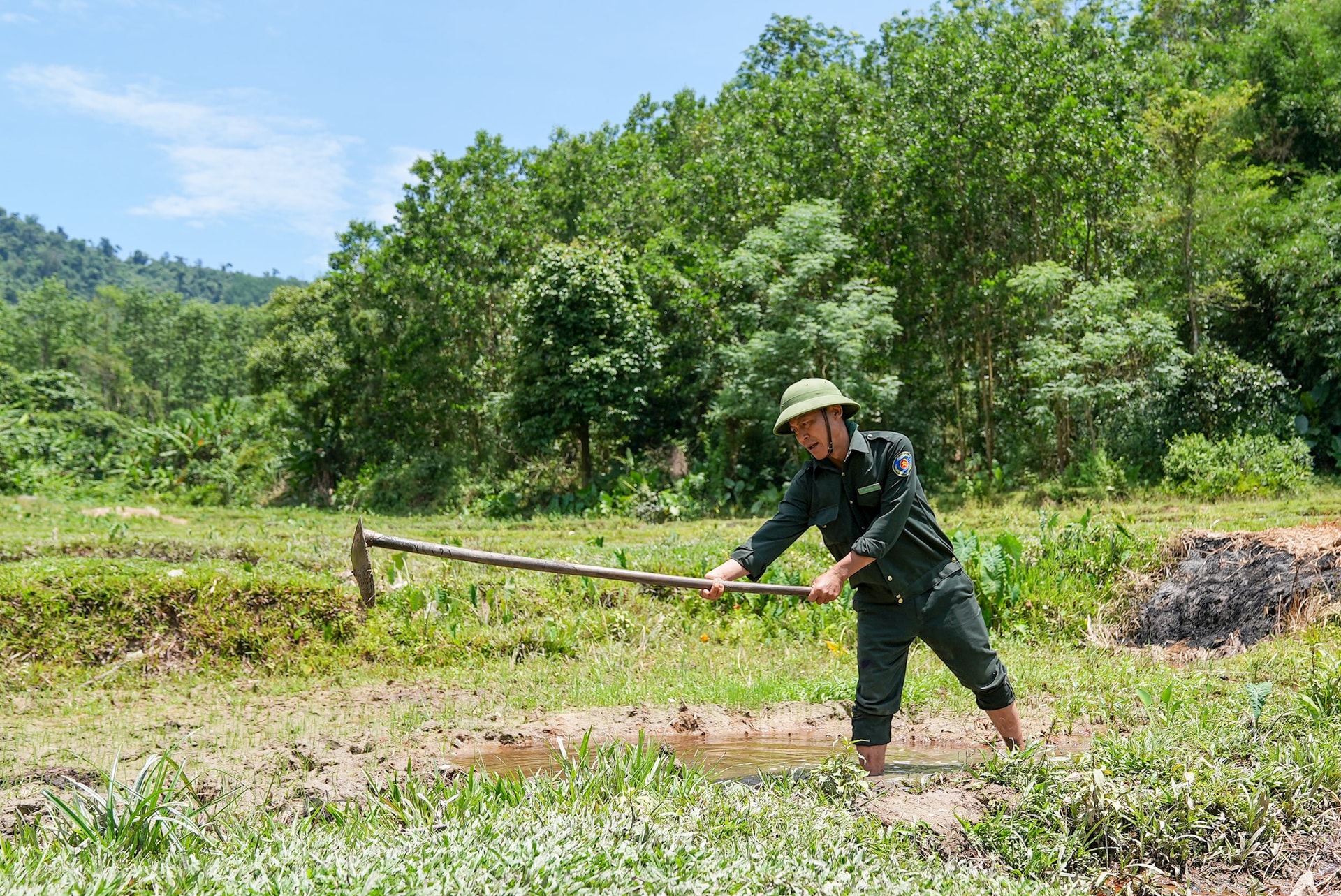
Bringing livelihoods back to the village.
Mr. Ngo Quang Trung, the forest protection team leader at checkpoint 3, Tra Giac commune ( thuộc the Bac Tra My Protective Forest Management Board), has been involved in forest protection work for many years.
In the past, when forest management and protection were lax, most people relied on the forest for survival. They used the wood to build houses, then cleared and burned the forest to cultivate rice paddies and plant acacia trees.
"When I was young, due to a lack of awareness, I used to herd buffalo for illegal loggers, then I would lead buffalo to pull timber out of the forest for hire, and transport timber for sale. The destruction of the forest and the flash floods that swept through the village made me reconsider my actions; if I did something wrong, I must know how to correct it," Mr. Trung shared.
Living locally, Mr. Trung witnessed countless instances of deforestation. Since 2005, he has been familiar with the area, providing forest rangers with information about suspicious individuals entering and leaving the forest, as well as areas at risk of deforestation. Thanks to his knowledge of the trails and paths used by illegal loggers, he guided forest rangers in raids and dismantled many violations. He worked quietly, without pay, but Mr. Trung felt a great sense of relief.
"The core issue remains the people's livelihoods. Previously, the people still heavily relied on slash-and-burn farming, which involved clearing and burning the land to sow seeds. Some seasons were good, some were bad, and poverty was a vicious cycle. Malicious individuals exploited this weakness to entice people to participate in deforestation," Mr. Trung said.
More than five years ago, he donned the uniform of a specialized forest protection force when he was recruited by the Bac Tra My Protective Forest Management Board. In charge of Hamlet 3 – a "hot spot" for deforestation with dozens of cases each year – Mr. Trung proposed that the forest management support the people in reclaiming land to cultivate wet rice. He believed that only when people had enough to eat would the mindset of relying on the forest for sustenance come to an end.
“As a respected figure in the village, for many years I have been encouraging villagers not to abandon their fields and to maintain rice cultivation to ensure food security. For households facing difficulties, I am willing to contribute labor and use my own money to buy seeds to support them. In some areas that are difficult to plow, I buy or obtain equipment and components to assemble plows for the villagers to use. But my resources are limited, and I cannot create a strong shift in the villagers' awareness, while there is still a lot of abandoned land…” – Mr. Trung lamented.
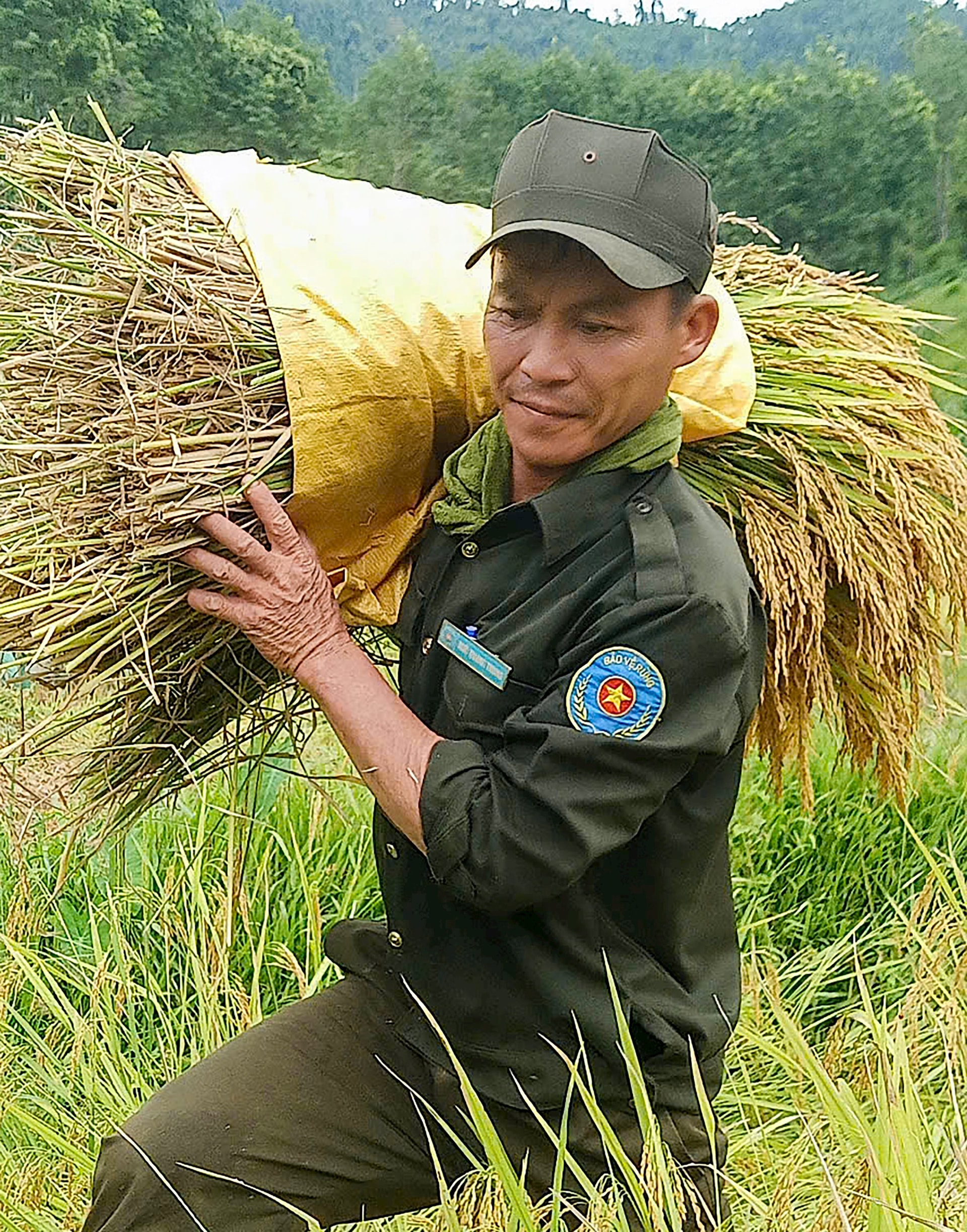
Fortunately, the forest owner where Mr. Trung worked strongly supported this approach, readily providing funding and manpower to transform the area. He was assigned the task of implementing the model, and received support and cooperation from the people of Hamlet 3.
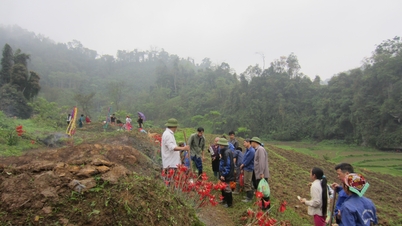
Of the nearly 2.5 hectares of reclaimed rice land, Mr. Trung still remembers the happy faces of the people of Hamlet 3C (Tra Giac Commune) when 8,000 square meters in the Suoi Nua area, Lang Hanh Phuc, were planted with rice in 2024. That was the first time the Ca Dong people there knew how to cultivate wet rice.
"The villagers live near the old-growth forest, but for a long time they only knew how to cultivate rice in the fields. Moving their livelihoods away from the forest is very important. I am continuing my survey to expand the agricultural land in this village," Mr. Trung said.
Eyes and ears protect the forest.
Today, the local people have become invaluable "eyes and ears" for the forest protection force, but Mr. Trung is not complacent because wildfires are unpredictable, especially in the context of increasingly harsh weather during the dry season.
“I remember the forest fire in the area a few years ago, caused by people burning fields. The flames, under the summer sun, spread rapidly, igniting adjacent acacia and rubber plantations. To prevent the fire from spreading into the forest, we had to battle the smoke and flames for several days straight. Now, during the dry season, the forest protection force doesn't dare to be negligent or rest for a single day,” Mr. Trung recounted.
With this year predicted to be extremely hot, Mr. Trung and the members of his outpost have intensified patrols and forest monitoring. This year, the wild mango season is in full swing in the old-growth forests. "The more people entering and leaving the forest to collect wild mangoes, the higher the risk of deforestation and forest fires," Mr. Trung worried.
Previously, the slopes of Tra My mountain were covered in vibrant yellow acacia trees. However, destructive exploitation methods such as pruning and felling have led to a significant decrease in the number of acacia trees. Faced with this situation, Mr. Trung went to each village, urging people to protect their livelihoods, only gathering acacia trees and not listening to those who incite them to cut down acacia trees. This act not only destroys the forest species and carries criminal charges, but also deprives future generations of their livelihoods.
"It's not easy for a seed to immediately grow into a forest. From now on, forest conservation must be done from the roots, from the trees to the birds... This responsibility doesn't just belong to the forest protection force, but needs to be awakened in the community's awareness," Mr. Trung expressed.
Source: https://baoquangnam.vn/ong-trung-tra-no-rung-xanh-3157379.html
![[Photo] Prime Minister Pham Minh Chinh receives the Chinese Ambassador to Vietnam](https://vphoto.vietnam.vn/thumb/1200x675/vietnam/resource/IMAGE/2026/04/05/1775397481797_ndo_br_dsc-5512-jpg.webp)



































































![[INFOGRAPHICS] Exploiting children's personal images for profit can result in fines of up to 50 million VND.](https://vphoto.vietnam.vn/thumb/402x226/vietnam/resource/IMAGE/2026/04/06/1775442200854_1775442148.webp)
















Comment (0)