

Developing inland waterways – a sustainable solution to reduce Vietnam's logistics costs.
Increasing investment in waterway transport by 2-3% per year (reaching 5-7% of total investment in transportation) would bring significant economic benefits because the average cost per ton-kilometer of road transport is 3-5 times higher than that of inland waterway transport.
 |
| Dr. Bui Thien Thu – Professor at Okayama University (Japan), Director of the Vietnam Inland Waterways Administration. |
Recently, public and private sector investment in infrastructure in Vietnam reached 5.7% of GDP, the highest in Southeast Asia and the second highest in Asia, after China (6.8% of GDP).
Currently, the country has approximately 595,000 km of roads (including 2,021 km of expressways), 3,143 km of railways, 34 seaports with over 100 km of wharves, 1,015 ships with a total tonnage of 10.7 million tons (ranking 3rd in ASEAN and 27th in the world ); and 16 inland ports (11 have been announced, and 5 ICDs have been planned as inland ports).
The inland waterway sector currently has over 17,000 km of waterways usable for inland waterway transport, with 310 ports, more than 6,000 inland waterway terminals, 270,000 inland waterway vessels, nearly 3,000 coastal vessels, and 352 inland waterway shipbuilding facilities.
To achieve the breakthrough goal of infrastructure development, in 2023 and 2024, Vietnam added 312 km of expressways, with the target of 3,000 km expected to be completed by 2025.
In the aviation sector, the National Assembly recently approved adjustments to the investment plan for the Long Thanh International Airport Project; and approved the investment plan for the high-speed railway project on the North-South axis.
In the field of inland waterways, the Ministry of Transport has coordinated with other ministries, sectors, and localities to complete and put into operation the canal connecting the Day River with the Ninh Co River, and is currently signing a loan agreement for the Project to Develop Inland Waterway and Logistics Corridors in the Southern Region (expected to commence in Q3/2025).
In the maritime sector, the Ministry of Transport and local authorities are currently accelerating the investment in Lien Chieu Port and dredging many important shipping channels such as: the Cai Trap Canal channel project, the Rach Gia channel, Hai Phong channel (Lach Huyen section), Hai Thinh channel, Cua Lo channel, Da Nang channel, Sa Ky channel, Soai Rap channel, Saigon - Vung Tau channel; the Hau River channel for large-tonnage ships; completing and putting into operation the project to renovate and upgrade the shipping channel to the ports in the South Nghi Son area; completing construction and currently adjusting the project for 3 construction packages of the Cai Mep - Thi Vai channel upgrade project…
Congestion at seaports poses a risk of increased logistics costs.
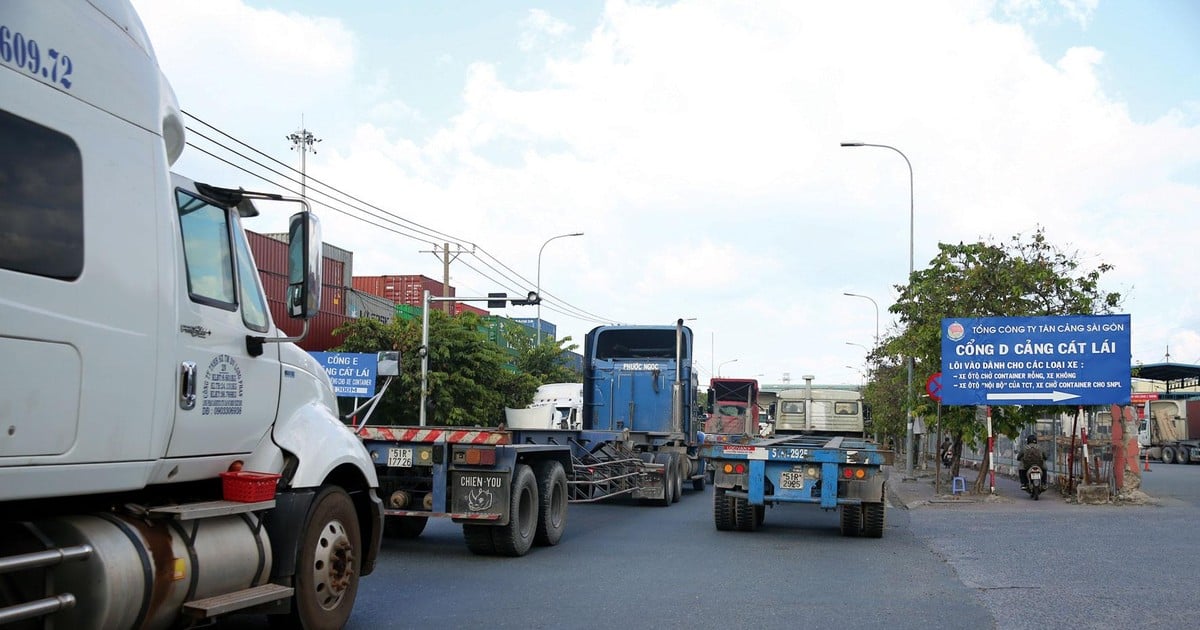 |
| Traffic congestion on the road leading to Cat Lai Port – Ho Chi Minh City. |
With the current state of logistics infrastructure mentioned above, it basically meets the increasing transportation needs serving the socio-economic development of the country; however, the connectivity between different modes of transport is not good, especially between road, waterway, and seaport transport.
Specifically, currently, while we have virtually no railway lines connecting to seaports, the connection between road transport and major seaports (Hai Phong, Quang Ninh, Ho Chi Minh City, Ba Ria - Vung Tau) is very congested, especially at the Cat Lai port area in Ho Chi Minh City.
According to a study by the United States Agency for International Development (USAID): In 2021, an average of 16,400 trucks arrived at Cat Lai Port daily, with trucks potentially waiting up to 3 hours before reaching the gate, causing traffic congestion along the connecting roads to the port. If lined up in a single row, these 16,400 trucks would stretch for 322 km… USAID also predicts that by 2030, the volume of containers passing through Cat Lai Port will double.”
Not only the Cat Lai port area in Ho Chi Minh City, but according to forecasts, the volume of goods handled through Vietnam's seaport system is expected to double by 2030 compared to the present time. Specifically: Hai Phong seaport will increase 2.2 times (reaching 67.6 million tons in 2023, projected to reach 215 million tons in 2030); Ho Chi Minh seaport will increase 1.5 times (reaching 165.4 million tons in 2023, projected to reach 253 million tons in 2030); and Ba Ria - Vung Tau seaport will increase 2.1 times (reaching 112.7 million tons in 2023, projected to reach 236.9 million tons in 2030).
Currently in Vietnam, average logistics costs are equivalent to 16.8-17% of GDP, which is still quite high compared to the global average (around 10.6%). With the aforementioned rate of increase in cargo volume, if logistics infrastructure and connectivity between different modes of transport are not improved, they will not be able to meet transportation demands. Congestion on routes leading to major seaports will become increasingly serious, and logistics costs could increase even further than they are now, unless long-term, sustainable transportation solutions are implemented.
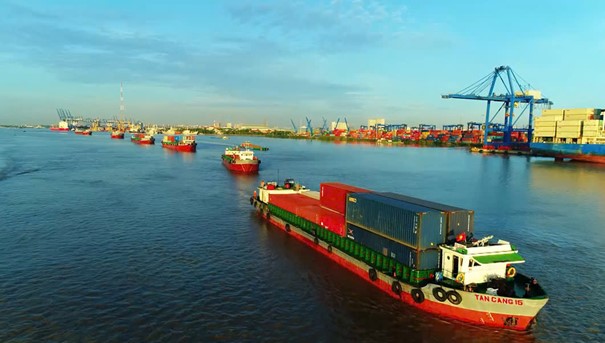 |
| Container transport by barge – a solution to reduce congestion at seaports. |
Inland waterway transport – a sustainable solution to reduce logistics costs.
Currently, transportation accounts for 60% of total logistics costs; therefore, improving logistics infrastructure to meet transportation needs is essential to reduce logistics costs in Vietnam.
However, expanding and upgrading road and rail infrastructure to meet current and future transportation needs up to 2030 requires significant state budget investment (according to the plan approved by the Prime Minister, the capital investment needed for transportation infrastructure in 5 transport sectors is approximately 2,100-2,200 trillion VND, of which: road transport accounts for approximately 900,000 billion VND; and rail transport accounts for approximately 240,000 billion VND).
Meanwhile, our country is blessed with a system of rivers and canals, along with coastal shipping routes running the length of the country, making it very convenient for developing inland waterway transport.
With advantages such as high-volume transport, low costs, and contributions to reducing road maintenance and management costs, alleviating traffic congestion, minimizing traffic accidents, and improving environmental pollution (IMO statistics show less than 3% CO2 emissions), inland waterway transport currently handles approximately 20% of goods transported in Vietnam.
According to the World Bank, this proportion is very high compared to the world average (in China, the European Union, and the United States, it is only about 5-7%).
Many waterway transport routes are playing a very good role, contributing significantly to reducing the burden on road transport, such as: the coastal transport route with a throughput of nearly 100 million tons/year, effectively contributing to reducing accidents and congestion on the North-South road axis; the container transport route connecting Ho Chi Minh City seaport with Cai Mep - Thi Vai seaport, with more than 70% of the container volume passing through Ba Ria - Vung Tau seaport being transported by barge.
In particular, the international waterway connecting Phnom Penh, Cambodia, with the seaports of Ho Chi Minh City and Ba Ria - Vung Tau, spanning over 400 km, has handled 30 million tons of goods and nearly 1.6 million passengers. Container traffic on this route has increased by an average of 20% per year, reaching over 430,000 TEUs in 2023.
In addition, container transport on inland waterway corridors in the North, although still low in market share, has seen many positive changes recently: the Hai Phong - Bac Ninh route has increased from 3 trips/week in 2018 to 35 trips/week now; the Ninh Binh - Hai Phong route, newly launched at the beginning of 2024, has reached 4 trips/week.
From the above analysis, it can be seen that one of the long-term, sustainable solutions to reduce logistics costs is to increase investment and remove policy obstacles to promote the development of inland waterway and coastal transport using river-sea hybrid transport (VR-SB).
It should be added that inland waterways are a sector with a high proportion of non-state budget capital mobilization (approximately 82%). However, to promote private investment, public investment must act as "seed capital" to improve the signaling system, shipping channel infrastructure, and increase the clearance of bridges crossing rivers, etc. Then, private investment will develop a modern fleet of waterway vessels and a system of ports and wharves to meet transportation needs, especially ports and wharves for container handling.
According to a World Bank study: “If the proportion of investment in road infrastructure is reduced by 2-3% per year, it will not significantly impact transport efficiency. However, if investment in waterway transport is increased by 2-3% per year (reaching about 5-7% of total investment in the transport sector), it will have a very strong impact on the growth of inland waterway transport, bringing enormous economic benefits to the nation, because the average cost per ton-kilometer of road transport is 3 to 5 times higher than that of inland waterway transport.”
In addition to increasing investment budgets for inland waterway infrastructure, several policies also need attention to address obstacles in the development of inland waterways, including: adding bridges and wharves specifically for inland waterway vessels at seaports and dry ports (this could be included as a condition during investment and announcement); for provinces and cities experiencing severe congestion on routes leading to ports (such as Ho Chi Minh City), policies are needed to exempt or reduce fees to alleviate congestion, traffic accidents, and environmental pollution.
In fact, Hai Phong City and Ho Chi Minh City have already reduced port infrastructure fees by 50% for goods transported by waterway, and Ho Chi Minh City has waived 100% of port infrastructure fees for goods transported by barge on the Vietnam-Cambodia Agreement waterway.
In addition, localities could also research and issue policies to support waterway transport businesses when transporting goods by barge to and from seaports located within their jurisdiction, similar to the policies supporting shipping companies opening container shipping routes to and from ports, as implemented by the provinces of Ha Tinh, Thanh Hoa, Nghe An, and Thua Thien Hue.
Accordingly, at Chan May port – Thua Thien Hue, shipping companies/shipping agents that unload or load cargo at Chan May port on a route with a minimum frequency of two arrivals per month will receive a subsidy of VND 210,000,000 per arrival.
Businesses exporting or importing goods in containers to/from Chan May port (excluding temporarily imported goods for re-export and transit goods) will receive support at a rate of VND 800,000 per 20-foot container and VND 1,100,000 per 40-foot container.
Simultaneously with increasing state budget investment in the development of inland waterway transport infrastructure and implementing solutions to promote the development of waterway transport as mentioned above, solutions to attract capital from the private sector need to be given more attention to enhance connectivity between transport modes in order to achieve the goal of reducing logistics costs to match the world average, thereby increasing the competitiveness of Vietnamese goods and promoting the development of the economy.



![[Photo] Prime Minister Pham Minh Chinh receives the Director of RMIT University Melbourne (Australia)](https://vphoto.vietnam.vn/thumb/1200x675/vietnam/resource/IMAGE/2026/04/02/1775142120087_thiet-ke-chua-co-ten-2026-04-02t214220784-png.webp)










































































Comment (0)