

Thanks to the success of the microsurgical vascularized periosteal flap transfer surgery, after 6 years of continuously wearing a splint and cast, unable to walk on her own and having to completely depend on her parents in all activities, the girl NL (7 years old, Ninh Binh ) with congenital tibial pseudoarthrosis was able to walk on her own two feet.
Baby NL was found to have congenital pseudoarthrosis of the tibia when he was just a toddler. This is a rare disease that may be related to genetic factors, especially in families with people with neurofibromatosis type 1.
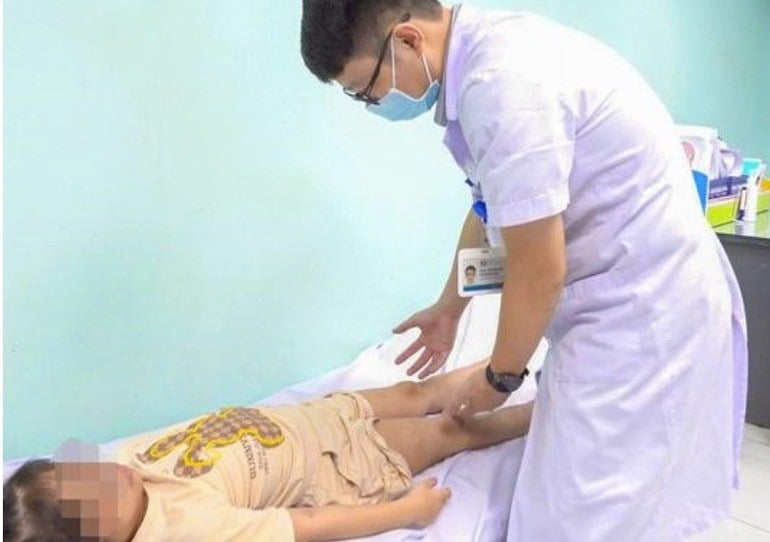 |
| The patient is being treated at the medical facility. |
In children with the disease, the tibia develops abnormally, is easily broken and is very difficult to heal; the curvature increases, leading to shortened limbs, deformities and a sharp decrease in mobility.
At the National Children's Hospital, doctors from the Orthopedic and Rehabilitation departments examined, consulted and treated conservatively with orthopedic braces to minimize bone deformities.
Before coming to the new technique, the child had undergone 3 different surgeries such as cutting the artificial joint socket, autologous bone grafting, and allografting combined with bone fixation. Despite the improvement, the bone still could not heal as expected.
Dr. Hoang Hai Duc, Head of the Orthopedic Department, National Children's Hospital, said that congenital tibial pseudoarthrosis is one of the most difficult diseases to treat in pediatric orthopedic trauma. The older the child, the weaker and more curved the bones become.
“If not treated effectively, the risk of severe limb shortening, deformity or disability is very high. After evaluating the entire previous treatment process, we decided to approach a new method of grafting a vascularized periosteal flap to reconnect the child's bones,” Dr. Duc shared.
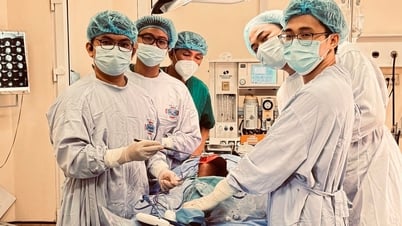
This technique uses a vascularized tibial periosteal flap from the healthy leg to transfer to the damaged leg. Before grafting, the surgeon removes the prosthetic socket and all the diseased periosteum, then fixes the tibial prosthesis with screws. Next, the vascularized periosteal flap is grafted to the diseased bone site using microsurgery, connecting small blood vessels to ensure the graft is nourished.
The surgery lasted 4.5 hours continuously, requiring absolute precision and close coordination between many specialties. The doctors had to carefully calculate each incision, the direction of dissection, how to preserve the flap's blood vessels and at the same time thoroughly remove the diseased bone.
Previously, the Orthopedic Department of the National Children's Hospital had a lot of experience in complex microsurgical techniques such as nerve grafting to treat nerve plexus injuries and lymphatic flap grafting to treat lymphedema of the limbs. This was an important foundation that helped the team confidently carry out this successful transplant.
After 6 weeks, X-rays showed that the bone callus was well formed, the new bone regenerated strongly and the prosthetic socket was firmly compensated. Compared with previous surgical methods, the speed and quality of bone healing were clearly superior.
By the 9th week, the patient's cast was removed and he began to walk again. Currently, NL can walk independently, go to school by himself and participate in activities with friends like other children.
The patient’s mother emotionally shared that for the past 6 years, her parents had to carry her wherever she went; they had to take her to school 4 times a day; all of her personal activities were extremely difficult. “Seeing her being able to walk by herself and play with friends, I still feel like I’m in a dream,” she choked up.
The success of the surgery marks an important step forward for the medical team at the National Children's Hospital in mastering advanced microsurgical techniques in the world .
According to experts, NL’s recovery journey is a great source of encouragement for children with congenital tibial pseudoarthrosis. From this result, many families will be given more confidence to persevere with treatment, helping children have the opportunity to have healthy legs, to walk, live and study normally like their peers.
Source: https://baodautu.vn/phep-mau-cho-be-gai-bi-benh-xuong-hiem-gap-de-doa-doi-chan-d440199.html
![[Photo] Dan Mountain Ginseng, a precious gift from nature to Kinh Bac land](/_next/image?url=https%3A%2F%2Fvphoto.vietnam.vn%2Fthumb%2F1200x675%2Fvietnam%2Fresource%2FIMAGE%2F2025%2F11%2F30%2F1764493588163_ndo_br_anh-longform-jpg.webp&w=3840&q=75)

























































Comment (0)