

Deteriorating infrastructure
Currently, Hanoi has approximately 540 traditional markets. This market model caters to over 50% of the shopping needs of residents in the inner districts and about 70% of those in the suburbs. However, many traditional markets are now severely dilapidated, failing to meet safety and hygiene standards, fire prevention requirements, and commercial etiquette, resulting in a significant decline in customer traffic.
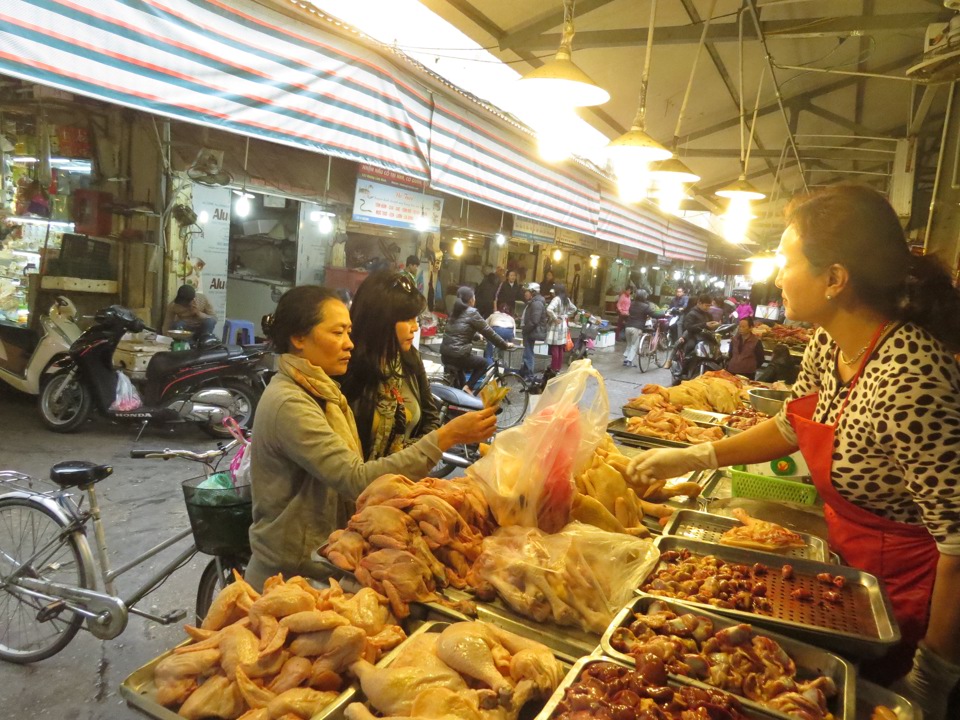
For example, Cau Giay Market (Cau Giay District), once a bustling market with over 200 vendors occupying two floors, now only has nearly 30 vendors on the first floor. Similarly, Kim Lien Market (Dong Da District), a third-class market with a space of only about 1,000 square meters, has 199 business stalls. To date, after decades of operation, the entire market has seriously deteriorated, and the vendors all hope for renovation or reconstruction to attract more customers.
To renovate and upgrade traditional markets, the Hanoi People's Committee has issued a plan to implement investment targets for the construction and renovation of markets in the city for the period 2024-2025. Accordingly, the city will invest in building 17 new markets and renovating, repairing, and upgrading 21 existing markets. According to Ms. Nguyen Kieu Oanh, Deputy Director of the Hanoi Department of Industry and Trade, the department has coordinated with relevant departments and agencies to resolve difficulties and obstacles in the investment, construction, and renovation of markets. To date, Hanoi has completed the construction and put into operation four markets: Phu Do Market (Nam Tu Liem District), Dong Tam Market (Hai Ba Trung District), Tram Troi Town Center Market (Hoai Duc District), and Chau Long Market (Ba Dinh District).
We request that the Department of Planning and Architecture expedite the development of the detailed market development plan at a scale of 1/500, thereby providing a basis for the locality to attract businesses to invest in the construction and renovation of traditional market systems in the area.
Chairman of the People's Committee of Dan Phuong District , Nguyen Van Duc
Regarding market renovation and upgrading, as of October 2024, districts and towns had completed the renovation of 19 out of 38 markets. It is expected that by the end of 2024, Hanoi will complete the construction of 4 more markets. By the end of 2025, it is expected that 2 more new markets will be built in Bac Tu Liem and Nam Tu Liem districts, and 10 more markets will be renovated.
Shortcomings in attracting capital for market renovation.
In reality, although the Hanoi People's Committee has focused on upgrading and renovating traditional markets, many shortcomings remain in the implementation process. The Nga Tu So Market (Dong Da District), built in 1987 with an area of over 8,500 square meters and considered a Class 1 market, has deteriorated to an alarming degree.
According to the city's plan for the 2021-2025 period, the Nga Tu So market was included in the list of new construction projects. However, it remains in its current state despite the delegated authority to invest in markets being assigned to the district level, which is allowed to use public investment funds. This is because, according to regulations on investment, the district level is allowed to use public investment funds for "community markets." However, community markets are classified as category 3 markets, making it difficult for category 1 markets like Nga Tu So market to access budget funds.
Not only is the Nga Tu So market facing difficulties in its renovation and reconstruction, but many other market construction and renovation projects in Hanoi are in a similar situation. The reason is that many localities are encountering obstacles in meeting criteria for commercial infrastructure, especially those building advanced new rural areas and striving to become districts. Nguyen Kieu Oanh, Deputy Director of the Hanoi Department of Industry and Trade, shared that the implementation of market planning is currently slow. The transformation of market models also faces many difficulties; while there is a desire to switch to a socialized model, it cannot be handed over to businesses because the land remains public land, leading to difficulties in resolving procedures for land allocation and leasing for markets after transformation. Furthermore, Decree No. 167/2017/ND-CP discourages businesses from participating in investment.
Furthermore, regulations stipulate that new constructions are limited to 60% of the market density, with the remainder allocated to auxiliary facilities and green infrastructure. This makes it impractical to allocate 100% of vendors to the ground floor, and it's unlikely that more than 50% of vendors would agree to rebuilding the traditional market system.
According to Phung Ngoc Son, Vice Chairman of the People's Committee of Nam Tu Liem District, although the State has agreed to use budget funds to invest in the construction of the market, the implementation process has encountered many difficulties, especially the limited land lease fees, which have not encouraged investors to boldly invest as called for by the city. "The Department of Construction has provided guidance to resolve these issues because there are many bidding document templates. We can apply methods such as auctioning public assets, bidding for joint ventures with state management, or bidding for the management and operation part, rather than allocating land, as land use certificates are currently not issued..." - Mr. Phung Ngoc Son suggested.
According to Nguyen Van Duc, Chairman of the People's Committee of Dan Phuong District, residents in the district currently need to exchange and sell agricultural products with neighboring localities, but there is no wholesale market to serve this need. The reason is that the Department of Planning and Architecture has not yet developed a 1/500 scale plan for the market system, so the locality cannot yet socialize investment capital.
A mechanism is needed for businesses.
To attract businesses to invest in renovating traditional market systems, economic experts suggest building a transparent mechanism for businesses. Conversely, businesses investing in market renovation should design them to be functionally appropriate.
To address the difficulties in renovating and rebuilding market systems, Deputy Director of the Department of Industry and Trade Nguyen Kieu Oanh proposed that the Ministry of Finance provide support mechanisms such as exemptions and reductions in land rent, and preferential interest rates on loans for market construction investments… for businesses participating in the investment, construction, management, and operation of markets. At the same time, she requested that the Ministry of Industry and Trade provide clearer regulations regarding the rights and responsibilities of business households in each case of assigned or leased business space, as well as how to handle cases where business space lease contracts have been signed and rent has been paid in advance for market construction… Hanoi City should consider allocating public investment funds in the market sector to ensure funding for market renovation according to the list and criteria set out in the City Party Committee's programs.
Based on the Long Bien Market renovation model, Nguyen Trong Nghia, Head of the Long Bien Market Management Board (Ba Dinh District), believes that local markets only need moderate investment, ensuring convenience and appropriate fees so that traders can continue their business. Initially, partial renovations can be carried out to ensure fire safety and food hygiene. Regarding market renovation and upgrading, architect Tran Huy Anh of the Vietnam Architects Association also stated that traditional markets have always been located in convenient locations to attract customers and facilitate buying and selling. However, many investors have renovated markets into "complexes" of markets and apartment buildings or markets and offices for rent, thus failing to attract traders. Therefore, to attract businesses, investors must restore the original function of the market during renovation to create a highlight for urban architecture. In addition, the opinions of the small business community and residents should be solicited regarding the renovation plan, and this feedback should be used as a basis for making appropriate adjustments.
Traditional markets still ensure the supply of 80% of fresh produce for the people, providing outlets for agricultural production. To make traditional markets attractive to consumers, the first step is to renovate them with clear and transparent planning; establishing standards and criteria for building civilized markets, training market staff, organizing product sourcing, and displaying prices…
Former Chairman of the Hanoi Supermarket Association , Vu Vinh Phu
Source: https://kinhtedothi.vn/cai-tao-cho-truyen-thong-phu-hop-voi-doi-song-dan-sinh.html
![[Photo] National Assembly Chairman Tran Thanh Man takes the oath of office](https://vphoto.vietnam.vn/thumb/1200x675/vietnam/resource/IMAGE/2026/04/06/1775453300886_ndo_br_1-2229-jpg.webp)


![[Photo] Da Nang: A sea of people respectfully paying homage to the Bodhisattva Avalokiteshvara.](https://vphoto.vietnam.vn/thumb/1200x675/vietnam/resource/IMAGE/2026/04/06/1775454198203_ndo_br_lh24-jpg.webp)














![[Photo] Sidewalks in Vung Tau ward are now more spacious.](https://vphoto.vietnam.vn/thumb/1200x675/vietnam/resource/IMAGE/2026/04/06/1775455388046_5-6796-jpg.webp)






















































Comment (0)