

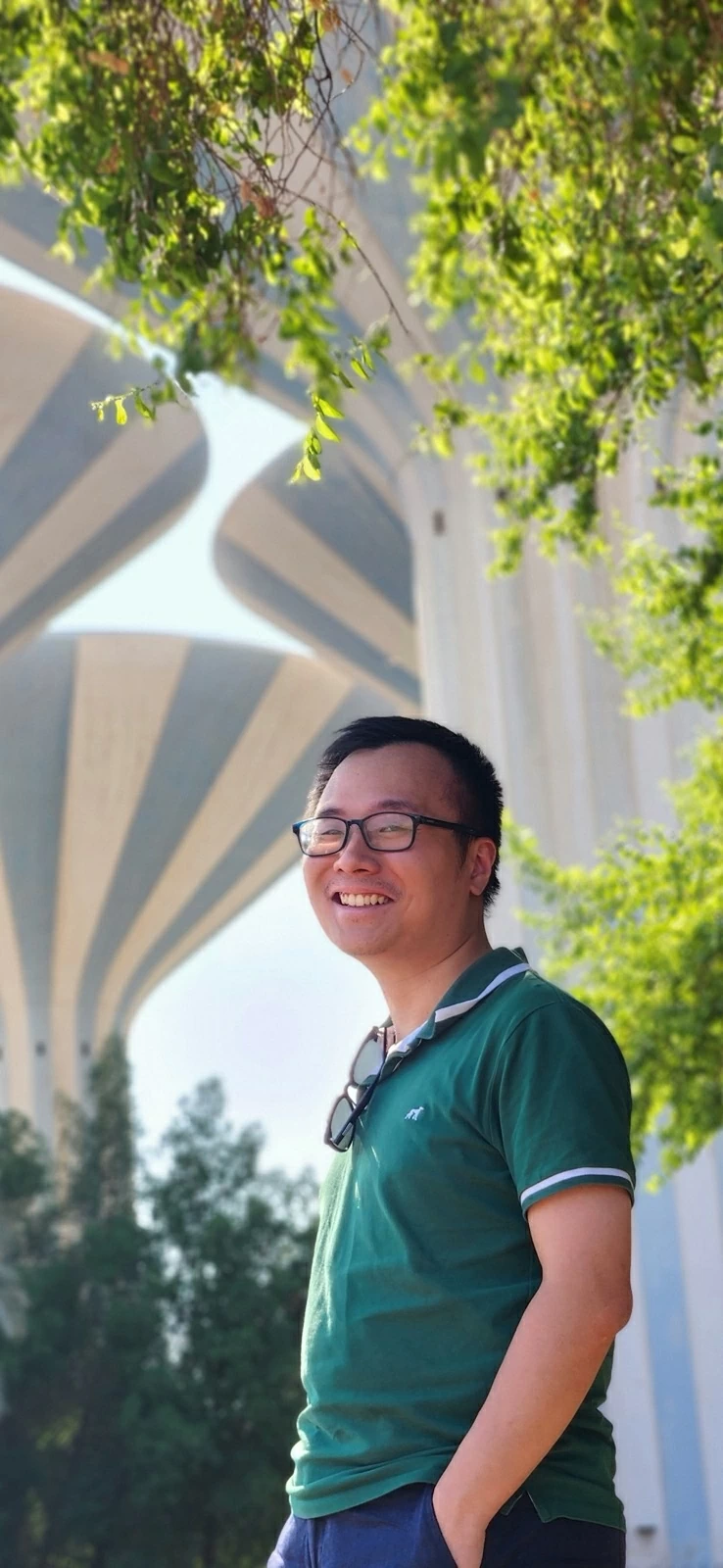
 |
| Mr. Nguyen Huu Duc. (Photo courtesy of the photographer) |
The story about the weather
Let's begin with a story about the weather. In Kuwait, stories about the weather aren't just for starting conversations; people can chat about the weather for an entire coffee break if they want.
Kuwait has the typical weather of a Gulf nation. That is, as the hot summer draws to a close, you'll experience a rare touch of humidity while walking near the coast, or perhaps be invited to eat at a restaurant along the Arabian Gulf Road – the coastal road of the capital region.
In Kuwait, the transition from summer to winter is, of course, accompanied by autumn. However, that autumn might only last for five days, or at most, a little over two weeks. During that rare period, Kuwait becomes a truly livable country – sunny but not too hot, windy but not too cold, with temperatures ranging from 25-32 degrees Celsius, making it incredibly pleasant to go out and enjoy the city. In Kuwait, the City Council has built a vast park near the high-rise commercial buildings; it's an ideal place for people to exercise, enjoy some rare greenery, and, if they wish, have a meal near an artificial lake where the water fountain show starts at 7 pm.
As October passes and the cold season begins, mosques across the country hold a day of prayer for rain (usually on a Saturday) to seek balance in the climate. The first rains may come shortly after the prayer, or may not arrive until the beginning of the following year. A light drizzle is fine, but a heavy downpour means students nationwide will certainly have a day off from school. The Kuwaiti Ministry of Education is responsible for making decisions about school closures due to bad weather, and this monitoring is sometimes real-time; parents have occasionally received two or three notifications from schools in a single evening, each contradicting the previous.
As the cold season gradually comes to an end, people start thinking about escaping the heat. Outdoor events and activities always have specific summer schedules – some places may be temporarily closed for 3-4 months due to unforeseen circumstances. At work or during the summer holidays, you'll hear and be asked a lot about your travel plans. Kuwaitis automatically understand that administrative procedures will be slower in the summer, as even something as simple as going outside requires a high degree of determination when temperatures sometimes exceed 50 degrees Celsius.
Along with other weather patterns such as sandstorms and freezing temperatures, the cycle of sunshine and rain has a significant influence on daily life, creating many intriguing stories in Kuwait. After all, the country has also done something truly unique in the world by deciding to change Independence Day from June 19th to February 25th, citing one of the reasons for the change as "to avoid the extreme heat of summer."
The story of word of mouth
The intrigue of Kuwait existed and was recounted long before the advent of the internet, social media, and messaging apps. Diwaniya (community gatherings) – a distinctive cultural feature that Kuwait has best cultivated – embody how Kuwaitis tell the stories of events that occurred during a day, a month, a year, or even a period of history.
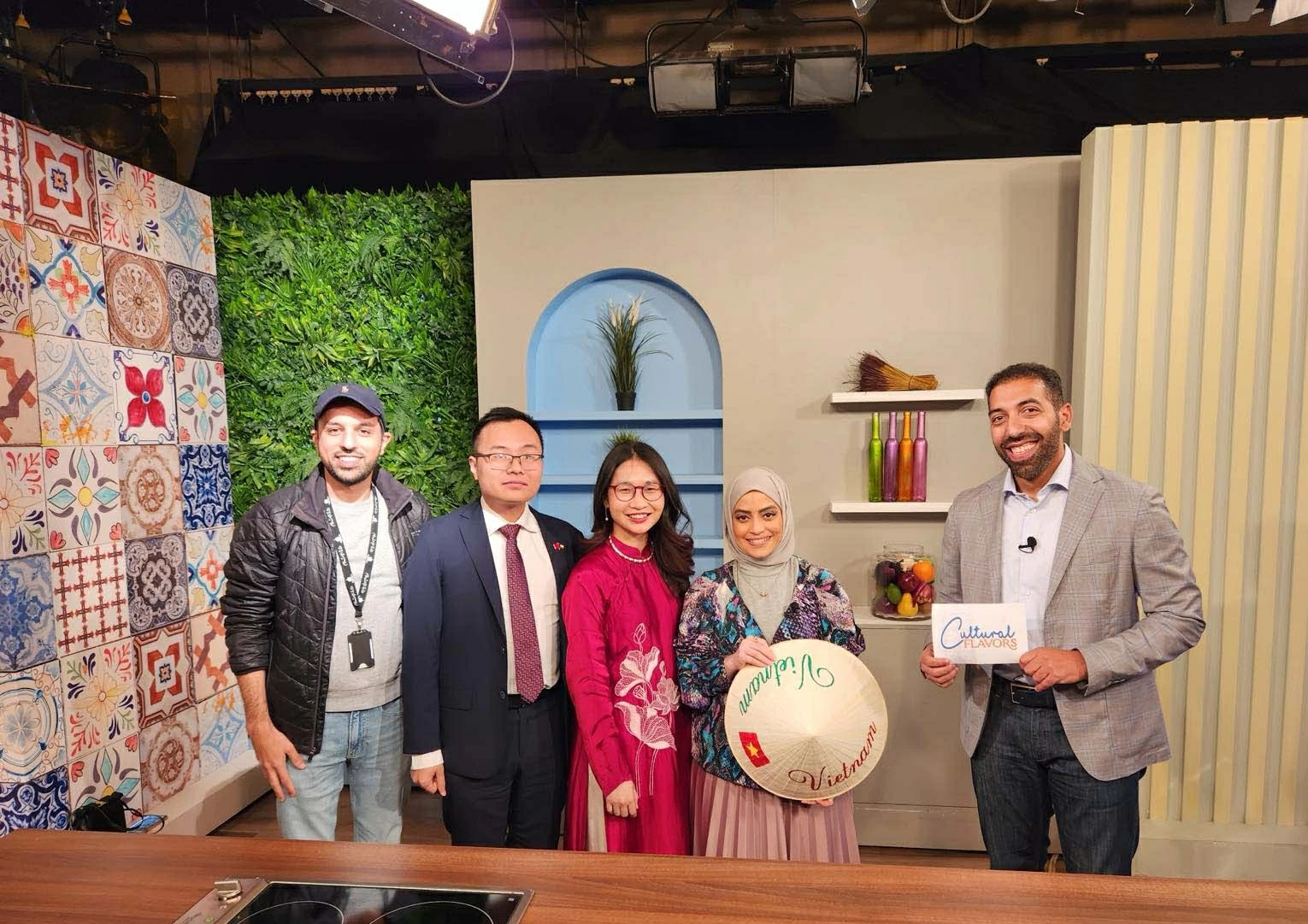 |
| Mr. Nguyen Huu Duc participated in a program introducing Vietnamese culture on Kuwait Television. (Photo courtesy of the broadcaster) |
Foreigners and Kuwaitis alike agree that this is a “word-of-mouth culture.” In this culture, every element is a link in a chain, spreading from one person to ten, and from ten to a hundred. Imagine a new office worker with juicy gossip about a newly opened entertainment venue, or a nasty colleague; he or she might tell their friends at a dinner party in the Mubarakiya district, tell relatives at a diwaniya at an uncle's house in the same “block” (a district-level administrative unit in Kuwait), or simply tell the taxi driver after work. This cycle will be repeated at least two or three more times before the person involved is aware of what has been spread.
Word-of-mouth is a double-edged sword, as no one knows how far or for how long a story can travel. The positive aspects of word-of-mouth are currently being fully utilized by the diplomatic corps in Kuwait in their foreign relations activities – during the Ramadan fasting month, diplomatic officials are sent on numerous evening diwaniya (meetings) to gather information about the local situation, promote the potential for cooperation, investment, and tourism of the country they represent, and build networks.
The most striking illustration of Kuwait's word-of-mouth influence is the way parliamentary candidates operate during elections. Journalists and influential figures are invited to numerous events to gather information about what a candidate will do once they have a seat in Parliament. A plethora of radio programs, podcasts, and live videos on social media appear during the campaign period to influence young people – who make up half the country's population; through these channels, young people have "material" to discuss and make their own decisions.
One positive aspect of Kuwait is that, no matter how advanced modern technology becomes, oral culture still thrives in the country. Perhaps it reminds people of all ages, social classes, and positions that human connection is incredibly important, maintaining the unity of a society and a nation.
The story of pride
This year marks an even-numbered anniversary for Kuwait, as the country will celebrate its 65th Independence Day and 35th Liberation Day on February 25-26.
Patriotism has recently been frequently mentioned in speeches by the royal leader, the Prime Minister of Kuwait, and government officials. The country's development has not always been smooth sailing, as continuous political upheaval in recent years has significantly impacted the implementation of infrastructure projects as well as major projects in the financial and commercial sectors.
 |
| A military band performance celebrating Kuwait's Independence and Liberation Day in 2025. (Photo courtesy of TGCC) |
In this context, Emir Sheikh Meshal Al-Ahmad Al-Jaber Al-Sabah, who will turn 86 this year, plays a symbolic role in encouraging the development of the Kuwaiti people. Since taking office at the end of 2023, "national identity" has been a phrase he frequently emphasizes when referring to the Kuwaiti people's participation in building the nation. Conversely, the people of Kuwait – the most devout Muslims in the region – always remember their Emir as a wise, intelligent, and extremely decisive leader in all his actions and words, all for the development and stability of their country.
During major holidays, the pride of the Kuwaiti people is even more evident in how they use the flag's colors to decorate many places. Besides the current flag with its four colors—black, green, white, and red—Kuwaits also display the traditional flag with red and the word "Kuwait" neatly written in Arabic on it. Shopping malls, shops, parks, schools, and even many homes are covered with positive messages of patriotism.
This year, Kuwait's National Day and Independence Day celebrations fall during Ramadan. And as the Gulf nation diversifies its economy through tourism development, the past few months have seen several notable events in Kuwait, most recently the 2025 French Super Cup match between PSG and Marseille. Large crowds flocked to the Jaber Al-Ahmad International Stadium hoping to see the 2025 Ballon d'Or winner Dembele and other stars showcase their skills in the match.
From the moment of independence in 1961 to the moment Kuwait won and liberated its country in 1991, exactly three decades passed. And at the midpoint of that period was 1976 – a special year in Kuwait-Vietnam relations.
On January 10, 1976, more than eight months after Vietnam's reunification, Kuwait and Vietnam officially established diplomatic relations, beginning a shared journey of mutual understanding and cooperation in many fields. Kuwait was the first Gulf nation to establish diplomatic relations with us, and the starting point of that relationship was undoubtedly Kuwait's admiration for Vietnam's story of reunification, patriotism, and pride in its miraculous achievement.
***
These anecdotal stories are just three of the countless unique things that Kuwait holds within this small country. To explore an Arab nation, one might need "One Thousand and One Nights," as in that book. Hopefully, these stories will make the journey of learning about Kuwait in particular and West Asia in general easier.
Source: https://baoquocte.vn/tan-man-chuyen-kuwait-359573.html
![[Photo] National Assembly Chairman Tran Thanh Man attends the groundbreaking ceremony for the National Highway 1A spatial axis project.](https://vphoto.vietnam.vn/thumb/1200x675/vietnam/resource/IMAGE/2026/05/19/1779161360398_ndo_br_bnd-1412-jpg.webp)
![[Photo] Capturing the moment the tide recedes at Yen Binh Son rapids - a million-year-old scenic spot in Quang Ngai.](https://vphoto.vietnam.vn/thumb/1200x675/vietnam/resource/IMAGE/2026/05/19/1779175463885_yen9-1199-jpg.webp)



































![[Photo] General Secretary and President To Lam receives Indian Defense Minister Rajnath Singh](https://vphoto.vietnam.vn/thumb/402x226/vietnam/resource/IMAGE/2026/05/19/1779184046302_anh-man-hinh-2026-05-19-luc-16-46-58.png)
















Comment (0)