

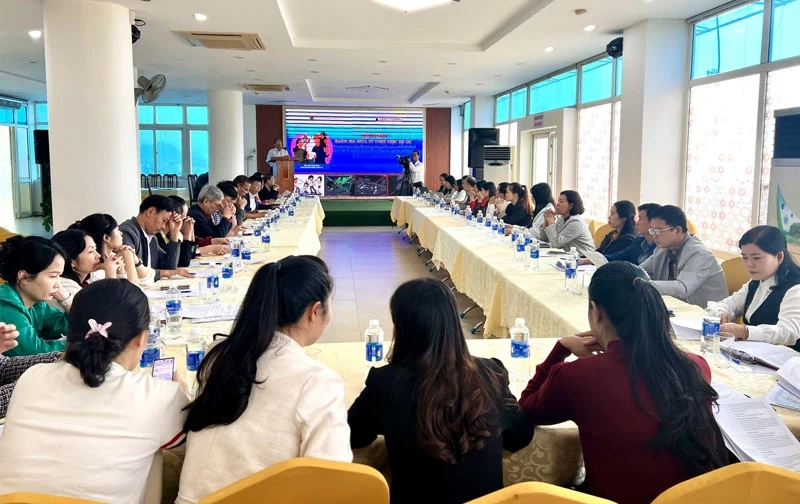
The conference reviewed the results and outlined the next phase of the project "Enhancing community capacity in preventing physical violence against children in Thanh Hoa ".
Protecting children from physical violence is not only a human rights requirement but also a fundamental condition for their holistic development. Recognizing this, the project was implemented in 15 communes/wards (after mergers, 11 communes/wards remained) with the cooperation of the government, schools, and the community. As a result, out of 5,400 children in the target group, 3,390 received knowledge on preventing physical violence, prevention skills, and positive discipline methods. Notably, 456 children trained as communicators continued to share their knowledge with 1,544 peers, spreading the spirit of "know yourself - protect yourself - help your friends" in the school environment. Among parents and caregivers, 11,909 people received information through training or community activities. The good news is that many parents are realizing for the first time the long-term harm of corporal punishment as a parenting method and are proactively changing their behavior within the family, moving towards positive discipline methods.
Simultaneously, 450 officials from government agencies, mass organizations, social organizations, and child protection service providers received comprehensive training in handling situations, procedures for supporting children experiencing violence, and inter-sectoral coordination methods. The active involvement of this team helped to strengthen the "protective chain" within the community, from detection and reporting to intervention and support, creating a safer environment for children. Community outreach activities also exceeded expectations, with 75 community meetings and 360 radio broadcasts reaching nearly 34,400 people, demonstrating the project's widespread impact.
Overall, Phase 1 showed that the project was implemented on schedule, met its objectives, and was positively received by local authorities, schools, and the community. The goal of raising awareness shifted from theory to action: parents committed to refraining from violence; children confidently shared and reported when they perceived risks; and community workers mastered support skills. No cases of physical violence were recorded in the project area up to June 2025. However, progress was also affected by the transition to a two-tiered local government model, leading to changes in personnel and coordination mechanisms at the grassroots level, requiring adjustments in Phase 2 to ensure the project's continuity.
Based on these results, the next step is to consolidate the foundation already built, while strongly promoting the sustainability of communication models, coordination mechanisms, and children's self-protection capabilities. First and foremost, it is necessary to continue strengthening community communication activities in a more in-depth and diversified manner to adapt to social changes in the context of technology. Children's forums and coordination mechanism workshops should be implemented flexibly at the provincial level to adapt to the new government model. Bringing together representatives from many sectors and localities in a single forum will facilitate the widespread sharing of experiences and avoid duplication of resources.
Next, the team of communicators, including both children and adults, needs to be strengthened and further trained in communication skills, especially group activity organization skills and skills in identifying and supporting peers at risk of violence. Children showed significant maturity after the training, but to maintain and improve quality, phase 2 should include additional advanced training sessions, a "peer support" model, and life skills clubs in schools or communities. When children become inspirational agents, the project will have a more natural, sustainable, and cost-effective impact.
Another crucial solution is stabilizing the project's organization and personnel in the context of changing government models. Merging communes and wards or changing the district-level association system could affect task assignments and coordination. Therefore, as soon as the new system comes into operation, it is necessary to urgently strengthen the project management board in each locality, clearly identify the responsible parties, and issue regulations on coordination between associations, the government, and mass organizations. Only when coordination channels are smooth can the process of supporting children who have experienced violence be implemented promptly and in accordance with regulations.
Furthermore, Phase 2 should focus on promoting group discussions, community maps, and child-friendly assessment tools to listen to children's genuine voices and adjust activities to suit their needs. Children's participation not only makes activities more engaging but also creates a sense of responsibility and ownership, bringing the project closer to its goal of building a community-based child protection model.
Finally, to promote a more widespread culture of non-violent education , it is necessary to propose incorporating positive discipline content into the activities of community organizations such as women's associations, youth unions, and senior citizen associations. Each organization, when becoming a "communication point," will form a multi-layered network encompassing the entire community. Children in such an environment will not only be protected but also empowered to protect themselves. With synchronized solutions, this will be the "key" to building a safe, non-violent community where all children are protected and respected.
Text and photos: Tran Hang
Source: https://baothanhhoa.vn/tang-cuong-nang-luc-cong-dong-nbsp-de-bao-ve-tre-em-271775.htm
![[Photo] Prime Minister Pham Minh Chinh receives the Governor of Tochigi Province (Japan)](/_next/image?url=https%3A%2F%2Fvphoto.vietnam.vn%2Fthumb%2F1200x675%2Fvietnam%2Fresource%2FIMAGE%2F2025%2F12%2F16%2F1765892133176_dsc-8082-6425-jpg.webp&w=3840&q=75)
![[Photo] Prime Minister Pham Minh Chinh receives Lao Minister of Education and Sports Thongsalith Mangnormek](/_next/image?url=https%3A%2F%2Fvphoto.vietnam.vn%2Fthumb%2F1200x675%2Fvietnam%2Fresource%2FIMAGE%2F2025%2F12%2F16%2F1765876834721_dsc-7519-jpg.webp&w=3840&q=75)
![[Image] Leaked images ahead of the 2025 Community Action Awards gala.](/_next/image?url=https%3A%2F%2Fvphoto.vietnam.vn%2Fthumb%2F1200x675%2Fvietnam%2Fresource%2FIMAGE%2F2025%2F12%2F16%2F1765882828720_ndo_br_thiet-ke-chua-co-ten-45-png.webp&w=3840&q=75)


![[Live] 2025 Community Action Awards Gala](/_next/image?url=https%3A%2F%2Fvphoto.vietnam.vn%2Fthumb%2F1200x675%2Fvietnam%2Fresource%2FIMAGE%2F2025%2F12%2F16%2F1765899631650_ndo_tr_z7334013144784-9f9fe10a6d63584c85aff40f2957c250-jpg.webp&w=3840&q=75)





























![[Photo] Prime Minister Pham Minh Chinh attends the Vietnam Economic Forum 2025](https://vphoto.vietnam.vn/thumb/402x226/vietnam/resource/IMAGE/2025/12/16/1765893035503_ndo_br_dsc-8043-jpg.webp)














Comment (0)