


Many tourism experts believe that the collection of French architecture in Da Lat is a valuable cultural resource for developing distinctive tourist tours.
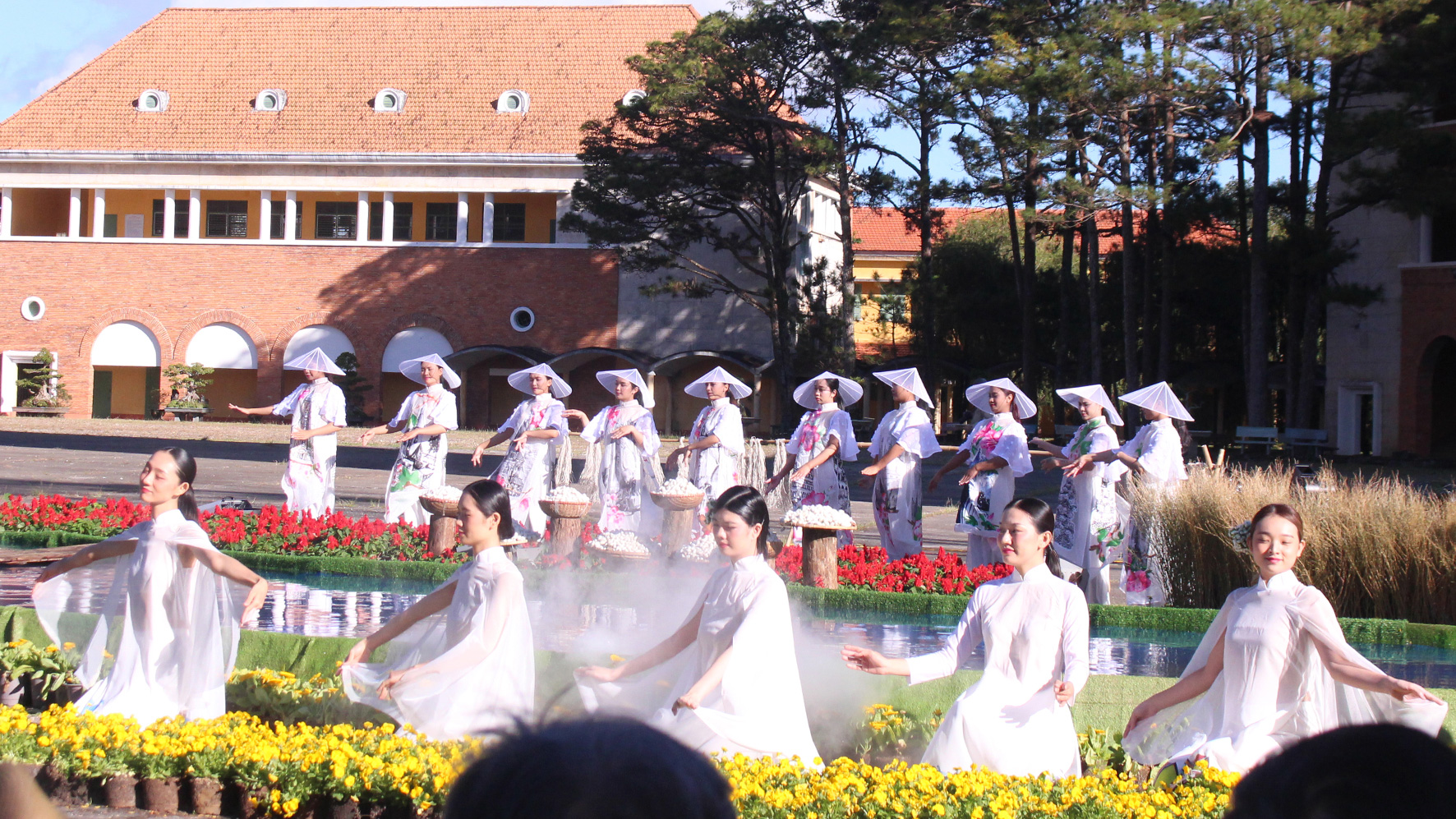 |
| Art in the architectural space of Da Lat |
Mr. Huynh Van Trung, a tour guide specializing in organizing tours for international tourists visiting Da Lat, shared: "In reality, many foreign tourists have expressed a desire to experience architectural tours in Da Lat. However, the level of engagement of foreign tourists with this unique type of tour is still quite modest compared to the actual demand." Mr. Trung argued that this limitation is not due to a lack of architectural resources in Da Lat, but rather to other subjective and objective factors such as the insufficient openness of architectural works to create specialized tours, the lack of in-depth documentation for presentations to foreign academics, and the lack of supplementary services to enhance the attractiveness of architectural tourism... “From its inception, Da Lat has been an ecological resort city, embodying the spatial structure of a European urban area, a style of architecture that combines with the landscape, respecting the beauty of nature to the fullest extent, with architecture being a part of nature. Each architectural work and cluster of architectural works here is skillfully created, on the one hand making full use of Da Lat's topography, and on the other hand enhancing the beauty of the natural landscape,” Mr. Trung said. Agreeing with Mr. Trung, Mr. Nguyen Ngoc Hai, a tour guide in Da Lat, acknowledged: “From its inception, Da Lat has had a European appearance, with thousands of unique architectural works, including villas, mansions, offices, schools, churches... It currently preserves about 2,500 architectural works in the European style. These architectural heritage sites are the soul and backbone of the heritage city of Da Lat.”
Regarding why tours exploring French colonial architecture haven't yet been developed in Da Lat, Mr. Hai honestly stated: "Most of the French colonial architectural heritage sites are currently government offices or owned by businesses, so tourist visits are somewhat limited. Furthermore, some of the French colonial architectural heritage sites are deteriorating, affecting the design of architectural exploration tours." According to Mr. Hai, the lack of knowledgeable guides specializing in architecture is also a barrier to developing architectural tours. "Having beautiful materials doesn't automatically mean the dish will be delicious if you don't know how to prepare it. Similarly, a good tour guide needs to know how to tell interesting stories to tourists based on Da Lat's existing cultural and architectural resources," Mr. Hai explained. According to visual artist Nguyen The Son, we can absolutely revive Da Lat's architectural heritage through artistic activities within its spaces. The architectural heritage sites themselves should have their own dedicated exhibition rooms showcasing their history, alongside expanding interaction with new art forms. Only then will Da Lat's architectural heritage truly contribute to the local cultural industry.” Mr. Hai added that to achieve what visual artist Nguyen The Son suggested, the State needs to take the lead, followed by professional tourism companies surveying the actual needs of tourists to design tours, routes, and destinations. With the support of artists and art activists, building architectural tourism tours is certainly feasible, thus revealing a new type of tourism in Da Lat.
Source: http://baolamdong.vn/du-lich/202411/tour-du-lich-kien-truc-da-lat-6542e9f/






















































![[Photo] Coc Ly market bustling on the eve of Tet](https://vphoto.vietnam.vn/thumb/402x226/vietnam/resource/IMAGE/2026/02/14/1771062261424_baolaocai-br_img-6457-jpg.webp)




Comment (0)