


Ho Chi Minh City's dream of becoming a mega-coastal city is gradually becoming a reality as, at the 11th Conference of the 13th Central Committee of the Communist Party of Vietnam, it was agreed to merge Ho Chi Minh City with Binh Duong and Ba Ria - Vung Tau provinces.
Specific steps
At the recent 39th Conference (thematic conference) of the Executive Committee of the Ho Chi Minh City Party Committee, 11th term, the Standing Committee of the City Party Committee presented the draft plan for rearranging and merging provincial-level administrative units.
This project has developed a plan to merge three provincial-level administrative units, namely Ba Ria - Vung Tau, Binh Duong, and Ho Chi Minh City, based on the implementation of two tasks: reorganizing provincial-level administrative units and reorganizing commune-level administrative units; ensuring that after the reorganization, Ho Chi Minh City will be a centrally-governed city, maximizing the potential and advantages of the three localities in terms of land area, population size, and economic growth results, striving to become a new growth pole for the whole country and the Southeast region in the future.
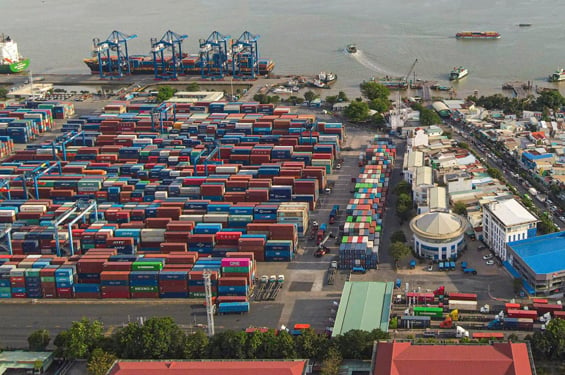
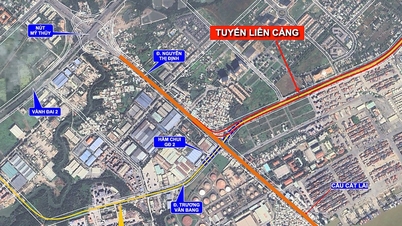
Cat Lai Port – Vietnam's largest and most modern international container port – is facing prolonged congestion.
The newly reorganized and merged Ho Chi Minh City has an area of 6,772.65 km2 (reaching 135.43% of the standard), a population of 13,706,632 people (reaching 979.04% of the standard), and 168 subordinate administrative units, forming a new megacity in the Southeast region. In 2024, the total state budget revenue of these three provinces and cities was 677,993 billion VND.
The draft proposal recommends that the Central Government consider and approve allowing Ho Chi Minh City, after the reorganization and merger of provincial-level administrative units, to extend the implementation period of Resolution 98/2023/QH15 on piloting special mechanisms and policies for the city's development until the end of 2030...
The draft plan for the reorganization and merger of provincial-level administrative units was approved by the Executive Committee of the Ho Chi Minh City Party Committee, 11th term, at its conference.
Expanding the city's space is a crucial step for Ho Chi Minh City to become a true maritime megacity, serving as both a production center, a transit hub, and a Southeast Asian maritime service center. The merger with Binh Duong (which has strengths in industry, urban development, and logistics) and Ba Ria-Vung Tau (deep-water seaports and coastal tourism) creates opportunities for Ho Chi Minh City, after the merger, to genuinely expand its maritime presence; possessing infrastructure, deep-sea space, and a robust logistics economy . This will also create a continuous urban-industrial-seaport-service chain, similar to the models currently applied in Shanghai (China), Singapore, or Bangkok (Thailand).
The merger of the three administrative units is not merely a reorganization of geographical boundaries, but also a decisive step for Ho Chi Minh City to transform itself into a Southeast Asian maritime megacity – a convergence point of sea, industry, logistics, finance, and creative people. A new regional center is emerging, stemming from the country's own aspirations for reform.
Developing new economic spaces
Professor Dang Hung Vo, former Deputy Minister of Natural Resources and Environment , believes that the merger of Ho Chi Minh City with Ba Ria - Vung Tau and Binh Duong provinces is of great significance, creating conditions for the city to develop its marine economy, including tourism, exploitation of natural resources, renewable energy for wind and solar power production, and renewable energy from tides and ocean waves.
So, what exactly does the marine economy entail for Ho Chi Minh City? Answering this question, Professor Dang Hung Vo stated that this is an issue that Ho Chi Minh City needs to consider. Currently, we have only adjusted administrative boundaries and haven't yet considered the new economic space. Therefore, the next step is to aim for the development of this new economic space. Within this, marine tourism alone could create a new position by attracting foreign tourists.
According to Professor Dang Hung Vo, Ho Chi Minh City has a very special location, bordered on one side by a huge industrial region (Southeast Vietnam) and on the other by a key agricultural region (Mekong Delta). From this position, it is clear that Ho Chi Minh City has enormous potential for service sector development.
"From now on, Ho Chi Minh City can fully consider high-quality services that the world is very interested in, such as: financial services centers, training to improve the quality of human resources, or technology services, taking advantage of its seaport and transportation advantages..." - he commented.
Professor Dang Hung Vo stated that Ba Ria - Vung Tau possesses modern deep-water ports capable of receiving large international vessels. Meanwhile, Ho Chi Minh City has an international port system with significant advantages in logistics services and a favorable trading location.
If Ho Chi Minh City organizes and operates services better and at more competitive costs, waterway transport will certainly develop strongly. In that case, Ho Chi Minh City could completely become an international transit hub (logistics hub), a stopover and connection point for international cargo ships. This would help Ho Chi Minh City attract international shipping routes to its ports, creating favorable conditions for the development of logistics services and the maritime economy.
The current challenge is for stakeholders to sit down together, calculate, and develop a specific strategy to realize this potential, based on the principles of geoeconomic analysis. Ho Chi Minh City needs to review its planning, clearly define its new development landscape and priority areas; and then implement projects in the most effective and appropriate way.
However, to realize that ambition and potential, much remains to be done, from planning and infrastructure investment to perfecting policies and mechanisms and ensuring synchronized connectivity. Coordination and strategic planning are needed for Ho Chi Minh City to maximize the advantages of this newly developed coastal area. Equally important is the need for a workforce with the energy and expertise to implement marine economic development projects.
Rearrange the master plan.
According to Mr. Le Duy Hiep, a logistics expert and former Chairman of the Vietnam Logistics Business Association (VLA), Ho Chi Minh City is the largest economic, administrative, and logistics center in the country.
Ho Chi Minh City's port system plays an extremely important role, especially Cat Lai Port - currently the largest and most modern international container port in Vietnam. However, Cat Lai Port is also facing prolonged congestion, creating an urgent need for planning adjustments and rational allocation of cargo flows.
Meanwhile, the Cai Mep - Thi Vai port complex in Ba Ria - Vung Tau is gradually asserting its position as a deep-water international gateway port in the South. In the long term, it will be a major destination for international container shipping routes, contributing to reducing the burden on Ho Chi Minh City's port system and enhancing the import and export capacity of the entire Southern region.
Mr. Hiep believes that when Ho Chi Minh City merges with Binh Duong and Ba Ria - Vung Tau, the potential for growth in logistics and freight transport will be enormous. Currently, Ho Chi Minh City, Binh Duong, and Ba Ria - Vung Tau are the pillars in the Southeast region's regional linkage.
In the future, with the formation of the Can Gio deep-water port and the synchronization of supporting logistics systems, the new Ho Chi Minh City will become a leading logistics and maritime import/export center in Vietnam. Furthermore, services within the logistics supply chain will play a crucial role, creating a modern logistics ecosystem, saving costs, and enhancing the competitiveness of Vietnamese goods in the international market.
To realize that potential, Mr. Hiep believes the biggest challenge currently is the reorganization of the overall planning for the entire expanded Ho Chi Minh City area, the seaport system, logistics warehouses, and key transportation infrastructure projects. In particular, the ring roads, especially Ring Road 3, play a crucial role in connecting areas, facilitating the smooth flow of goods, reducing urban traffic pressure, and optimizing transportation costs.
When localities in the Southeast region are merged or managed more effectively, adjusting planning will avoid overlapping and conflicts of interest, and give investors more confidence.
"Ho Chi Minh City needs to proactively listen to opinions from experts and industry associations to build a logistics and port system development strategy that suits actual needs and international trends. This will not only help maximize the potential of the maritime economy but also contribute to making the Southern key economic region a driving force for national development in this era of progress," Mr. Hiep commented.
(To be continued)
The economy is on a very large scale.
Dr. Tran Quang Thang, Director of the Institute of Economics and Management of Ho Chi Minh City, commented that in the context of strong investment in inter-regional transportation infrastructure, especially ring roads and expressways, the synchronized development of public transportation systems will help connect the satellite cities of the three merged localities, thereby creating momentum for economic development.
According to Mr. Thang, the new Ho Chi Minh City's economic scale could account for nearly 30% of the country's GRDP. "After the merger, Ho Chi Minh City could become a model of sustainable urban and industrial development, balancing growth with environmental protection, if properly and comprehensively planned, from deep-water ports and international airports to expressways, thereby boosting economic competitiveness," he emphasized.
Source: https://nld.com.vn/tp-hcm-huong-den-sieu-do-thi-bien-19625041720243724.htm


![[Photo] General Secretary To Lam works and extends New Year greetings to the Party Committee, government and people of Dak Lak province.](https://vphoto.vietnam.vn/thumb/1200x675/vietnam/resource/IMAGE/2026/02/11/1770808701306_ndo_tl_img-4099-5201-jpg.webp)


















































Comment (0)