

For over a millennium, the furnace fires in Tra Dong village (Thieu Trung commune, Thanh Hoa province) have continued to burn, preserving a sophisticated traditional craft that alone defines the identity of an entire region.
Famous for its majestic Buddha statues, resonant bronze bells, and intricately carved religious artifacts, Tra Dong is not only a craft village but also a living museum of Vietnamese history and culture.
The glorious millennium of the ancient bronze village.
Tra Dong bronze casting village, located in Thieu Trung commune, Thanh Hoa province, is not only a craft village but also one of the cradles of Vietnamese bronze casting art.
The village's history is intertwined with legendary stories, believed to have begun during the Dinh or Early Le dynasties, with a strong and glorious development under the Ly and Tran dynasties.
Tra Dong has a bronze casting craft that has existed for over 1,000 years, making it one of the oldest and most famous bronze casting villages in the country.
According to legend, the person who pioneered and passed on the bronze casting craft to the villagers was either Nguyen Minh Khong (also known as Ly Quoc Su, a famous Zen master during the Ly Dynasty) or Khong Minh Khong, a founding figure of the craft who made significant contributions to the dissemination of sophisticated bronze casting techniques.
From generation to generation, the secrets of metallurgy, alloy blending, mold making, and carving have been strictly preserved by the artisans of Tra Dong, passed down only to their descendants within the village.
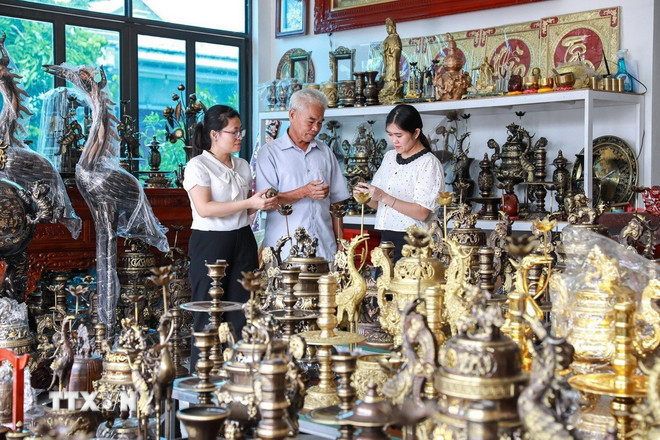
During the feudal era, Tra Dong was renowned for producing valuable items for the imperial court, from Buddhist ritual objects to court utensils. Tra Dong's reputation extended beyond household goods, becoming associated with cultural and spiritual landmarks of national significance.
The secret lies in the "spirit of the land" and the "power of the fire".
What sets Dong Tea apart is the perfect combination of exquisite traditional techniques and exceptional ingredients.
The art of bronze casting in Tra Dong primarily utilizes the clay mold casting method, a technique that demands almost absolute patience and experience.
The process of casting bronze in Tra Dong is a series of rigorous steps, including:
Model making: Creating a model using wax or soft materials, determining the shape and feel of the product.
Mold making: This is a secret step. The mold is made from a mixture of clay, rice husk ash, and some secret additives, then fired in a charcoal kiln. The smoothness, durability, and heat resistance of the mold determine the quality of the copper surface when cast.
Copper smelting: Copper is melted at temperatures of thousands of degrees Celsius. Tra Dong artisans have a secret recipe for mixing copper alloys with other metals (such as tin, zinc, and lead) according to a family tradition, creating a distinctive color and durability, while also ensuring the molten copper flows evenly, filling even the smallest details of the mold.
Pouring and cooling the copper: This is the crucial moment, requiring absolute precision in terms of time and temperature.
Finishing touches: After casting, the product is demolded, cleaned, polished, and, most importantly, carved and buffed. It is these exquisite, soulful, handcrafted carvings that have created the unique brand of Dong Tea.
The meticulousness and experience of the craftsmen are also evident in the creation of Tra Dong copper alloy - the finished copper typically has a deep, antique brown hue, not overly shiny, but possesses exceptional durability over time.
Tra Dong's influence in historical works
The reputation of Tra Dong bronze casting is not just empty praise, but is proven through concrete projects of great historical and cultural significance:
The Amitabha Buddha statue at Thầy Pagoda is one of the representative works, showcasing the outstanding sculpting talent of artisan Trà Đông.
Large bronze bells in temples: The resonant, deep, and far-reaching sound of the Tra Dong bronze bell is favored by large temples.
Bronze incense burner and crane altar set: Tra Dong's altar sets are always sought after for their exquisite carvings of the Four Sacred Animals and Eight Immortals, reflecting solemnity and traditional worship culture.
Restoration works: In the restoration and preservation of historical relics, artisans from Tra Dong are always the top choice for recreating ancient bronze artifacts, ensuring their originality and historical value.
Keeping the flame alive in the modern context.
Today, the Tra Dong craft village not only stands strong but also thrives. Despite facing competition from industrial products, the artisans here persevere in preserving traditional handcrafted casting techniques.
Currently, dozens of families in the village continue the craft, not only casting religious artifacts but also expanding into handicrafts, souvenirs, and especially casting bronze portrait statues on demand.
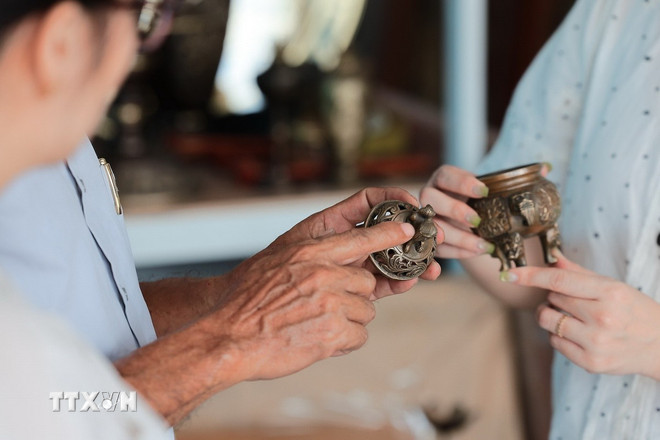
In particular, with love and passion, the bronze casting artisans of Tra Dong village have meticulously researched and successfully cast bronze drums using traditional handcrafted methods in various sizes, receiving high praise from scientists both domestically and internationally. These include the bronze drum with the Ngoc Lu design and patterns from 2000, the largest bronze drum in Vietnam with a drumhead diameter of 1.51m and a height of 1.21m in 2007, and the Ngoc Lu version bronze drum considered the largest in the world, weighing approximately 8 tons, standing 2m high, and with a drumhead diameter of 2.7m in 2013...
In 2010, the artisans of Tra Dong bronze casting village participated in casting 100 bronze drums to offer as part of the Grand Celebration of the 1,000th anniversary of Thang Long- Hanoi .
The products of the bronze casting artisans of Tra Dong village have contributed to enriching and advancing Vietnamese culture, imbued with a strong national identity. Through the ups and downs and vicissitudes of time and history, the traditional bronze casting craft of Tra Dong village has retained its unique and distinctive characteristics unmatched anywhere else.
With these outstanding values, on September 4, 2018, the Ministry of Culture, Sports and Tourism issued Decision No. 3325, announcing the list of national intangible cultural heritage, in which the traditional bronze casting craft of Che (Tra Dong) village, Thieu Trung commune, Thieu Hoa district, Thanh Hoa province (now Thieu Trung commune, Thanh Hoa province) is one of the 8 heritages recognized as national intangible cultural heritage in this round.
The Tra Dong bronze casting craft has been recognized as a National Intangible Cultural Heritage, affirming the historical and cultural value of the craft village. This recognition is not only a source of pride but also a motivation for the local government and artisans to promote preservation efforts and expand the craft village tourism model.
Visitors to Tra Dong not only get to buy exquisite bronze products but also have the rare opportunity to witness the entire traditional bronze casting process - from preparing the clay and creating the mold to pouring the molten bronze into a fiery inferno.
The bronze casting artisans of Tra Dong are doing a quiet but profoundly meaningful job: they are not only creating bronze artifacts, but also "casting" the cultural heritage, spirit, and identity of the Vietnamese people, ensuring that the flame from over a thousand years ago will continue to burn brightly for future generations.
Source: https://www.vietnamplus.vn/tra-dong-noi-lua-va-dat-ket-tinh-thanh-tinh-hoa-dong-viet-post1070995.vnp


![[Photo] Prime Minister Pham Minh Chinh attends the Conference on the Implementation of Tasks for 2026 of the Industry and Trade Sector](/_next/image?url=https%3A%2F%2Fvphoto.vietnam.vn%2Fthumb%2F1200x675%2Fvietnam%2Fresource%2FIMAGE%2F2025%2F12%2F19%2F1766159500458_ndo_br_shared31-jpg.webp&w=3840&q=75)



















































































Comment (0)