

In the context of shrinking agricultural land in Ho Chi Minh City – the country's largest metropolis – due to rapid urbanization, the need to increase the value of agricultural production is becoming increasingly urgent. This value encompasses yield, quality, price, and stability. Furthermore, it serves as evidence of changes in farming practices and the improved skills of farmers.

A delegation of leaders from the Agriculture and Environment Newspaper, along with reporters from various newspapers, visited the Tuan Ngoc Hydroponic Vegetable Cooperative. Photo: Phuc Lap.
During a field trip to a modern hydroponic vegetable farming model in Ho Chi Minh City, witnessing it firsthand, we shared the view that even in urban areas where land is extremely valuable, it's possible to become a farmer, grow vegetables, and earn billions of dong instead of renting out the land, building skyscrapers, or engaging in other businesses as is commonly done. Furthermore, this agricultural model offers many other benefits related to sustainable development and environmental protection.
This is the hydroponic vegetable farming model of Tuan Ngoc Hydroponic Vegetable Cooperative in Long Truong ward, Ho Chi Minh City.
Thinking ahead of its time.
From the center of Ho Chi Minh City, after about half an hour's drive, the greenhouse complex of Tuan Ngoc Hydroponic Vegetable Cooperative was in front of us. Mr. Lam Ngoc Tuan, the Chairman of the Cooperative, was waiting and led us into the greenhouse where various vegetables are grown. Although it was scorching hot and humid outside, with the temperature on our phones reaching 30 degrees Celsius, the air was noticeably cooler as soon as we stepped through the gate into the greenhouse. This was thanks to the temperature control system using IoT technology.
In the 1,000-square-meter greenhouse, vegetables are grown in trays of water, placed on waist-high racks, with a system of pipes supplying nutrients hidden beneath the racks. From above, all you see are lush green patches of vegetables.

Mr. Lam Ngoc Tuan, Chairman of Tuan Ngoc Cooperative. Photo: Phuc Lap.
The recirculating hydroponic system (with stagnant water) helps save up to 40% of watering time, eliminates the need for cooling water, and balances the processes of surface transpiration on leaves and root water absorption, allowing plants to survive in hot environments.
Tuan Ngoc Hydroponic Vegetable Cooperative specializes in growing leafy vegetables such as mustard greens, curly kale, sweet cabbage, mint, kale, dandelion greens, spinach, chrysanthemum greens, water spinach, blanched mustard greens, Chinese broccoli, bok choy, lettuce, etc., especially glass lettuce.
"Why does the cooperative only grow leafy vegetables and not fruit vegetables like tomatoes, cucumbers, and eggplants?" I wondered. "If we grew fruit vegetables, the control process would change, there would be a lack of consistency, and the care would be more difficult," Mr. Tuan explained.

The vegetable garden utilizes advanced technology and is controlled by modern IoT. Photo: Phuc Lap.
To ensure the highest product quality, the cultivation process is strictly implemented to guarantee that the product is free from microorganisms and heavy metals, starting with the selection of seeds, followed by the use of coconut fiber as a growing medium – an inert medium that does not retain any substances. Coconut fiber also helps retain moisture for the plant roots better and is decontaminated and microbially controlled before use. The water used is sourced from the tap and left to stand for a day to remove chlorine and balance the pH.
“The nutrients for the plants are imported from developed countries such as Belgium, Israel, and India… and must contain 16 macro, micro, and trace minerals to help the plants grow steadily and retain their natural flavor as if grown in soil. The water used to nourish the plants must also be absolutely clean and free of impurities,” Mr. Tuan said.
After three years of establishment, the cooperative began managing its model using IoT applications with a sensor-based control system in the vegetable garden to monitor temperature and humidity in the greenhouse. The IoT system is programmed and controlled via a mobile app. If there's a change, such as insufficient or excessive light, the roofing system automatically adjusts to open or close. If the humidity is low, the system automatically activates a misting system. From a single location, Mr. Tuan can monitor the condition of the vegetable gardens of affiliated households located tens of kilometers away and adjust the temperature and humidity directly on his phone.
Furthermore, the hydroponic system is recirculated by water reservoirs containing nutrients such as zinc, iron, calcium, and magnesium. Sensors are installed in the reservoirs to measure nutrient concentration and pH levels, optimizing the delivery of nutrients to the vegetable plots via the piping system. IoT also regulates the amount of water needed for the plants, thus reducing water consumption by up to 70% compared to traditional production.
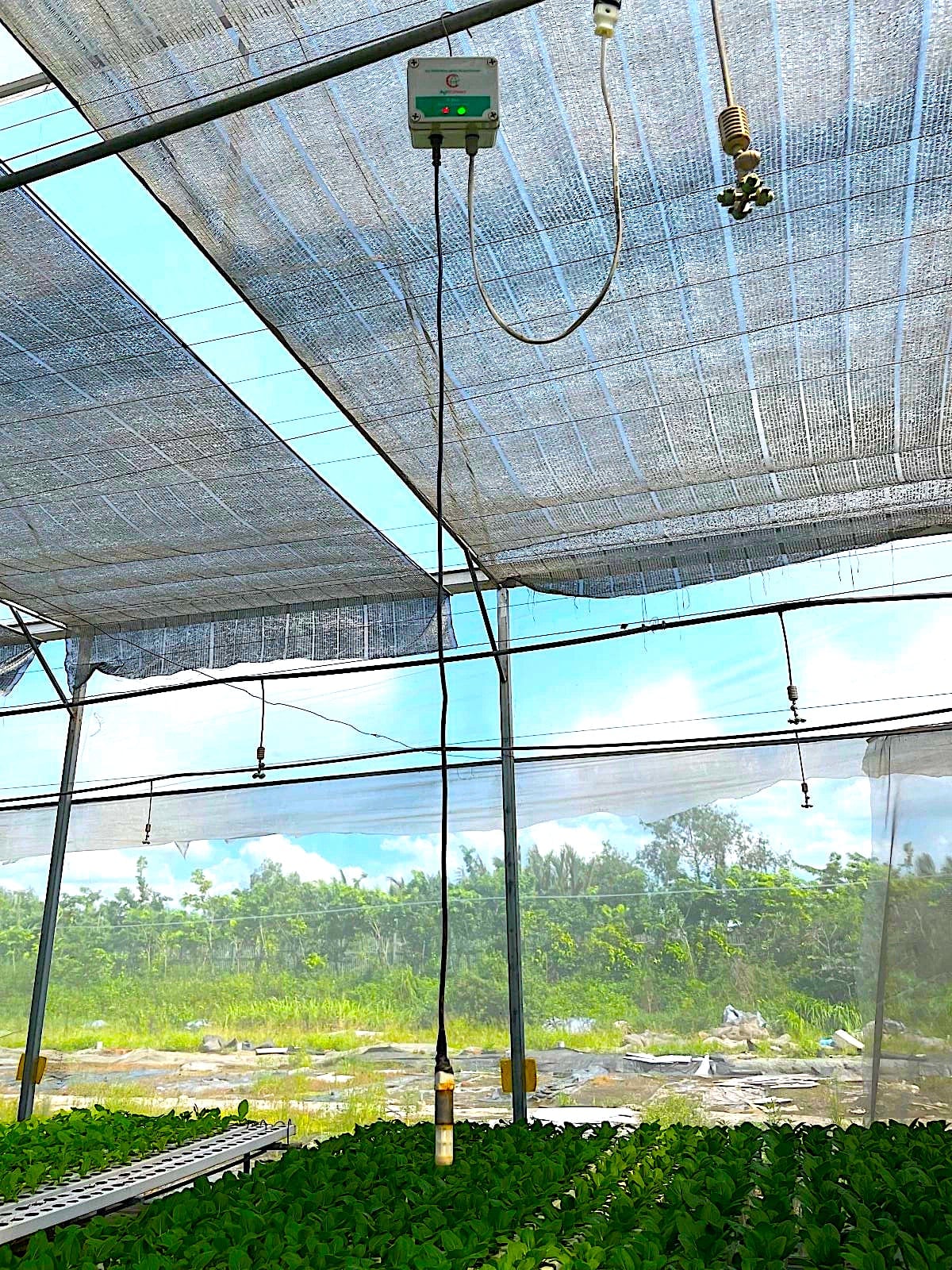

IoT sensors in greenhouses and the principle of recirculation combined with static hydroponics in the vegetable garden of Tuan Ngoc Hydroponic Vegetable Cooperative. Photo: Phuc Lap.
“From an initial 1,000m2, Tuan Ngoc Hydroponic Vegetable Cooperative has expanded its area to 7,000m2, then 10,000m2, and is currently continuing to expand. After 7 years of operation, from 3 tons/month in 2019, production has gradually increased to 6 tons, 12 tons, then 18 tons/month, and currently the cooperative has achieved a production of 27-30 tons/month. This shows that consumers are increasingly paying more attention to health and confirms the correct direction of the cooperative,” Mr. Tuan said.
The " 4 no's" and "1 on-site" standards - the key to success .
While giving us a tour of the greenhouse, Mr. Tuan said: “The climate in Ho Chi Minh City is quite hot, so controlling the temperature inside the greenhouse is very important for the vegetables to grow well. In the garden, we have installed a temperature and humidity sensor system. When the temperature exceeds 32 degrees Celsius, the sensor will automatically activate the misting system to cool the greenhouse.”
When humidity is too high, the fan automatically activates to cool the area. In the morning, the fan also automatically activates to draw in fresh air, helping the plants photosynthesize better. In the evening, the system automatically shuts off the water pump. Specifically, when the water temperature rises to 28-30 degrees Celsius, reducing oxygen levels, the system will pump oxygen into the water for the plant roots to absorb, helping the plants develop fully. The entire system is centrally managed at a data center and stored on a computer to serve as data for subsequent seasons.”

Harvesting vegetables at Tuan Ngoc Hydroponic Vegetable Cooperative. Photo: Phuc Lap.
Mr. Tuan shared: The key to the cooperative's success is its rigorous, scientific management process, from seeds to care, processing, and preservation, adhering to the "4 no's" and "1 on-site" standards.
The first standard is to "say no" to pesticides. Instead of using chemical pesticides, the cooperative uses homemade biological preparations from ginger, garlic, and chili peppers to prevent fungal diseases and pests.
Secondly, the seeds are of guaranteed quality, with clear origins, and are not genetically modified. “The cooperative selects seeds from reputable brands in Vietnam, Japan, and Taiwan. The seeds are sown in a carefully treated coconut coir substrate for better germination. The sowing stage is done outdoors for one day, then the seedlings are grown on a nursery rack for 10 days before being transferred to the main hydroponic system for automatic nourishment.”

The vegetable processing stage is strictly controlled. Photo: Phuc Lap.
The product is free from heavy metals such as lead and arsenic because the entire cultivation process is strictly controlled, from water, seeds, and fertilizers to the growing medium.
Finally, all products from the cooperative are guaranteed to be free from two common intestinal pathogens: E.coli and Salmonella, before reaching consumers.
“The vegetables are clean and ready to eat. You can just pick them and eat them right away without washing, without worrying about stomach aches because they are grown high up in greenhouses, completely free of dust. Besides that, the vegetables must meet standards for appearance; they are visually appealing. These strict standards meet the requirements of even the most demanding customers,” Mr. Tuan said.
According to Mr. Tuan, besides higher quality, hydroponic vegetable farming yields significantly higher productivity compared to soil-based farming. With 1,000 square meters, soil-based farming only produces 10 kg per day, but hydroponics can yield 100 kg. The reason is that soil-based farming is subject to adverse natural conditions such as humidity, microbial growth in the soil, and weather. If humidity is too high or the soil is waterlogged, the vegetables are susceptible to root rot, and microorganisms and fungi growing in the soil can harm them.

Agricultural experts visit and chat with Mr. Lam Ngoc Tuan, Chairman of Tuan Ngoc Hydroponic Vegetable Cooperative. Photo: Phuc Lap.
Meanwhile, the greenhouse system and nutrients provided by the hydroponic system overcome the disadvantages of growing in soil. The optimized living environment helps the plants grow quickly. In addition, because hydroponically grown vegetables do not require soil, the planting density can be higher.
To achieve his current success, Mr. Lam Ngoc Tuan spent more than two years researching and applying technology to the hydroponic vegetable cultivation process. Furthermore, the role of specialized agricultural agencies in Ho Chi Minh City cannot be overlooked, including the Southern Agricultural Science Institute (under the Ministry of Agriculture and Environment ) – an organization that has partnered with the Tuan Ngoc Hydroponic Vegetable Cooperative for several years.
Mr. Ngo Xuan Chinh, Director of the Center for Research and Transfer of Agricultural Technological Advancements under the Southern Institute of Agricultural Science and Technology, shared: “Agriculture in Ho Chi Minh City is facing many difficulties due to decreasing land area and increasing food demand. To meet this demand, producers must seek new farming methods that are highly productive while still ensuring quality. Not to mention other challenges such as climate change, competition from imported products, and market pressure… Therefore, Tuan Ngoc Hydroponic Vegetable Cooperative is a very successful model.”

Mr. Ngo Xuan Chinh, Director of the Center for Research and Transfer of Agricultural Technological Advancements ( thuộc Southern Institute of Agricultural Science and Technology) - who has been a long-time partner with Tuan Ngoc Hydroponic Vegetable Cooperative. Photo: Phuc Lap.
"Currently, the supply capacity of Tuan Ngoc Hydroponic Vegetable Cooperative only meets 1/10 of the order demand from partners. Currently, the cooperative's products are supplied not only to large supermarkets but also to many organic food stores, restaurants, and large hotels in Ho Chi Minh City and surrounding areas such as Thu Dau Mot (formerly Binh Duong), and Bien Hoa."
Therefore, we will continue to expand the cultivated area and adhere to the unified process. Members wishing to join the cooperative must fully comply with the regulations, planting procedures, and apply the care formulas provided by the cooperative. In return, the cooperative will guarantee the purchase of the products at a stable price, one and a half to two times higher than the market price, depending on the type of vegetable,” Mr. Tuan said.
Currently, Tuan Ngoc Hydroponic Vegetable Cooperative has transferred technology and opened three more models in Ninh Thuan, Long An, and Binh Duong (formerly) with an area of approximately 3,000m². The cooperative's model has been selected by Ho Chi Minh City as a model for farmers' associations, visitors, and schools to learn from and research.

Mr. Lam Ngoc Tuan: "We will continue to expand the area of hydroponic vegetables with a unified care process." Photo: Phuc Lap.
“Tuan Ngoc Hydroponic Vegetable Cooperative is a testament to the capabilities and efforts of farmers in Ho Chi Minh City in applying new technologies to agricultural production. Not only does it address the issue of limited agricultural land, but the cooperative also creates added value for agricultural products.”
"The cooperative is on its way to becoming one of the exemplary agricultural models in Vietnam, contributing to promoting sustainable development for Ho Chi Minh City's agricultural sector," Mr. Ngo Xuan Chinh commented.
Source: https://nongnghiepmoitruong.vn/trong-rau-khong-dat-cham-vuon-tu-xa-d791156.html







































































Comment (0)