

According to China News , Jielong-3 was launched by the Taiyuan Satellite Launch Center off the coast of Yangtze River (in Guangdong province, southern China) to put nine satellites into orbit. This is the third launch of Jielong-3, following the first in December 2022 and the second a month ago.
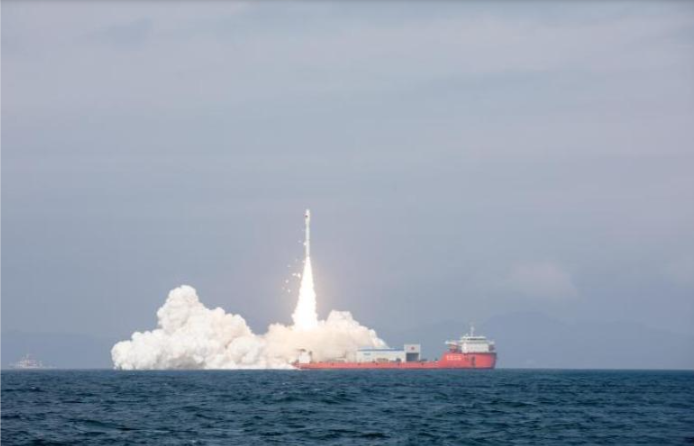
The Jielong-3 rocket, carrying nine satellites, was successfully launched from the sea near Yangjiang, Guangdong province, China, on February 3rd. (Photo: China News)
The Jielong-3 rocket, developed by the China Aerospace Science and Technology Corporation (CASC), is capable of carrying a 1,500kg payload into a 500km orbit and can be launched from the sea or land.
CASC previously stated that the Jielong-3 could carry more than 20 satellites at a launch cost of under $10,000 per kilogram, a globally competitive price in the small rocket segment.
According to Reuters , Chinese President Xi Jinping has called for expanding strategic industries, including the commercial space sector, viewing it as key to building "satellite constellations" for communications, remote sensing, and navigation.
Playing a key role in building China's commercial satellite network is the ability to expand the launch system, diversify rocket types to suit different payload sizes, reduce launch costs, and increase the number of satellite launch sites, including building more spaceports and using sea-based launch vessels.
Besides CASC, China's commercial satellite launch sector also includes many other companies such as Galactic Energy. This company's Ceres-1 rocket made its maiden flight in November 2020. A notable feature of Ceres-1 is its ability to carry a 300kg payload to an orbit of 500km.
Galaxy Energy conducted seven Ceres-1 launches in 2023, compared to four launches between 2020 and 2022.
In China's commercial space race, Landspace cannot be overlooked. In 2023, the company made history with the Zhuque-2 rocket, successfully launching the world's first satellite using methane and liquid oxygen as fuel. This is considered a breakthrough in the use of inexpensive rocket fuel in China.
Orientspace, established in 2020, made a breakthrough in the large-scale rocket market this year with the launch of its Gravity-1 rocket from a ship off the coast of Shandong province (eastern China).
Gravity-1 is capable of delivering payloads of up to 6,500 kg to low Earth orbit, making it the most powerful launch vehicle developed by a private Chinese company.
Small rockets can carry payloads of 2,000 kg, suitable for small and microsatellites. Medium rockets, on the other hand, can carry payloads of 20,000 kg, suitable for Earth observation satellites, telecommunications, and scientific missions.
Finally, there are heavy-lift rockets capable of carrying payloads exceeding 20,000 kg, often used for interplanetary missions, space station deployments, and launching large satellites. The Falcon rocket developed by SpaceX has a payload capacity of 64,000 kg.
Hua Yu (Source: China News, Reuters)
Source
![[Photo] Prime Minister Pham Minh Chinh receives the Governor of Tochigi Province (Japan)](/_next/image?url=https%3A%2F%2Fvphoto.vietnam.vn%2Fthumb%2F1200x675%2Fvietnam%2Fresource%2FIMAGE%2F2025%2F12%2F16%2F1765892133176_dsc-8082-6425-jpg.webp&w=3840&q=75)

![[Photo] Prime Minister Pham Minh Chinh receives Lao Minister of Education and Sports Thongsalith Mangnormek](/_next/image?url=https%3A%2F%2Fvphoto.vietnam.vn%2Fthumb%2F1200x675%2Fvietnam%2Fresource%2FIMAGE%2F2025%2F12%2F16%2F1765876834721_dsc-7519-jpg.webp&w=3840&q=75)
![[Image] Leaked images ahead of the 2025 Community Action Awards gala.](/_next/image?url=https%3A%2F%2Fvphoto.vietnam.vn%2Fthumb%2F1200x675%2Fvietnam%2Fresource%2FIMAGE%2F2025%2F12%2F16%2F1765882828720_ndo_br_thiet-ke-chua-co-ten-45-png.webp&w=3840&q=75)
![[Live] 2025 Community Action Awards Gala](/_next/image?url=https%3A%2F%2Fvphoto.vietnam.vn%2Fthumb%2F1200x675%2Fvietnam%2Fresource%2FIMAGE%2F2025%2F12%2F16%2F1765899631650_ndo_tr_z7334013144784-9f9fe10a6d63584c85aff40f2957c250-jpg.webp&w=3840&q=75)




































![[Photo] Prime Minister Pham Minh Chinh attends the Vietnam Economic Forum 2025](https://vphoto.vietnam.vn/thumb/402x226/vietnam/resource/IMAGE/2025/12/16/1765893035503_ndo_br_dsc-8043-jpg.webp)



















Comment (0)