E- Government - Towards a Service-Oriented Administration (Part 2): Local Government as the Central Operating Unit
E-Government - Towards a Service-Oriented Administration: Part 1: The Foundation for Digital Government
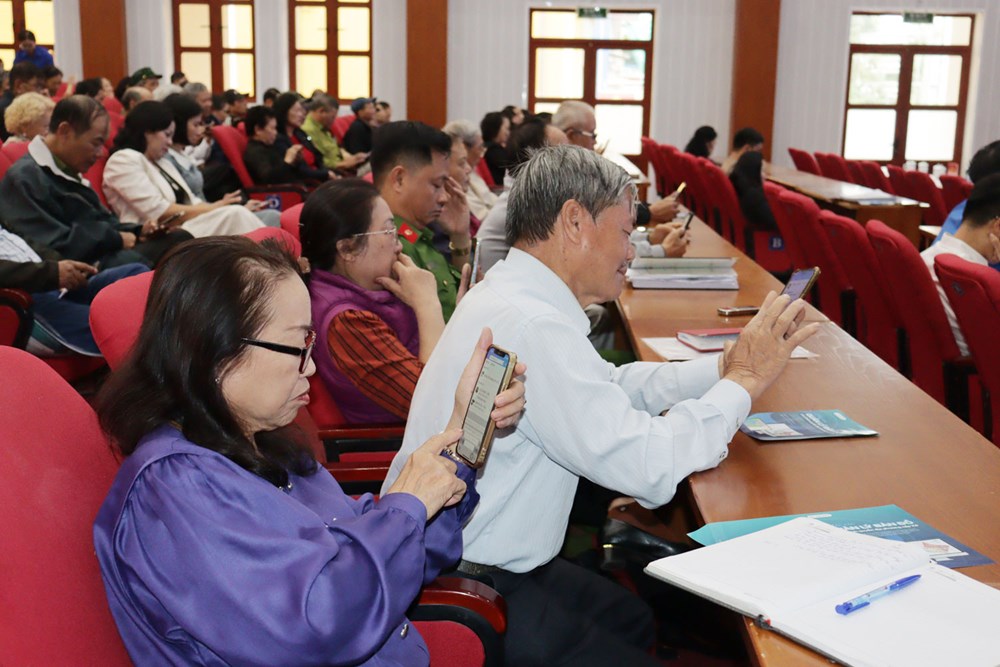
Instructions for citizens on using public administrative services on the digital platform in Le Chan ward, Hai Phong city.
If data is the "blood vessels" of e-government, then people are the "heart" that keeps those vessels running smoothly. Building a digital government is not just about investing in infrastructure; it must simultaneously develop digital human resources, both in the public sector and in society at large.
Building a team of digital citizens.
At the national level, the development of "digital citizens" is concretized through Project 06 on the development and application of population data, electronic identification and authentication. This project not only creates a technical foundation for online public services but also forms a digital ecosystem where each citizen has a unique electronic identity, guaranteed privacy, and equal access to digital services. When all citizens have digital identities, digital payment accounts, and digital public service accounts, the digital government truly becomes a government of the people, by the people, and for the people.
In the public sector, the digital competence of officials and civil servants is a crucial factor. Over the years, the Ministry of Interior , in collaboration with the Ministry of Science and Technology, has organized digital skills training programs for more than 300,000 officials and civil servants nationwide. However, a significant gap still exists between the central and local levels, and between urban and rural areas. In many places, officials are still hesitant to use electronic management systems, fearing mistakes and scrutiny, thus lagging behind in adopting technology.
That is why the Government is promoting the Digital Transformation Training Program for leaders and managers at all levels by 2030, aiming for 100% of officials, civil servants, and public employees to have basic digital skills, with at least 30% reaching an advanced level. Only when leaders understand the value of data and technology can they make data-driven decisions and drive the system toward genuine digitalization.
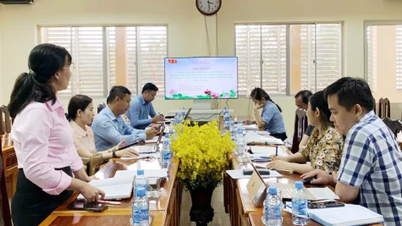
In Lai Chau province, to operate a digital government, the province has organized training programs on digital skills for officials, civil servants, and young people. Hundreds of classes have been opened over the past two years, helping commune and ward officials learn to use e-government applications, understand the online document processing procedures, and even guide citizens in installing and registering electronic identification and making cashless payments.
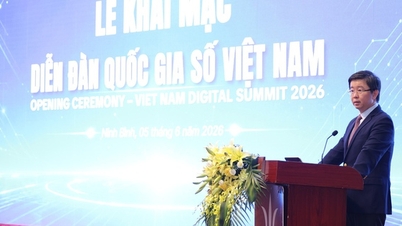
At the program celebrating National Digital Transformation Day 2025, Deputy Prime Minister Nguyen Chi Dung emphasized: "Every official, civil servant, and citizen must become a true digital citizen, knowing how to use, exploit, and actively create value in the digital space." This shows that digital transformation will only truly succeed when it becomes a culture—a culture of innovation, a culture of service, and a culture of data.
When every public official is not afraid to learn, every business is not afraid to invest, and every citizen is not afraid to change, then the digital government will truly have a solid foundation, a foundation built by people, for people, and serving people.
Serving the people
People are not only at the center of digital transformation but also the target of digital transformation. An effective e-government is one where every citizen, whether in mountainous areas, islands, or urban areas, can access public services, healthcare, education, payments, and communicate with government agencies conveniently, safely, and equally.
Over the years, Vietnam has made significant strides in building an e-government. From initial platforms such as the National Public Service Portal and the National Population Database, to the development of electronic identification and authentication infrastructure (VNeID), the interoperability of electronic documents between government levels, and the deployment of nationwide online meeting, management, and monitoring platforms, the administrative apparatus has gradually shifted from a "paper-based - manual" model to a "data-based - electronic" model. Each year, tens of millions of applications are processed online, saving trillions of dong in social costs.
According to a report by the Ministry of Science and Technology at the National Digital Transformation Day 2025, 99.3% of villages and hamlets nationwide have mobile broadband coverage; the average mobile internet speed reached 146.64 Mb/second, ranking 20th in the world; the rate of online processing of applications reached nearly 40%, a nine-fold increase compared to 2019. The digital economy contributes 14-15% of GDP and is expected to reach 20% by 2025. These figures not only reflect the speed of technological development but also demonstrate a shift in governance thinking, from a government that manages to a government that serves.
A modern administration is measured by its ability to serve. When citizens can complete procedures anywhere, receive instant feedback, and monitor the processing of their own applications, that's when a truly "service-oriented government" emerges. Digital transformation gives the administrative apparatus the ability to be "closer to the people," putting the people at the center and using satisfaction as a measure. "Closer to the people" is not just about bridging geographical distances, but also about bridging the gap between data and action, between the desires of the people and the response of the government.
Hai Phong is one of the leading localities in administrative reform and digital transformation towards a service-oriented government. The city has uniformly implemented a "One-Stop Electronic Service" system and high-level online public services across all administrative agencies, from the city level to the commune and ward levels, ensuring fast, transparent, and online-monitorable processing of applications.
By the third quarter of 2025, Hai Phong had exceeded the government's targets for both online application submission and online payment, with nearly three-quarters of administrative documents being processed digitally; and over 99% of documents being resolved on time or ahead of schedule. The satisfaction rate in handling feedback and suggestions reached an absolute high, clearly demonstrating the effectiveness of the e-government model operating on a data-driven platform.
In addition, the city has announced and standardized hundreds of administrative procedures, expanding the areas of online implementation, from business registration and land management to public services. The transparency, interconnectedness, and digitization of processes enable citizens and businesses to submit, track, and receive results directly on electronic platforms, contributing to increased transparency and quality of administrative services.
In Can Tho, the city government considers digital transformation as a driving force for improving the quality of services for citizens and businesses. Based on a unified electronic one-stop system, Can Tho is promoting the provision of online public services at levels 3 and 4, while integrating with the VNeID identification platform and electronic payments. By the third quarter of 2025, more than 60% of administrative documents will be submitted online, all 2,169 administrative procedures will have been synchronized to the system, with 8,851 user accounts regularly accessing the city's public service portal.
Connecting data across departments, agencies, districts, and counties significantly reduces processing time, increases transparency, and enhances oversight. Many processes that previously took 5-7 days are now shortened to 2-3 working days. Digital transformation not only simplifies administrative procedures but also changes the management mindset, shifting from "processing documents" to "serving needs." Data is interconnected, feedback is processed in real time, creating a more transparent, efficient, and people-friendly administrative environment than ever before.
Furthermore, data from intelligent systems helps the government analyze trends, identify problems, and make decisions earlier. When every field report and every social indicator is digitized and updated in real time, citizens are no longer simply "requesters" of services but become partners in governance, co-creating a better quality of life.
Digital transformation should not only aim for economic and technological goals, but first and foremost, it must be for the lives of the people. Being closer to the people means faster, more efficient, and safer service. When all procedures can be completed with just one touch, when people are listened to and receive immediate feedback, the distance between the government and citizens disappears, leaving only a bond of trust.
An e-government is not just a government that operates on data, but a government that listens to the data of its people. An e-government is only truly complete when every policy, every application, and every reform is geared towards a single goal: serving the people.
Source: https://baovanhoa.vn/nhip-song-so/tu-con-nguoi-va-vi-con-nguoi-178786.html
































































![[Video] Sunset at Lap An Lagoon – Where the sun sets over the fishing nets](https://vphoto.vietnam.vn/thumb/1200x675/vietnam/resource/IMAGE/2026/05/31/1780192137701_beach-landscape-sea-water-nature-grass-745871-pxhere-com.jpeg)






































Comment (0)