

Previously, the regulation stipulating that semi-processed agricultural products were not subject to VAT declaration and calculation had been stipulated by the Government in Government Decree 209/2013.
Concerns about reduced competitiveness of Vietnamese agricultural products.
In a document sent to the Prime Minister, the Vietnam Chamber of Commerce and Industry (VCCI) reported numerous difficulties and problems arising from the implementation. Law on Value Added Tax Circular No. 48/2024 and its implementing guidelines.
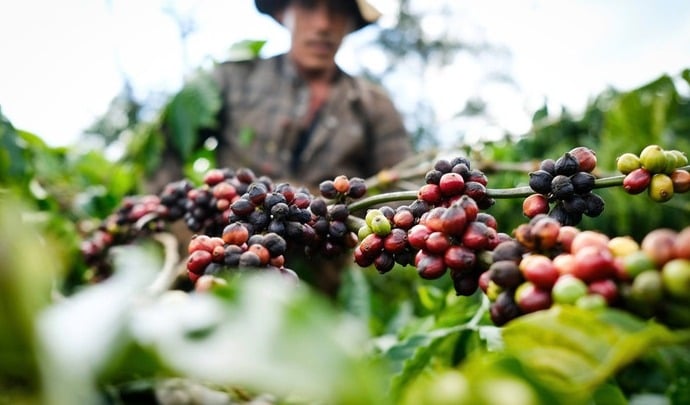
According to point d, clause 2, article 9 of the Value Added Tax Law, products that have not been processed into other products or have undergone only basic processing are subject to a 5% Value Added Tax (VAT). However, in reality, agricultural products such as coffee, pepper, cashew nuts, shrimp, fish, and raw timber mainly undergo only basic processing stages such as peeling, drying, and milling, which do not generate substantial added value.
Therefore, VCCI believes that applying a 5% VAT rate to this group of agricultural products is inconsistent with the nature of VAT, which is only levied on the added value during the production and business process.
In particular, the mechanism of collecting VAT upfront and refunding it later is forcing businesses and households in the agricultural sector to advance a large amount of capital to fulfill their VAT obligations, while the profit margin of these sectors is very low, only 1-3%.
For example, to fulfill its VAT obligations on semi-processed agricultural products, the coffee industry has to pay approximately 10,000 billion VND per year, and the pepper industry has to pay approximately 2,235 billion VND per year, placing significant financial pressure on agricultural export businesses.
This increases export costs, causing Vietnamese agricultural products to lose their competitive advantage compared to countries like Brazil, Indonesia, and India, where raw agricultural products are exempt from or subject to a 0% VAT rate.
Proposing a series of solutions to overcome obstacles.
To remove obstacles for businesses and household businesses in various sectors. Regarding agricultural production and export, the Vietnam Chamber of Commerce and Industry (VCCI) proposes that the Prime Minister consider restoring, or temporarily restoring, the regulation exempting semi-processed agricultural products from VAT declaration and calculation, as was previously applied in Government Decree 209/2013.
At the same time, we propose that the Government assign the Ministry of Agriculture and Environment to take the lead in coordinating with relevant ministries and agencies to issue a specific list of commonly processed agricultural products for each commodity sector, ensuring consistency and understanding among localities.
VCCI also recommended that the Government direct the Ministry of Finance to develop an automatic tax refund mechanism for valid applications with no signs of fraud, similar to the model being implemented in India.
Adjust regulations related to tax refund conditions to remove the requirement that businesses are only eligible for tax refunds when the supplier has declared and paid taxes.
It is necessary to promptly issue specific legal guidelines to remove obstacles in transactions between businesses and farmers – the main production force but lacking a suitable mechanism to officially participate in modern supply chains.
Clear guidelines are needed regarding VAT exemptions for small-scale farmers, ensuring that no administrative barriers are created that hinder the process of sourcing raw materials domestically.
Source: https://baoquangninh.vn/vcci-kien-nghi-khoi-phuc-quy-dinh-khong-khai-thue-tinh-thue-vat-voi-nong-san-so-che-3381355.html

![[Photo] Prime Minister Pham Minh Chinh holds a phone call with the CEO of Russia's Rosatom Corporation.](/_next/image?url=https%3A%2F%2Fvphoto.vietnam.vn%2Fthumb%2F1200x675%2Fvietnam%2Fresource%2FIMAGE%2F2025%2F12%2F11%2F1765464552365_dsc-5295-jpg.webp&w=3840&q=75)


![[Photo] Closing Ceremony of the 10th Session of the 15th National Assembly](/_next/image?url=https%3A%2F%2Fvphoto.vietnam.vn%2Fthumb%2F1200x675%2Fvietnam%2Fresource%2FIMAGE%2F2025%2F12%2F11%2F1765448959967_image-1437-jpg.webp&w=3840&q=75)





































![[OFFICIAL] MISA GROUP ANNOUNCES ITS PIONEERING BRAND POSITIONING IN BUILDING AGENTIC AI FOR BUSINESSES, HOUSEHOLDS, AND THE GOVERNMENT](https://vphoto.vietnam.vn/thumb/402x226/vietnam/resource/IMAGE/2025/12/11/1765444754256_agentic-ai_postfb-scaled.png)





































Comment (0)