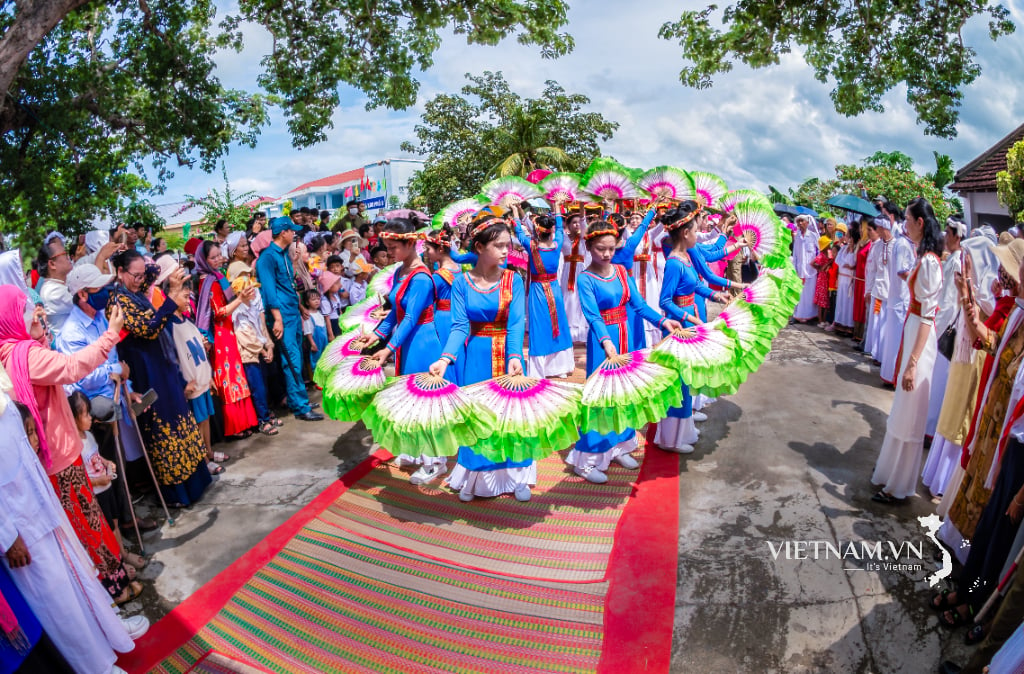
Dat Tai village (Hoang Ha commune, Hoang Hoa district) is a peaceful, ancient land with a traditional village culture and unique customs preserved and passed down through time. Mentioning Dat Tai also brings to mind a village in Thanh Hoa province with a thriving carpentry trade that has flourished for hundreds of years, renowned far and wide.
 In the fast-paced rhythm of modern life, Dat Tai village is changing and developing day by day. Photo: Khanh Loc
According to local records, around the Ly Dynasty, a group of fishermen made their living by following the Tuan Ngu River (a branch of the Ma River). Upon reaching the Dat Tai area, they found it to be a low-lying place abundant with shrimp and fish, so they settled there, established a village, and called it Ke Tre. Later, it became Tre village, and then Nac Tai Trang.
Towards the end of the Tran Dynasty, the country was in turmoil, forcing many families from the North to relocate and flee to the South. The Nac Tai Trang area became a refuge for these families escaping the chaos. Around the beginning of the 16th century, a group of carpenters from Yen Yen (Nam Dinh province) came to Thanh Hoa to work. Seeing the favorable location, the master carpenter decided to stay, build a house, start a family, practice his craft, and pass it on to the people of Nac Tai Trang. Later, Nac Tai Trang was renamed Dat Tai.
The carpenters of Dat Tai are not only skilled at building communal houses, temples, and shrines, but also adept at making cabinets, beds, tables, and chairs... Legend has it that when the Governor-General of Thanh Hoa , Vuong Duy Trinh, passed through Dat Tai, impressed by the reputation and skill of the local craftsmen, he left behind a couplet at the village's ancestral temple: "Heaven bestows intelligence, Hoang Hoa prospers / Saints support the usefulness, Dat Tai's talent," which translates to: Heaven bestows intelligence, Hoang Hoa flourishes / Saints support the usefulness, Dat Tai's fame (according to the book "History of the Revolutionary Movement of the Party Committee and People of Hoang Ha Commune").
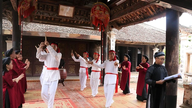


The book "History of the Revolutionary Movement of the Party Committee and People of Hoang Ha Commune" records: The artisans of Dat Tai village once undertook the construction of many large architectural works of high artistic value, such as the team of craftsmen led by Mr. Le Van Phan restoring the Vietnam Museum of Ethnology in Hanoi... The traces of the skillful hands of the Dat Tai carpenters still exist in the large architectural project of Tra Co Temple in Mong Cai City, Quang Ninh Province. Upon completion of the project, the Dat Tai artisan team created a horizontal plaque inscribed with four ancient characters: Nam - Son - Tinh - Tho, as a commemorative plaque for Tra Co Temple, signifying that the temple will endure forever like the mountains of Vietnam.
And right here in Thanh Hoa province, when visiting ancient architectural structures, it's not difficult for future generations to "find" traces of the Dat Tai carpentry craft. A visit to Phu Dien village communal house – a grand and sturdy wooden architectural relic with many exquisite wood carvings – revealed to the locals that the ancient communal house owes much to the work of the carpenters from Dat Tai village. In particular, the reputation of the Dat Tai carpenters is further confirmed by numerous traditional wooden houses, some over a hundred years old, still preserved in many villages throughout Thanh Hoa province.
The people of Dat Tai village are always proud that, whether they pursue the craft or not, every man must know how to carve and sculpt... However, the carpentry trade in Dat Tai village hasn't always flourished. There have been periods when, for various reasons, the village's traditional craft fell into decline. But the love and passion for the craft have helped the people preserve and make a living from it. Mr. Nguyen Dinh Kien, the head of Dat Tai village, said that currently about 70% of households in Dat Tai are engaged in carpentry.
Along with earning a living, generations of people in Dat Tai have also joined hands to build and cultivate beautiful wooden architectural works in their homeland. In the past, "Dat Tai village had 4 communal houses, 3 shrines, 2 pagodas, 1 temple, and 1 Confucian temple. Each hamlet had a communal house, namely Hung communal house, Tay communal house, Dong communal house, and Quan communal house. Each communal house usually had 5 to 7 bays..." (from the book "History of the Revolutionary Movement of the Party Committee and People of Hoang Ha Commune"). Along with the communal houses and shrines were sacred spaces where the people of Dat Tai worshipped their deities. Sadly, many valuable architectural works in Dat Tai no longer exist today.
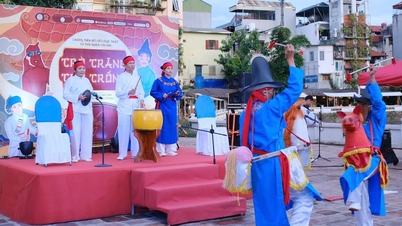
Besides its long-standing carpentry trade, Dat Tai also has a traditional wrestling festival. According to the elders in the village, no one knows exactly when the wrestling festival originated. Folklore tells that in ancient times, there were three lions in the village garden who used to play with a ball, a game called "hý cù" (playing with a ball). Based on this legend, the people of Dat Tai organized the wrestling festival at the beginning of spring, conveying the meaning of praying for national peace and prosperity, bountiful harvests, and success in their work.
The wrestling festival of Dat Tai village takes place on the second day of the Lunar New Year. Unlike traditional festivals that usually take place in the morning, the Dat Tai village wrestling festival begins at noon (12 PM). At this time, people go to the Western shrine to pay respects to the village's tutelary deity. Strong young men are responsible for carrying the tutelary deity's palanquin and the wrestling ball from the Western shrine to Quan Pagoda. After the respectful ceremonies, people gather in the village square to compete in the wrestling match.


In the rhythm of modern life, we can feel Dat Tai changing and developing day by day. The sounds of chiseling, carving, and wood-saw machines echo from small alleys to main roads throughout the village, carrying with them the joy, dedication, and aspirations for prosperity of the people of this traditional woodworking village in Thanh Hoa province.
Khanh Loc
Source



![[Photo] General Secretary and President To Lam working with the Technical and Professional Center, Ministry of Public Security](https://vphoto.vietnam.vn/thumb/1200x675/vietnam/resource/IMAGE/2026/07/06/1783318005842_a1-bnd-1129-2263-jpg.webp)