

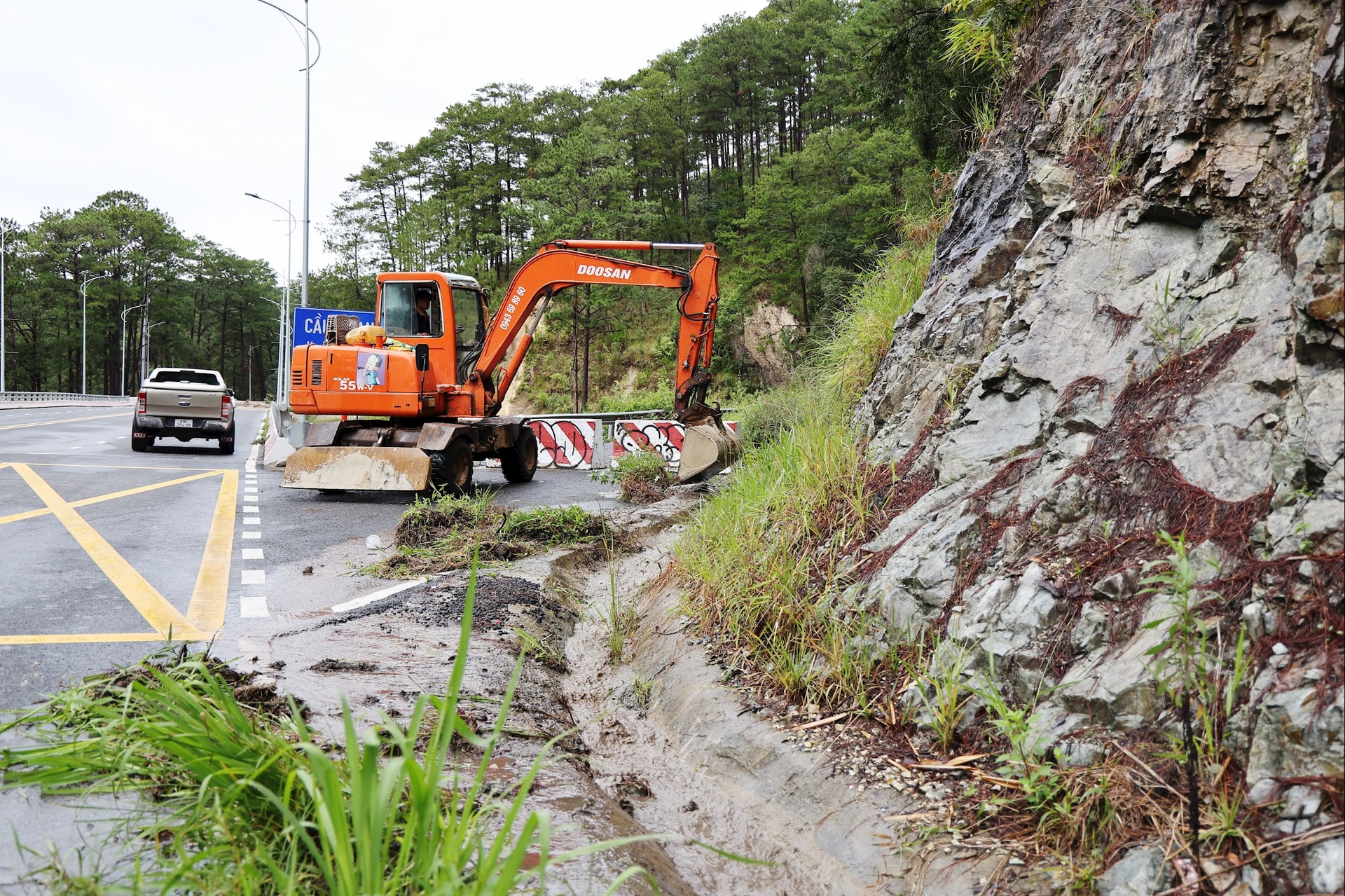
The main culprits causing landslides.
An expert from the Institute of Geological Sciences and Minerals and construction engineers have pointed out the core factors leading to the frequent landslides and degradation of road embankments. Among these, the most fundamental physical cause is the characteristics of the hilly and mountainous terrain in the Lam Dong highlands.
Geological analysis indicates that hilly soils are generally a mixture of rock and clay, with poor cohesion. This type of soil has porous cavities inside, making it susceptible to waterlogging after heavy, prolonged rainfall lasting at least six months each year in the Lam Vien plateau area. During these prolonged periods of rain, when the slopes are waterlogged, the excessive amount of water that cannot drain quickly enough will carry soil and rocks down, leading to the burying of drainage ditches, and in more severe cases, large-scale landslides onto roads.
However, experts also warn that landslides don't only occur during rainy days but can also happen a considerable time afterward, when the soil is still waterlogged. The landslide cycle only ends when the entire geological foundation is completely dry. Landslides in mountainous areas are particularly high-risk in places without old trees or where the forest cover is depleted. Experts say that tree roots play a crucial role in holding the soil.
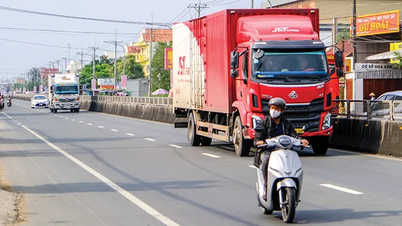
In addition, traffic pressure is also a significant factor. The mountain passes in Lam Dong are currently main roads with a high volume of traffic, especially large trucks and container vehicles carrying goods. This easily causes subsidence and degradation of the embankment slopes, increasing the risk of landslides if not regularly maintained. Poor drainage and maintenance are also considered by construction engineers to be contributing to the increasing severity of landslides.
It is easy to see that many mountain passes currently have drainage ditches and canals that are not regularly cleared. Clogged drainage ditches prevent rainwater from draining, causing it to overflow onto the road surface. Furthermore, some embankments lack drainage systems to collect water flowing down from the hilltops, leading to water runoff and seepage onto the earthen slopes, creating hazards and accelerating soil saturation, thus increasing the risk of landslides. In addition, the use of substandard construction materials for embankments is also a contributing factor to landslides.
Lessons from Japan
Given the serious landslide situation, strengthening disaster prevention and control, especially in mountainous areas during the rainy season, is extremely important. According to experts, the immediate focus should be on water management and slope reinforcement. Soil treatment, retaining walls (both positive and negative slopes), and clearing of horizontal and vertical drainage systems need attention, especially during the rainy season, to prevent further landslides. Most importantly, applying groundwater drainage measures is crucial to stabilize the slope.
In 2023, following a series of serious landslides, Japanese geological experts from Kawasaki Geological Survey Corporation were invited by the Lam Dong provincial government to survey and advise on preventative measures. After the survey, the experts shared their experience and suggested that Lam Dong should establish landslide maps and warning systems in high-risk areas. The country is currently implementing three main measures to mitigate damage from flash floods and landslides: infrastructure reinforcement, early warning systems, and population evacuation.
Following the devastating landslides that caused significant loss of life in 2023, Lam Dong province has identified many areas at risk of landslides and installed landslide monitoring and warning systems. However, the installation of these monitoring systems has only focused on residential areas in urban areas and has not yet been implemented on mountain passes.
Expanding the early warning system to key mountain passes, combined with synchronized and serious technical solutions, will be key to protecting people's safety and maintaining traffic connectivity, minimizing damage during the rainy and stormy season.
Source: https://baolamdong.vn/vi-sao-cac-cung-deo-lien-tuc-sat-lo-403910.html
![[Photo] Mrs. Ngo Phuong Ly meets and exchanges views with Mrs. Peng Li Yuan](https://vphoto.vietnam.vn/thumb/1200x675/vietnam/resource/IMAGE/2026/04/16/1776277858080_phu-nhan-1-jpg.webp)
![[Photo] The General Secretary, President and his wife meet with Vietnamese-Chinese friendship leaders.](https://vphoto.vietnam.vn/thumb/1200x675/vietnam/resource/IMAGE/2026/04/15/1776264829725_vna-potal-tong-bi-thu-chu-tich-nuoc-to-lam-gap-mat-nhan-sy-huu-nghi-viet-nam-trung-quoc-8703641-3130-jpg.webp)
![[Photo] My Son at night: A thousand-year-old heritage site amidst the Milky Way](https://vphoto.vietnam.vn/thumb/1200x675/vietnam/resource/IMAGE/2026/04/15/1776261039184_ndo_br_chon6-jpg.webp)

![[Photo] National Assembly Chairman Tran Thanh Man attends the opening session of IPU-152](https://vphoto.vietnam.vn/thumb/1200x675/vietnam/resource/IMAGE/2026/04/16/1776277863731_ctqh5-jpg.webp)














































































Comment (0)