

That night, the rain pattered incessantly on the tin roof. Each heavy raindrop seemed to fall unevenly, subtly signaling to everyone to wake up and hear the approaching winter. They were a mother and daughter standing together in front of an oil lamp, its flame flung by the wind seeping through the cracks in the door.
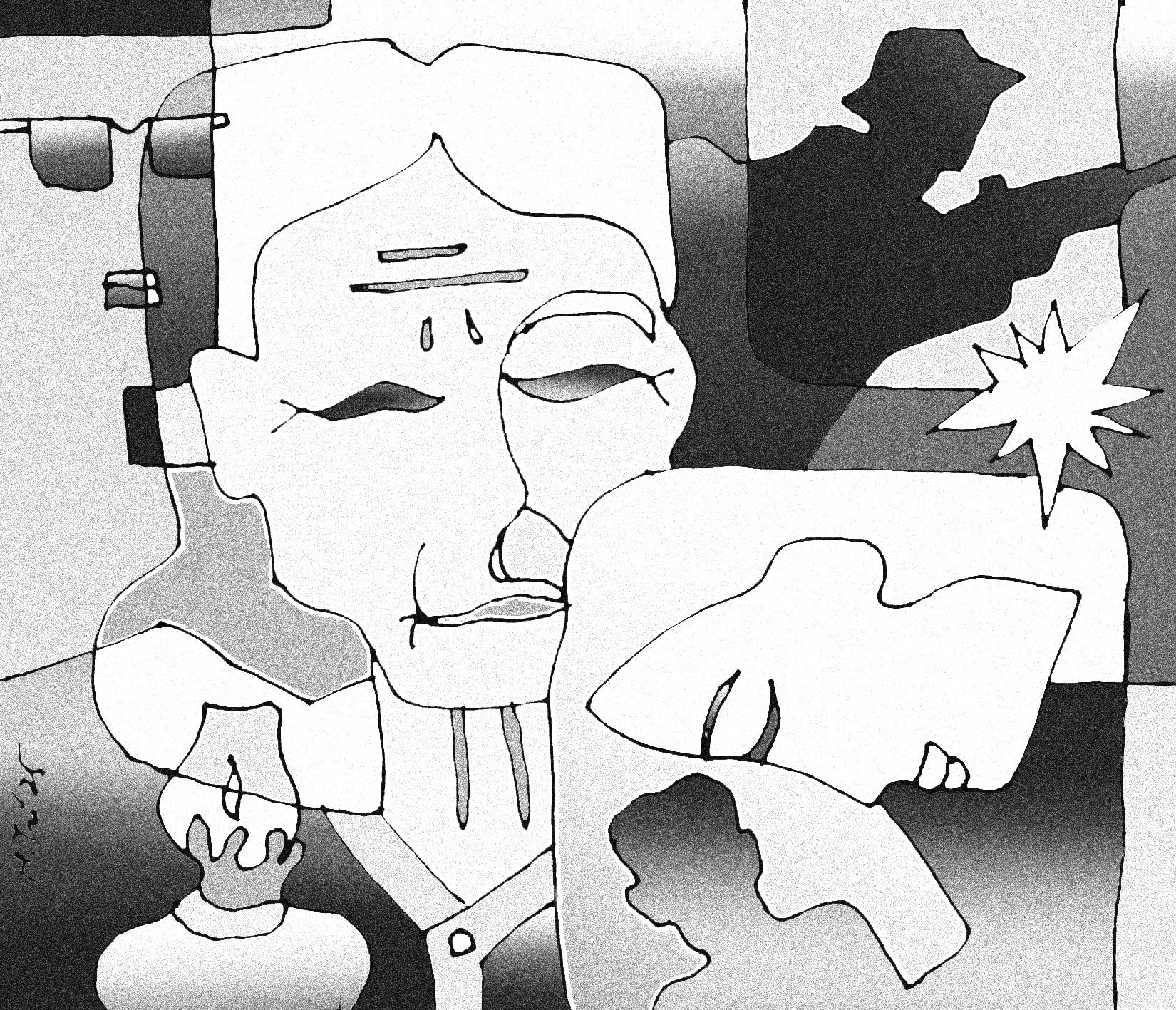
Illustration: HIEN TRI
The mother hugged her son tightly, her suppressed sobs making a muffled "hic... hic" sound. Tears silently fell onto his hand, still warm: "Go safely! Remember to write to me!" Their whispered words and hurried gestures were fleeting. Who knew that outside, the watchful eyes of the village headman were scrutinizing them? The young man gently removed his mother's hand and placed a small paper packet in it: "This is a lock of Thoa's hair, a token of our love. Please keep it for me! I'm leaving now!" Tam had no way to stay, not even for a day. He couldn't escape when, at the age of youth, he had to choose between two paths: jump to Base X or take up arms against the revolution.
Tam's hometown was an insecure area. In the morning, soldiers with their guns swaggered around. In the evening, the Liberation Army took control, using loudspeakers to call on people to resist the repression of the Saigon regime's soldiers.
The revolutionary base area was separated from Nhum village by only a field and a wide river overflowing with water from the upstream. Many times, American soldiers and special forces troops landed and raided Base X, but all ended in disastrous defeat.
The scouts and intelligence-gathering squads moved as if in an uninhabited place. Little did they know that the keen eyes of special forces scouts were watching them from the moment they infiltrated the revolutionary base until they left with joyful expressions. And then, large traps were often laid using precisely activated minefields to ensnare the enemy. Base X had been bombed by B52s many times, but it did not faze the liberation army. The numerous, layered caves, able to withstand heavy bombs and penetrating bombs, connected the nooks and crannies like a labyrinth, striking fear and demoralizing the invaders.
The three words "insecurity" were the assertion of District Chief Ngo Tung Chau during a village meeting in Ha. And it was indeed insecurity, not a joke. Before sunset, our soldiers, clad in AK rifles, marched through the village streets, singing loudly, "Our soldiers endure rain and sun. The rain makes them shiver, the sun darkens their skin..." They were like Phu Dong Thien Vuong rising from the heart of the earth, from the unwavering hearts of the people.
The village of Hạ was densely covered with bamboo. Beneath these ancient bamboo hedges lay secret tunnels that connected to each other, deterring the special police and local military scouts.
At night, Mr. Hai Ken used a loudspeaker made of rolled-up sheet metal, shaped like a trumpet flower, to shout from one end of the village to the other: "Hello! Hello! Listen, villagers of Ha! Listen! The liberation army is inviting you to immediately bring your hoes, shovels, and crowbars and gather at the Mong hut intersection to dig the main road. Hello! Hello!"
The next morning, it was the same Mr. Hai Ken who used a loudspeaker to loudly announce: "Hello! Hello! Listen, villagers of Ha! Listen! Representatives of the commune and the head of Hiep Phu hamlet are calling on you to immediately bring your hoes and shovels and gather at the Mong hut intersection to fill in the main road dug by the communists to prevent military vehicles from entering the X war zone. Hello! Hello!"
*
* *
Not a single night passed without the sound of gunfire echoing through Ha village, accompanied by the persistent barking of dogs from the river. Mrs. Mui anxiously remembered her son, who she heard had joined the main army of the military region. Her husband, the village militia leader, was ambushed and killed by the enemy while returning to the village. She silently received his body, not daring to shed a tear. A shrine for her husband was set up in a corner of the bedroom to avoid the prying eyes of the enemy.
She thought that with her husband's sacrifice, she could raise her children in peace. However, every time the soldiers came to the village to light lamps and explain the Front's policies to the people, the next morning the riot police would come to her house, point their guns at her back, and arrest her, taking her back to the commune for house arrest. This method of raids and repression by the authorities further spurred young men and women to leave their homes and flee to Base X.
The special police in District Y had incredibly keen senses, like American foxhounds. Especially Năm Rô, originally from Hạ village. Rô was assigned by his superiors to monitor the activities of revolutionary cadres operating underground because he knew every nook and cranny of Hạ village. Lieutenant Rô was also highly regarded by his superiors for his fierce anti-communist stance and his cunning in planting spies and informants within the revolutionary ranks.
The day after Tâm jumped off the mountain, Năm Rô led his soldiers to Mrs. Mùi's (Tâm's mother) house, ransacked it, destroyed the belongings inside, and repeated his old tactic: he shot Mrs. Mùi in the back and took her to the commune office for interrogation.
The man pressed the cigarette he was smoking against the frail woman's neck, hissing through clenched teeth: "Who did your son go to Base X with? Who instigated you to let him join the communists?" Mrs. Mui gritted her teeth, enduring the burning heat, and only answered once: "I don't know where he left home!" For a whole week, Ro and his henchmen interrogated Mrs. Mui without getting any results, so they finally released her.
The next day, while visiting the fields, Thoa met Mrs. Mui and approached her: "Brother Tam fought very well, Auntie! We're preparing for a big battle." Mrs. Mui's eyes lit up: "That boy is as brave as his father. Did he send any message to me, my dear?" The girl smiled: "I just happened to find out, Auntie. Don't worry! If there's any exciting news, I'll let you know."
Knowing that Thoa was Tam's girlfriend, Nam Ro kept a close eye on her every move. He had long secretly admired the girl with long, jet-black hair, fair skin, a tall figure, and a captivating smile. He repeatedly went to Thoa's house trying to woo her. Thoa skillfully rejected him, but he never gave up on his pursuit. Despite the area being insecure, Nam Ro secretly sent people to regularly ambush people near Thoa's house, hoping to eliminate his rival, Tam.
The battlefield was becoming increasingly fierce. For a long time, Thoa hadn't received any news from Tam. Every night, Mrs. Mui would light incense and pray to her husband for his protection, asking him to keep her son safe. Meanwhile, Nam Ro continued to commit atrocities against the people of Ha village.
While the soldiers dared not approach places where secret tunnels might be located, every morning he would crouch low, carrying a pistol and several miniature grenades the size of golf balls in his trouser pockets, scrutinizing the bamboo groves and examining the village ponds for signs of freshly dumped earth. Those digging secret tunnels chose to dump the soil into the ponds to conceal their tracks. Năm Rô, ambushing and capturing several revolutionary figures, brought them back to the district for torture. Those who survived, unable to endure the brutal torture, resorted to self-inflicted suffering, working for Năm Rô.
*
* *
On Liberation Day, Mrs. Mui received a death notice stating that Tam had died in the war and his remains had not yet been found. The "Homeland Honors" certificate hung on the wall next to a large photograph that Tam had given to Thoa on the day they fell in love.
As the years passed, Mrs. Mui still clung to the hope that her son, wounded in battle and suffering amnesia, had wandered somewhere and been taken in by the villagers. Then, one day, Tam recovered his health and suddenly returned. She often saw him in her dreams. He was strong and resolute, his eyes fixed on her as he softly said, "I'll be back with you, Mom, and with Thoa. I miss you and her so much! Please wait for me, Mom!"
Occasionally, Mrs. Mui would startle awake, looking up at the portrait, tears like glass beads rolling down her sunken, wrinkled cheeks. Thoa, now a woman past fifty, would visit Mrs. Mui whenever she had free time. One day, Mrs. Mui handed Thoa a package of paper, her voice hoarse: "Tam gave this to me to keep, and now I'm returning it to you. Find someone you like and marry them, because Tam will surely not come back!" Thoa's hands trembled as she unfolded the layers of paper. A lock of still-green hair appeared. She burst into tears. Mrs. Mui cried with her. The two women embraced and wept.
*
* *
A sleek, black Mercedes slowly came to a stop at the intersection. A middle-aged man in a white suit, his hair slicked back, revealing a high forehead, stepped out. He glanced around as if searching for something for a long time. He whispered to the driver, "Go across the street and ask the woman at the grocery store if this is the Mồng hut intersection!"
The man lit a cigarette, took a long drag, and exhaled the smoke in small puffs, appearing lost in thought. In an instant, the driver turned around with a grumpy expression: "It really is the Mồng Hill Crossroads, sir! I was just asking for directions, but the vendor kept staring at me, it was really annoying!" The man scoffed: "Knowing this is the Mồng Hill Crossroads is good enough; why bother paying attention to her attitude?"
Several neighbors came out to look at the stranger. One person, sounding knowledgeable, said, "Mr. Nam Ro is back visiting his hometown. He used to be a big shot in Ha village, and now he's back and looking for someone." Just then, Mrs. Mui and Ms. Thoa came out of the grocery store and walked towards the Mercedes. The man stared in astonishment, hastily got into the car, slammed the door shut, and urged the driver to speed away like a madman.
Source: https://baoquangnam.vn/viet-cua-chien-war-3153754.html

![[Photo] Prime Minister Pham Minh Chinh receives Lao Minister of Education and Sports Thongsalith Mangnormek](/_next/image?url=https%3A%2F%2Fvphoto.vietnam.vn%2Fthumb%2F1200x675%2Fvietnam%2Fresource%2FIMAGE%2F2025%2F12%2F16%2F1765876834721_dsc-7519-jpg.webp&w=3840&q=75)
![[Live] 2025 Community Action Awards Gala](/_next/image?url=https%3A%2F%2Fvphoto.vietnam.vn%2Fthumb%2F1200x675%2Fvietnam%2Fresource%2FIMAGE%2F2025%2F12%2F16%2F1765899631650_ndo_tr_z7334013144784-9f9fe10a6d63584c85aff40f2957c250-jpg.webp&w=3840&q=75)
![[Image] Leaked images ahead of the 2025 Community Action Awards gala.](/_next/image?url=https%3A%2F%2Fvphoto.vietnam.vn%2Fthumb%2F1200x675%2Fvietnam%2Fresource%2FIMAGE%2F2025%2F12%2F16%2F1765882828720_ndo_br_thiet-ke-chua-co-ten-45-png.webp&w=3840&q=75)

![[Photo] Prime Minister Pham Minh Chinh receives the Governor of Tochigi Province (Japan)](/_next/image?url=https%3A%2F%2Fvphoto.vietnam.vn%2Fthumb%2F1200x675%2Fvietnam%2Fresource%2FIMAGE%2F2025%2F12%2F16%2F1765892133176_dsc-8082-6425-jpg.webp&w=3840&q=75)







































![[Photo] Prime Minister Pham Minh Chinh attends the Vietnam Economic Forum 2025](https://vphoto.vietnam.vn/thumb/402x226/vietnam/resource/IMAGE/2025/12/16/1765893035503_ndo_br_dsc-8043-jpg.webp)























Comment (0)