

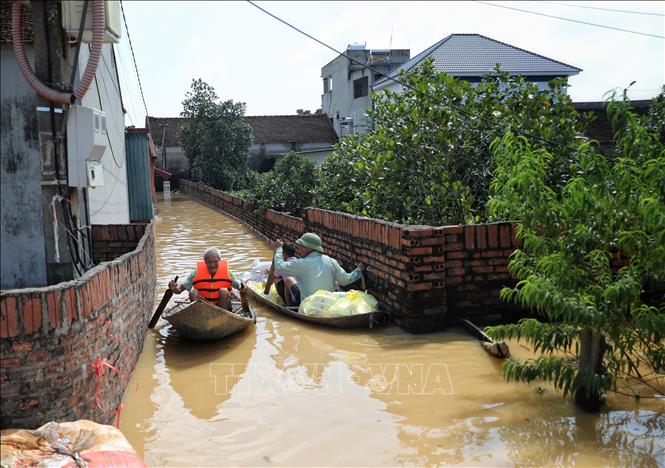
On behalf of the Vietnamese Government, Deputy Minister of Agriculture and Environment Nguyen Hoang Hiep extended sincere thanks to all partners, international organizations, and individuals who have consistently supported Vietnam in disaster prevention and mitigation efforts.
In 2024, partners provided Vietnam with approximately $25 million in aid along with thousands of tons of relief goods, making a significant contribution to helping people overcome difficulties after natural disasters. The Vietnamese people were truly moved and appreciated this valuable, timely, and effective support.
In 2025, natural disasters in Vietnam are expected to continue to be more complex and extreme. Despite Vietnam's efforts to implement numerous prevention and response measures, in reality, many natural disasters have occurred at a level exceeding the capacity of the population and the existing response system.
In particular, recent storms and their aftermath have caused serious damage to both people and property. The total estimated damage to date has reached 35 trillion VND, equivalent to approximately 1.3 billion USD – accounting for nearly 50% of the total damage caused by natural disasters in 2024. National GDP growth has also been affected, decreasing by about 0.2 percentage points, Deputy Minister Nguyen Hoang Hiep stated.
Deputy Minister Nguyen Hoang Hiep also stated that the patterns of natural disasters are changing significantly: some storms move very quickly over the sea but slow down when they reach land, causing prolonged heavy rain. In particular, late-season storms are making landfall in the North – a rare occurrence in previous patterns. Currently, flood levels in many areas have exceeded historical levels, posing a very high risk of prolonged flooding and landslides.
In light of this situation, the Vietnamese Government is proactively implementing response measures and support policies; and hopes to continue receiving the cooperation and support of its partners. Through this meeting, Vietnam wishes to share updates on the natural disaster situation, priority support needs, and to agree on mechanisms for the rapid and efficient transportation and distribution of relief goods.
Deputy Minister Nguyen Hoang Hiep also shared that essential goods for people's lives such as food, drinking water, water filters, household appliances, disinfectants, etc., are extremely urgent. In addition, restoring housing and production after the natural disaster is a top priority. According to preliminary statistics, almost 100% of houses in the flooded areas were damaged and need repair. Although the Vietnamese Government will issue a resolution with mechanisms to support and restore production, domestic resources are insufficient, and cooperation from international organizations is urgently needed.
Essential infrastructure such as health centers, schools, and government offices also need to be restored and put into operation as soon as possible to ensure stable living conditions, restore production, and maintain public services, Deputy Minister Nguyen Hoang Hiep said.
Regarding the coordination mechanism, Deputy Minister Nguyen Hoang Hiep proposed maintaining the approach used in 2024, with the participation of field assessment teams. “If all goes well, the working group will begin surveying the most severely affected areas tomorrow. Through this, we can assign tasks according to the strengths of each partner, maximizing overall effectiveness in emergency support and post-disaster recovery,” Deputy Minister Nguyen Hoang Hiep suggested.
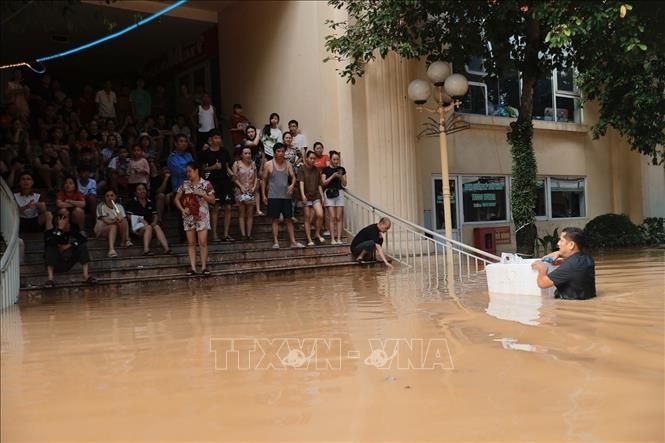
Ms. Pauline Tamesis, the United Nations Resident Coordinator in Vietnam, also expressed her deepest condolences to the Government and people of Vietnam for the immense losses of life and property caused by natural disasters in recent times. The United Nations in Vietnam stands alongside Vietnam not only in emergency response but also in long-term programs aimed at enhancing the resilience and adaptation of communities.
This year, Vietnam is facing floods of unprecedented scale and intensity, particularly affecting the most vulnerable groups in society. The United Nations will continue to work alongside the Vietnamese Government in disaster response, mobilizing resources, experts, and technology to provide effective support, especially in the context of increasingly limited international resources.
According to Pauline Tamesis, practical experience, particularly in responding to Typhoon Yagi in 2024, has yielded valuable lessons about the effectiveness of coordinated efforts. Partners will leverage their strengths, mobilizing the most appropriate and practical support according to their respective capabilities and expertise, to ensure that all assistance reaches the right place, at the right time, and meets the right needs.
At the meeting, several partners reported on their swift response and support to provinces and cities affected by recent natural disasters. All partners expressed their desire to deploy survey teams soon in order to develop plans and strategies for providing the quickest, most timely, and effective assistance.
Deputy Minister Nguyen Hoang Hiep instructed the Department of Dyke Management and Disaster Prevention and Control to quickly develop a plan and potentially establish three working groups to visit three routes: Tuyen Quang and Phu Tho; Cao Bang and Lang Son; and Bac Ninh and Thai Nguyen.
Source: https://baotintuc.vn/thoi-su/viet-nam-mong-muan-cac-doi-tac-quoc-te-tiep-tuc-ho-tro-khac-phuc-hau-qua-lu-lut-sau-bao-20251009172147953.htm

















![[Photo] Prime Minister Pham Minh Chinh holds a phone call with the CEO of Russia's Rosatom Corporation.](/_next/image?url=https%3A%2F%2Fvphoto.vietnam.vn%2Fthumb%2F1200x675%2Fvietnam%2Fresource%2FIMAGE%2F2025%2F12%2F11%2F1765464552365_dsc-5295-jpg.webp&w=3840&q=75)













































Comment (0)