

China's Qibbot robot can be remotely controlled with a response latency of just 12 milliseconds, less than 1/15th the time it takes to blink.
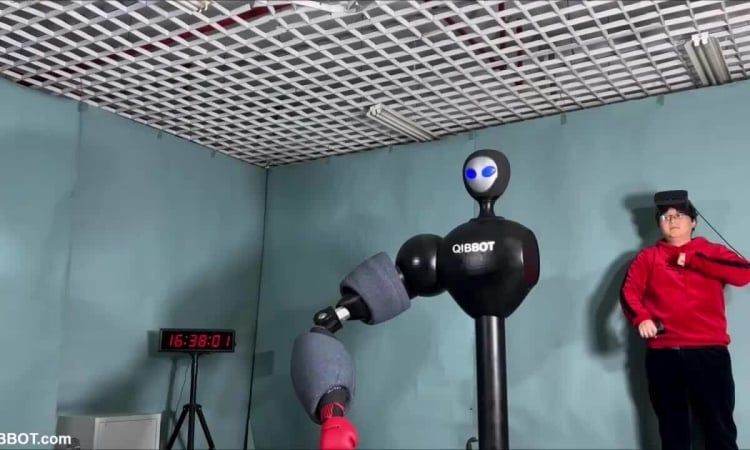
Qibbot remote-controlled robot. Video : Qibbot
Qibo Robotics Company in Shandong province, eastern China, has developed Qibbot, a one-armed, remote-controlled robot designed to mimic the real movements of a boxer, SCMP reported on August 3. The operator of Qibbot can stand nearby and control its actions like a coach outside the ring.
In a video shared by Qibo, Qibobot demonstrates an incredible response latency of just 12 milliseconds, a record for remote-controlled robotic systems. Qibo Robotics introduces it as the "world's fastest telerobot".

The primary technical challenge with fast remote-controlled robots is not their speed itself, but rather their responsiveness to operator actions. In situations such as sports competitions, crime fighting, and military operations, a robot's response time is extremely critical. Even the slightest delay can have significant consequences.
According to Geng Tao, founder of Qibo Robot, over 95% of the world's remote-controlled robots are designed for low- or medium-speed tasks, exhibiting significant reaction delays, often exceeding 100 milliseconds.
Qibbot has extremely low latency, just 12 milliseconds during high-speed operations, less than 1/15th the time it takes to blink, according to Geng. This means the operator can hardly feel any lag.
Remote-controlled robots rely on multiple factors to optimize speed and performance. To achieve impressive speed and extremely low latency, the team of experts at Qibbot focused on solving mechanical and controller challenges.
With Qibbot's control algorithm, Geng and his colleagues used a novel predictive controller alongside the conventional reactive controller. This real-time predictive tool anticipates system latency and reacts in advance, partially compensating for latency caused by mechanical systems and virtual reality devices.
Around the world, only a few robots have achieved the ability to be controlled remotely at high speeds with extremely low latency, but they are small in size and their remote control devices are very complex. Meanwhile, Qibbot stands 1.9 meters tall with a 1.5-meter-long arm, and even the one-armed version weighs up to 140 kg.

The Qibbot project began in 2019, and the team of experts spent three years developing the first-generation model. They then spent another year refining it before launching Qibbot in June.
Geng's team plans to build an upgraded version of Qibbot later this year with two arms, each with more joints and smoother movement. They believe that fast-moving, remotely controlled robots have potential applications in many emergency and dangerous situations such as crime fighting and military operations, and can significantly improve production efficiency.
Thu Thao (According to SCMP )
Source link






























































![[Video] Sunset at Lap An Lagoon – Where the sun sets over the fishing nets](https://vphoto.vietnam.vn/thumb/1200x675/vietnam/resource/IMAGE/2026/05/31/1780192137701_beach-landscape-sea-water-nature-grass-745871-pxhere-com.jpeg)







































Comment (0)