

At times, amidst the hustle and bustle of the city, a longing for tranquility arises. An afternoon without the blaring car horns, without a packed schedule, just a gentle breeze rustling through the leaves and the chirping of birds calling to each other as they return to their nests. In such moments, memories transport us back to the old porch, where the hammock once swayed between two pillars, where children once lay listening to the wind tell stories of their childhood.
At some point, when the gentle twilight falls on the moss-covered tiled roofs, the village bamboo groves rustle in the last breeze of the day, and the scent of straw from the kitchen lingers in the air, in that quiet moment, amidst the hustle and bustle of life, our hearts sink, remembering an old corner of the veranda where an old hammock once swayed to the rhythm of time.
The old hammock – more than just an ordinary object – is a piece of the soul of the countryside, a repository of innocent childhood days, a gentle call from departed loved ones. And then, in the hustle and bustle of life, a fleeting thought of that old hammock brings a moment of calm, as if touching the deepest, most beautiful part of one's memory.
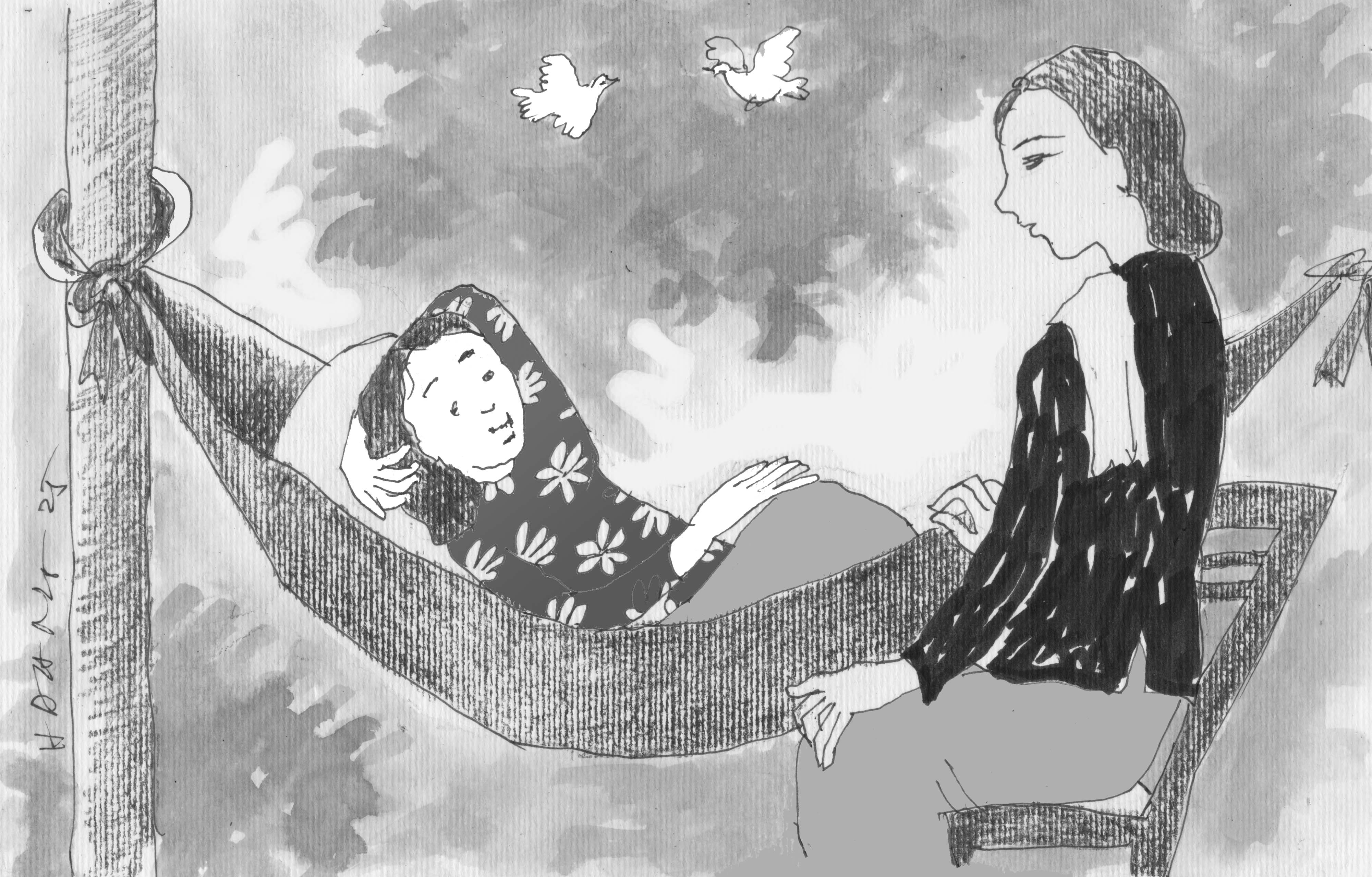 |
| Illustration: HOANG DANG |
Back then, hammocks were a connecting thread between people and nature, between the simple, rustic charm of the countryside and the innocent hearts of children. Securely tied to sturdy, dark ebony wooden posts, they creaked and swayed gently each summer afternoon, like a lullaby from Mother Earth. The hammock was inextricably linked to the lullaby, an invisible bond. I vividly remember the creaking of the hammock on those sweltering afternoons. My grandmother or mother would often lie there fanning themselves with a palm-leaf fan, softly humming lullabies: “Oh… Who can lie in a hammock without swaying? Who can meet someone from the past without looking?”, “The bee makes honey and loves the flower. The fish swims and loves the water, the bird sings and loves the sky…”
Following in the footsteps of grandmothers rocking their mothers, and mothers rocking their children, lullabies have become the essence of folklore, and the hammock has become a heritage of the countryside, a continuous source of life. Those gentle, deeply affectionate melodies, I didn't understand, and didn't need to understand, their meaning. Because when a mother rocks her child, she is also rocking her own heart. Those songs, that voice of hers, seeped into my very being, into every childhood dream.
Lying in the hammock, I gently kicked it with my feet, letting it sway, my eyes peering through the gaps in the thatched roof to see clouds drifting by and birds chirping among the branches. Beyond the hibiscus hedge, the midday clucking of chickens and the clanging of buffalo bells echoed from the riverbank, all like a simple yet deeply moving symphony of the countryside. The hammock was where I listened to stories of the old village, stories of the banyan tree at the village gate, stories of my grandparents' youth planting rice in the fields. It was where I hid my childish joys and sorrows, where my father mended his torn hammock, and my mother took a rest after her early morning market trip, her hair still fragrant with the scent of sunshine.
I still remember my father's story: the day our family received the death notice for my uncle, a war hero who died fighting against the Americans, the most cherished memento he left behind was a hammock made of dark green parachute fabric. That hammock was a part of my uncle's memories, a part of the blood and flesh of our country. It accompanied him throughout his years of marching on the Truong Son trail, temporarily hung between two trees in the forest, where he would nap amidst the bombing and shelling. The hammock, woven from dark green parachute fabric, absorbed sweat and forest dust, enduring countless sleepless nights, bouts of jungle fever, and even the dreams of his youth.
When the war ended, the soldiers returned home with their belongings, and the memories of the village boy reappeared in the hammock hanging under the eaves of the house as a memento. That hammock still felt cool to the touch, fragrant with the sweat of my grandmother, and then my parents, a lifetime of hard work. It continued to sway peacefully on summer afternoons, nurturing the souls of my siblings and me during our childhood. Each time I lay in the hammock, I felt not only the comfort of an old object, but also the breath of the ancient forest, of the harsh years that the previous generation had endured.
Growing up, following long journeys, people from the countryside left their villages, leaving behind their old hammocks, carrying with them dreams and memories. Now, no matter how far I go, my heart still aches whenever I hear the sound of a hammock echoing somewhere. That hammock may be worn and tattered, it may have been replaced by a comfortable sofa in a city apartment, but the feelings it holds are irreplaceable.
As the years passed, I grew up, left the village to study and work, and wandered through the city. The house no longer had wooden posts to hang the hammock; instead, there were cushioned chairs and air conditioning. But there was an emptiness in my heart that nothing could fill: the longing for the old hammock, the smell of the countryside after the rain, the lullabies my grandmother sang, and the slow, peaceful pace of life, like the river flowing past our gate.
In the afternoon in the countryside, the golden sunlight bathes the surface of the pond where water lilies float, and a gentle breeze carries the scent of fresh straw through the rows of betel nut trees in front of the gate. In that peaceful space, I am reminded of the hammock of yesteryear, the hammock that hung silently under the red tiled eaves, where my idyllic childhood memories were imprinted in the arms of my grandmother and mother. The hammock is no longer under the old eaves, but it still sways in my heart as a part of my memories, a touch of the countryside's soul that flows forever in my heart, gentle yet enduring, just like my homeland itself.
Source: https://baodanang.vn/channel/5433/202505/a-oi-thuong-canh-vong-xua-4006291/













































![[Infographic] Vietnam's Economic Situation Report, Q1 2026: Strong Growth Momentum](https://vphoto.vietnam.vn/thumb/402x226/vietnam/resource/IMAGE/2026/04/04/1775298512042_tang-truong-kinh-te-viet-nam.jpeg)
![[Image] Close-up view of the 10-lane road connecting to Long Thanh Airport](https://vphoto.vietnam.vn/thumb/402x226/vietnam/resource/IMAGE/2026/04/04/1775291871988_ndo_br_1-resize-5690-jpg.webp)




















Comment (0)