

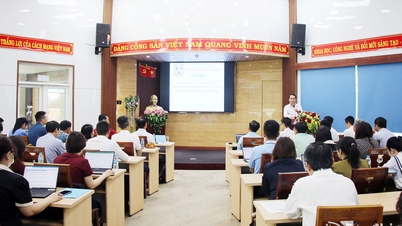
The "Meet the Experts" program, themed "Positioning Yourself in the Digital Age - Who Will Master AI?", organized by the University of Social Sciences and Humanities, Vietnam National University Ho Chi Minh City, analyzed, suggested, and guided the necessary skills for everyone, especially young people - the main force of the labor market in the not-too-distant future.
Pressure and opportunities from AI
With AI becoming a key driver of digital transformation, experts have analyzed the situation to help each individual understand their role in the face of these dramatic technological changes.
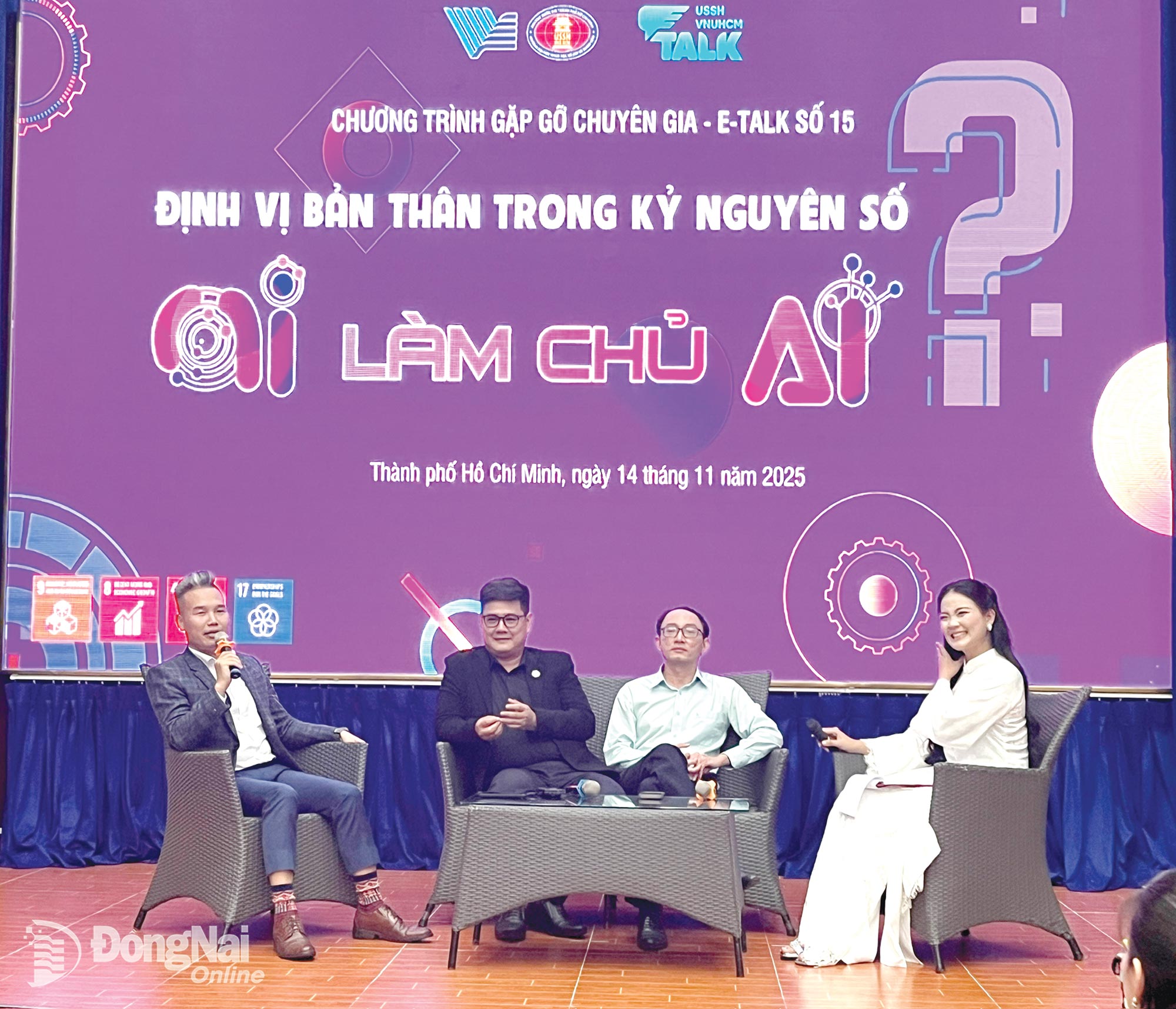 |
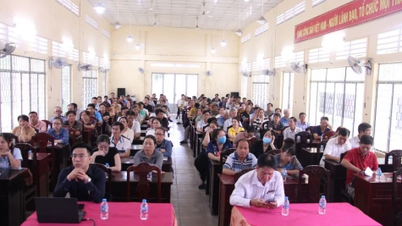
| Speakers exchange ideas at the Expert Meeting Program on the topic "Positioning Yourself in the Digital Age - Who Will Master AI." Photo: Lam Vien. |
According to the speakers, humans can only perform mental calculations up to five digits at most, while a single "enter" button can search thousands of documents, millions of poems, literary works, etc. Clearly, humans are completely outmatched in terms of measurement and calculation, but AI wouldn't "evolve" if we didn't input it. Humans, on the other hand, have a natural evolution and adaptability, especially in Vietnam, where adaptability is exceptionally good. We have a mechanism for self-learning and self-improvement; importantly, the knowledge we acquire is imbued with emotion.
Nguyen Vo Truong An, Deputy General Director of ASEAN Carbon Credit Exchange Joint Stock Company, commented: "Actually, AI is not new; it appeared in the world about 15-20 years ago. Technically, AI can be basically divided into two main types: machine learning, an algorithmic model where, when we provide it with input data, it will 'run' and produce the desired result; and a more advanced model, AI that generates data, finds its own data, and upgrades itself... thereby allowing the quality of AI tasks to evolve every day."
According to Mr. Truong An, generally speaking, all AI models in the world today depend on the following factors: human data provided to the AI, allowing the AI to access it; giving the AI the ability to think – algorithms; and goals set by humans. In addition, AI needs electricity to operate and water to cool down. Therefore, technically, humans clearly control AI, but the question is how to control it most effectively.
Preparing for the Digital Age
At the Expert Meeting program themed "Positioning Yourself in the Digital Age - Who Will Master AI?", speakers analyzed career trends, recruitment requirements, and the necessary skills for young people to adapt to the digital environment. Accordingly, each young person needs to identify and demonstrate their role at each stage.
 |
| This image of Tran Bien ward in 2050 was created by artificial intelligence. |
According to Mr. Nguyen Vo Truong An, once young people have identified their roles and aspirations, the next step is to acquire the necessary skills for the AI era. Currently, AI offers many tools for various purposes, such as AI translation, AI design, and AI for automated video and image production. These AI tools and applications enhance work efficiency, therefore, everyone needs to cultivate the necessary skills to master AI.
Giving an example comparing TikTok and Ted Talk, Mr. Pham Cong Nhat, Director of Communications at DOL English, stated: With TikTok, viewers watch short video clips and are interested in factors such as whether they are viral, trending, or whether the content is nonsensical or funny. These video clips don't require critical thinking, leading to the gradual "deterioration" and "shrinking" of our brains. In contrast, Ted Talk offers insightful content that encourages critical thinking and helps listeners develop critical thinking skills, which is highly valued by recruiters.
At the aforementioned forum, speakers also discussed the essential skills that young people need to equip themselves with right now. According to the speakers' suggestions, young people should read more books because reading offers many benefits, including improved concentration, language development, and brain development.
Sharing his thoughts on cultivating reading skills in today's busy society, Mr. Nguyen Vo Truong An said: He often listens to audiobooks. He takes advantage of opportunities to listen to audiobooks while commuting, doing housework, etc., to access new ways of thinking and stay updated on innovative developments in the world. That's how he survives, changes, and develops himself.
The more humans there are, the more they "survive".
While AI is believed to be capable of many things such as translation, machine and equipment control, and accessing large data sources, Mr. Nguyen Vo Truong An argues that professions involving innovation and optimization will not be replaced by AI. This is because the entire mindset regarding innovation, identifying outdated processes, replacing them with new ones, and optimizing resources can only be achieved by humans. Only humans, with their own thinking, experience, and reasoning, can "experiment" and "fail," proposing new things…
Discussing job opportunities for young people in the digital age, Master Pham Cong Nhat emphasized: In an era where AI calculates and analyzes with just a press of an enter key, the more human-like our skills are, the more we will "survive".
Clearly, AI is merely a supporting tool and cannot replace human thinking, experience, and values. Young people need to equip themselves with digital thinking, professional competence, and the ability to apply technology correctly to gain an advantage in today's job market.
It depends on each person's perception. The question arises: Why are such sophisticated and high-quality social networks "free"? Pham Cong Nhat, Director of Communications at DOL English, explains: Social networks collect information, analyze user data, and then "manipulate" user behavior and profit from understanding their users. Social networks aren't inherently good or bad; it depends on the user's perception. Those who understand and "use" them will gain many advantages. Those who don't understand will become "addicted" to social networks, leading to a loss of many soft skills – in other words, the social network "uses" them. The question of who "uses" whom ultimately depends on each individual's perception… |
Lam Vien
Source: https://baodongnai.com.vn/dong-nai-cuoi-tuan/202511/ai-lam-chu-ai-872219c/


![[Photo] General Secretary and President To Lam receives Amazon's Senior Vice President David Zapolsky](https://vphoto.vietnam.vn/thumb/1200x675/vietnam/resource/IMAGE/2026/05/22/1779466547770_a1-bnd-3513-6601-jpg.webp)





























































































Comment (0)