

Tet couplets are a unique literary genre. They consist of only two lines that are opposite in wording, meaning, and sound, adhering strictly to rhyme and meter. While concise and minimalist, when the two lines combine to form a harmonious whole, they brilliantly convey the thoughts and feelings of the writer and contain within them a treasure trove of Vietnamese culture – "meaning beyond words."

Because couplets are concise, refined, and strictly bound by rules, composing them is a difficult task. "Composing couplets is easy, but answering them is difficult," only learned scholars with profound knowledge of literature and historical allusions can accomplish this.
As a great cultural figure of the nation and the era, Ho Chi Minh's poetic legacy includes some extremely interesting and meaningful New Year couplets, written in erudite and concise language, imbued with Vietnamese and Eastern culture, and marking the distinctive poetic style of the revolutionary poet Ho Chi Minh.
In the spring of the year Giap Than - 1944, Ho Chi Minh wrote the article "Greeting Spring" in the Dong Minh newspaper, which included a couplet with profound meaning regarding the relationship between the joyful atmosphere of spring, celebrating Tet, celebrating the revolution, and wishing success: " Pouring a cup of spring wine, celebrating the revolution / Writing an article to greet Tet, wishing success ."

The Tet holiday of 1946, the year of the Dog, was the first traditional Lunar New Year after the successful August Revolution and the establishment of the Democratic Republic of Vietnam. President Ho Chi Minh composed a New Year couplet: “ Republican wine, equal flowers, celebrating the Spring of independence / Freedom cakes, fraternal sausages, celebrating the Tet of democracy .” Sharing that same joy, in his poem “Celebrating the National Newspaper” on the occasion of the first independent Tet, he wrote two pairs of couplets:
Independent, three glasses of wine, full and empty.
Freedom, golden and red, a forest of flowers
Homes everywhere welcome the democratic spring.
The whole nation rejoices in the blessings of the republic.
During the Tet holiday of the Year of the Pig 1947, President Ho Chi Minh visited the Voice of Vietnam radio station located at Tram Pagoda in Ha Dong (formerly) to recite a poem wishing a Happy New Year to the soldiers and people of the whole country. The abbot of the pagoda had prepared paper and pen and asked him for a couplet to celebrate the spring. He smiled brightly and happily wrote:
The resistance will surely win.
Nation building will always succeed.
Uncle Ho's couplet became a prophecy, a source of encouragement and faith for the entire nation as it embarked on the arduous resistance war.
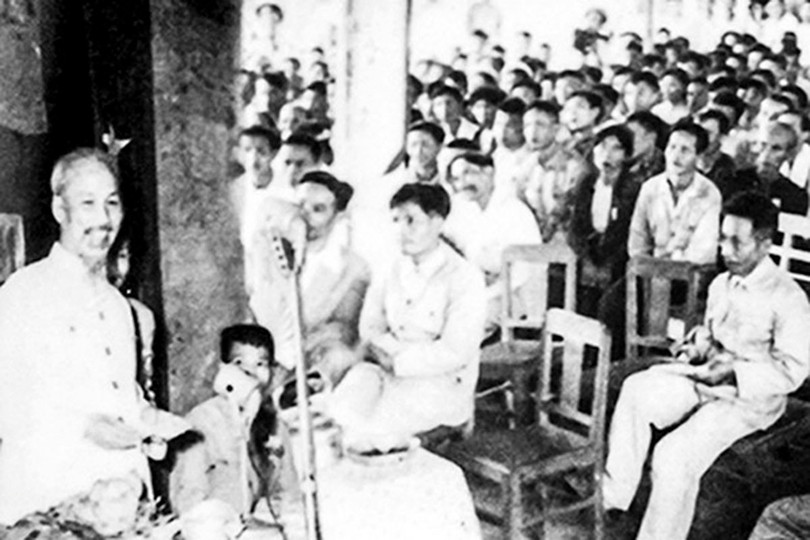
The Lunar New Year of 1953 was a vibrant one for the nation, with the entire army and people enthusiastically launching a general counter-offensive. In his "New Year's Greeting Poem" published in the Nhan Dan newspaper, Uncle Ho wrote like a rallying cry, like a battle cry, urging the entire nation into the final battle that would create a Dien Bien Phu victory that shook the world:
The protracted resistance will surely be victorious.
Independence and national unity will certainly lead to success.
As a man of profound Confucian scholarship, in his couplets, Uncle Ho skillfully used ancient idioms, combining them with popular, accessible language to create a harmonious blend of ancient and modern emotions. During the Tet holiday of 1955 (Year of the Goat), the resistance war against the French had achieved complete victory, the North had been fully liberated, and peace, independence, and democracy, though not yet complete throughout the country, had truly come to the North. In those couplets celebrating the spring, Uncle Ho wrote:
Peace, Unity, Independence, Democracy - Three auspicious signs.
Unity, Competition, Increased Production, and Saving - Five Blessings Entering the Home.
In this couplet, Uncle Ho used familiar New Year's greetings from Vietnamese and Eastern culture. The idiom "three goats opening the way" is taken from the three goats in the I Ching, symbolizing good fortune and opportunities, the end of hardship. The idiom "five blessings entering the house" refers to the five blessings: "longevity," "wealth," "health," "virtue," and "a peaceful death," representing the aspirations and desires of each person as they enter the new year. The fusion of ancient and modern cultures has made this couplet both traditional and modern, easily relatable to people.

Every spring, Uncle Ho wrote poems wishing a Happy New Year to soldiers and the people. His New Year poems were always written in the "seven-word eight-line" or "four-line" style, and therefore, he frequently used parallelism. In his New Year poems, many pairs of lines, if separated, would form interesting and meaningful couplets celebrating the New Year and Spring. In the spring of 1956, amidst the joy of the North competing to heal the wounds of war and rapidly advance towards socialism, and the South maintaining unwavering faith, in his New Year poem, Uncle Ho wrote:
The North is competing in construction.
The South held firm as an impregnable fortress.
For Uncle Ho, couplets were not only a cultural tradition of the spring season but also a weapon for him to wage revolution; the trumpet call to arms was the "proclamation" of the nation when Tet (Lunar New Year) arrived and spring came.
His couplets contribute a new style to the treasury of Vietnamese Tet couplets, not overly bound by traditional rules but still preserving the essence of our ancestors' couplets.
Source: https://baohatinh.vn/bac-ho-viet-cau-doi-tet-post305849.html

















































Comment (0)