

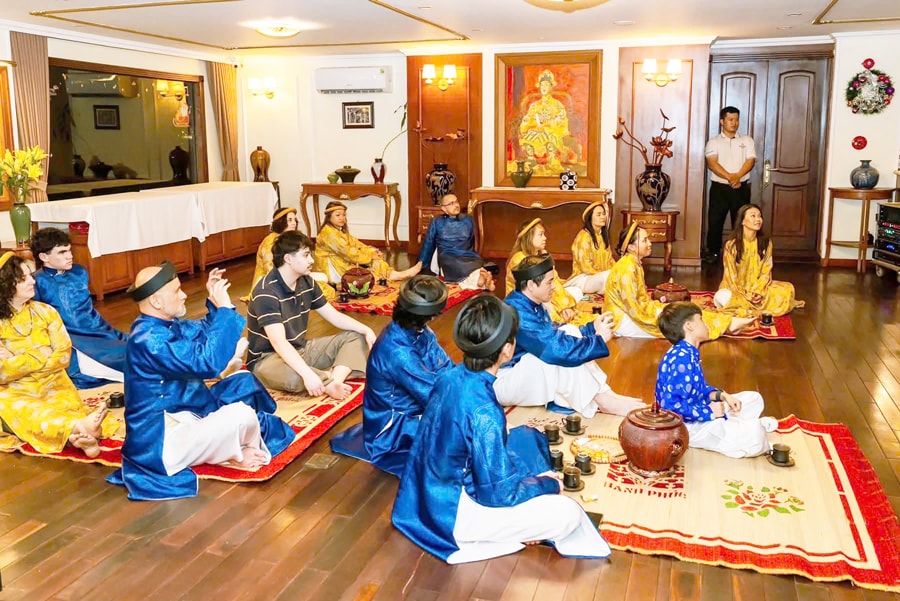
Falling in love with the soul of Thang Long
In the context of increasingly deep cultural exchange, the traditional values of Vietnamese Tet are viewed from many different perspectives. In the eyes of international friends, Tet still retains the richness of a distinctive culture, where family and spiritual values are elevated to the highest level.
Stella Ciorra, a British woman who has lived in Hanoi for nearly 30 years, is currently the President of the Friends of Vietnamese Heritage Association. She doesn't call herself a guest, but rather a child of the homeland comforted by Tet (Vietnamese New Year). Living in the Lac Long Quan area, Stella calls the two weeks leading up to Tet "The build-up period." She loves the traffic jams and the hustle and bustle of the Quang Ba flower market, because that's what Tet truly is.
If James Cooper, a British architect, once likened the scene of motorbikes carrying peach blossoms and kumquats on Hang Luoc Street to a "great migration of peach branches" or a chaotic yet poetic form of "art installation," then for Stella Ciorra, Tet enters the consciousness through the senses of smell and sight.
“Tet has a very distinctive scent, one that brings a sense of comfort,” shared Stella. It's a blend of the subtle fragrance of incense from temples and pagodas and the pure aroma of the herbal tea brewed on the afternoon of the 30th of Tet. This herbal fragrance, combined with the red of couplets, lanterns, and national flags hanging throughout the streets, has become a sacred spiritual symbol. “Whenever I think of Hanoi, that red color always comes to mind. The color of luck, happiness, peace, and new beginnings,” Stella said emotionally.
When Tet (Vietnamese Lunar New Year) is "tailor-made" for the high-end clientele.
Gone are the days when international tourists were hesitant to visit Vietnam during Tet (Lunar New Year) due to fears of shops closing and services ceasing. Under the skillful direction of professional travel companies, this limitation has been transformed into unique, authentic, and luxurious cultural tourism products.
Mr. Pham Ha, CEO of LuxGroup - renowned for its business philosophy of "emotional tourism," stated: International tourists, especially those in the luxury segment, are increasingly choosing the Lunar New Year period to visit Vietnam. They are not looking for concrete structures but rather for "living heritage."
At LuxGroup, the Lunar New Year experience for Western tourists is designed like a sophisticated film script. Before Tet, visitors immerse themselves in the hustle and bustle of the city streets, Buoi Market, and flower markets to feel the vibrant life of the people. But at the moment of New Year's Eve, they are present in the absolute tranquility of Ha Long Bay or Lan Ha Bay. On the cruise ships, the atmosphere of the traditional Northern Vietnamese Tet is fully recreated with peach blossoms, red couplets, and especially the Hang Trong paintings. He shared: "These paintings are not just for decoration; the 'To Nu' and 'Tu Binh' paintings 'tell' the story of the Vietnamese worldview to tourists. In addition, on the cruise ship, tourists can also try their hand at making banh chung (traditional rice cakes), listen to the legend of the round sky and square earth, and let their souls be carried away by the melodies of ca tru (traditional Vietnamese folk singing) amidst the vast expanse of the water."
Sharing the same perspective of turning "inconvenience" into "privilege," Mr. Trinh Viet Dung, CEO of Asiana Travel, affirmed that Vietnam is fully capable of welcoming global billionaires with "unimaginable" requests, as long as we "sell" them privacy and emotion. "I once organized a trip for a group of American billionaires who requested a recreation of the Lunar New Year atmosphere right in the middle of... October! To meet their demands, the company had to 'seal off' an old apartment complex on Ly Nam De Street, hire artisans to arrange out-of-season peach and kumquat blossoms, recreate the New Year's Eve feast and worship space. Another time, it was a lunch amidst golden ripe rice fields in Ninh Binh – an event that took place while other fields were still green. The trip combined helicopter and yacht travel, costing over ten billion dong many years ago. These 'telling' figures prove that: Tet culture, if exploited properly, is a 'gold mine' for the tourism industry."
Making Vietnamese Tet a global tourism brand.
From the stories above, it's clear that the potential of Tet tourism is limitless. But to transform this potential into a competitive advantage and gradually establish a leading position in the region, we need a systematic strategy, instead of a fragmented approach of "seasonal dishes." Mr. Nguyen Thuong Quan, Chairman of the Vietnam Chef Training and Employment Association, emphasized the crucial role of cuisine in winning over tourists. According to him, cuisine accounts for 70% of satisfaction with a destination. However, to ensure that Tet feasts for Western guests retain the "soul" of Vietnam while also appealing to international tastes, chefs need to be sophisticated in "interpreting" the dishes.
A prime example is the banh chung (Vietnamese sticky rice cake). For Vietnamese people, banh chung is considered the "national treasure," but for many Western visitors, it can be difficult to eat. Ms. Stella Ciorra also admitted to being "a little afraid" of boiled banh chung because it's heavy on the stomach. Understanding this, Mr. Quan suggested a variation by frying it until crispy, cutting it into small pieces like "Vietnamese pizza," and serving it with pickled vegetables. In addition, instead of the strong rice wine, chilled plum wine, lychee wine, or guava wine, with their fragrant tropical fruit aromas, would be the "key to unlocking" the hearts of diners.
However, compared to Thailand or Japan – countries that have been very successful in transforming cuisine and festivals into global popular culture – Vietnam still lags behind in marketing and brand positioning. Mr. Trinh Viet Dung frankly pointed out that, in order to attract ultra-high-end tourists, a more flexible policy mechanism is needed. Special requests such as sealing off a section of the old town, low-altitude helicopter flights, or the private use of heritage spaces for short periods of time... require flexibility and support from the government, rather than rigid prohibitions.
Sharing the same view, Mr. Pham Ha believes that the future trend in tourism is "net zero" and sustainable. European tourists are increasingly concerned about the environment and social responsibility. Therefore, developing tourism during Tet (Lunar New Year) cannot chase quantity, but must focus on quality, cultural depth, and environmental protection. Hanoi's Old Quarter must be preserved as a "living heritage," a place where people still live and work, rather than being turned into a film set for tourists.
This Lunar New Year of the Horse, when Hanoians see a young man or woman with blonde hair and blue eyes, resplendent in velvet ao dai (traditional Vietnamese dress), going to Tran Quoc Pagoda, or meticulously learning how to peel banh chung (traditional Vietnamese rice cakes) with bamboo strips, they have every right to be proud. These unique experiences that foreign visitors seek are actually the most essential values that our ancestors have preserved for millennia. To elevate Vietnamese Tet to a global level, there's no need to "invent" something alien. Let Tet be itself: a journey home, a rich cultural space where past and present intertwine. And the task of those working in tourism, as well as every citizen of the capital, is to become "ambassadors" to tell that story with warmth, subtlety, and an open, civilized mindset.
Source: https://hanoimoi.vn/tet-viet-trong-mat-tay-733724.html


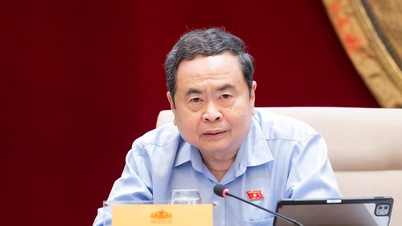
![[Photo] National Assembly Chairman Tran Thanh Man working with the Standing Committee of the Law and Justice Committee](https://vphoto.vietnam.vn/thumb/1200x675/vietnam/resource/IMAGE/2026/05/21/1779378929214_ndo_br_1-4610-jpg.webp)
![[Photo] General Secretary and President To Lam presides over a working session with the Central Policy and Strategy Committee on the development of the materials industry.](https://vphoto.vietnam.vn/thumb/1200x675/vietnam/resource/IMAGE/2026/05/21/1779359935432_a3-bnd-3129-1412-jpg.webp)























































Comment (0)