


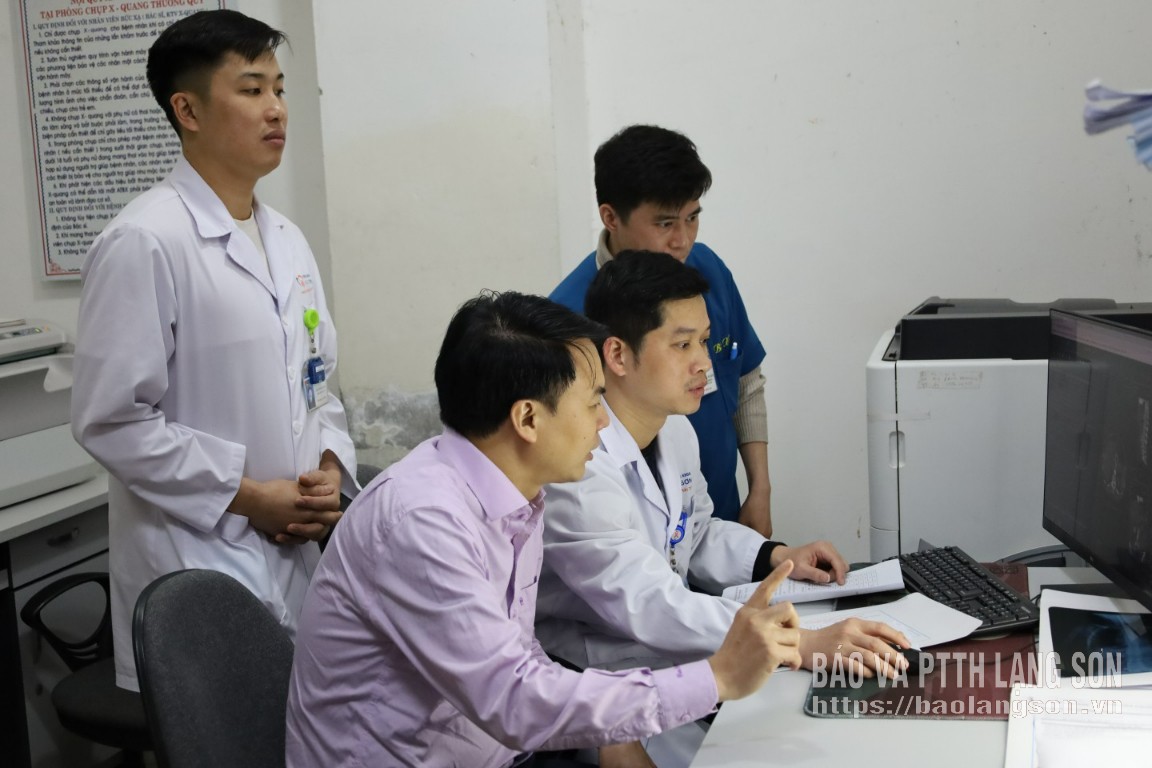
As the provincial-level referral hospital, the Provincial General Hospital (PPH) always considers the task of directing and supervising lower-level healthcare as a key priority to improve the quality of grassroots healthcare . In 2025, the hospital organized two direct visits to monitor, supervise, and encourage regional health centers, providing timely support to overcome difficulties and address shortcomings after the previous referral visits.
According to Dr. Dang Thi Thom, Head of the Referral and Guidance Department at the Provincial General Hospital: Along with direct support, the Provincial General Hospital effectively maintains telehealth services, creating a regular connection channel between the provincial level and lower-level facilities. Monthly online consultations are held regularly, focusing on difficult and complex cases. In 2025, the Provincial General Hospital organized two referral and guidance sessions, directly supervising and providing professional support to regional health centers; organized four training courses for over 300 medical staff; sent specialized teams to directly support the implementation of some surgical techniques at lower-level facilities such as thyroid surgery and tonsillectomy; and maintained online consultations and provided support in handling difficult cases as requested by the facilities.
Referral and guidance is the activity of providing support from higher-level medical facilities (provincial and central levels) to lower-level medical facilities (regional, commune, ward levels) in terms of technical expertise, professional skills, and management, aiming to improve the capacity of lower-level medical facilities and contribute to reducing overcrowding at higher-level medical facilities. |
Through this work, medical staff at lower-level facilities receive timely advice on diagnosis and treatment, contributing to improved professional capacity and reducing unnecessary referrals to higher-level facilities. In practice, the provincial general hospital's guidance and support for lower-level facilities has become an important professional "support system," helping grassroots healthcare gradually better meet the needs of people's health care and protection.
Not only at the Provincial General Hospital, but also at other healthcare facilities throughout the province, the work of directing and coordinating healthcare services has been implemented seriously, synchronously, and increasingly effectively. Provincial hospitals and regional health centers proactively develop plans for directing and coordinating healthcare services that closely match practical needs, focusing on training, mentoring, technology transfer, and support in managing difficult cases. Coordination and support between different levels of healthcare facilities are becoming increasingly close, contributing to a reduction in referral rates and an improvement in the quality of medical examination and treatment at the local level.
Dr. Nguyen Tien Lam, Director of Loc Binh Regional Health Center, said: "In 2025, the center has registered many areas for guidance and support, such as pleural aspiration, endoscopic surgery via the urethra, Doppler echocardiography, outpatient management of COPD patients, and laparoscopic cholecystectomy; and has sent two staff members for training at higher-level facilities. Currently, the unit is finalizing the necessary conditions regarding human resources and equipment, aiming to soon establish an outpatient clinic for managing and treating COPD and other new technical services. Simultaneously, we have also proposed that higher-level medical facilities support the transfer of technology to commune health stations, organize family medicine training for grassroots health workers, thereby gradually expanding local health services, reducing referrals to higher-level facilities, and facilitating people's access to primary healthcare services."
Through this work, the professional capacity of the medical staff at the grassroots level has been gradually improved, and many technical services that previously required referral to higher-level facilities can now be performed locally. For example, at the Bac Son Regional Health Center, after receiving support from higher-level medical facilities, the center successfully implemented two new techniques: thread embedding (76 cases) and tonsillectomy (11 cases). In addition, specialist urological surgery has been implemented, and in 2025, three cases of lithotripsy and endoscopic retroperitoneal stone removal were performed at the facility.
Mr. Duong Van Tiep, from Lan Gat village, Hung Vu commune, shared: "In July 2025, I was hospitalized and the doctor recommended tonsillectomy surgery. Previously, I would have had to be transferred to a provincial hospital for the surgery, but now, the Bac Son Regional Health Center has implemented this technique, so I can receive treatment right here in my locality. Not having to be transferred to another hospital has saved me a lot of costs, travel time, and shortened my treatment process."
Thanks to strengthened guidance and supervision, the capacity for medical examination and treatment at grassroots health facilities in the province continues to be consolidated and improved. In 2025, public medical examination and treatment activities reached 1,260,187 visits, achieving 132% of the annual plan; the number of inpatient treatments at hospitals and stays at commune health stations reached 153,597, achieving 94.6% of the plan; outpatient treatments reached 123,617, equivalent to 185.9% of the annual plan.
Source: https://baolangson.vn/chi-dao-tuyen-be-do-chuyen-mon-cho-y-te-tuyen-duoi-5073850.html































































Comment (0)