

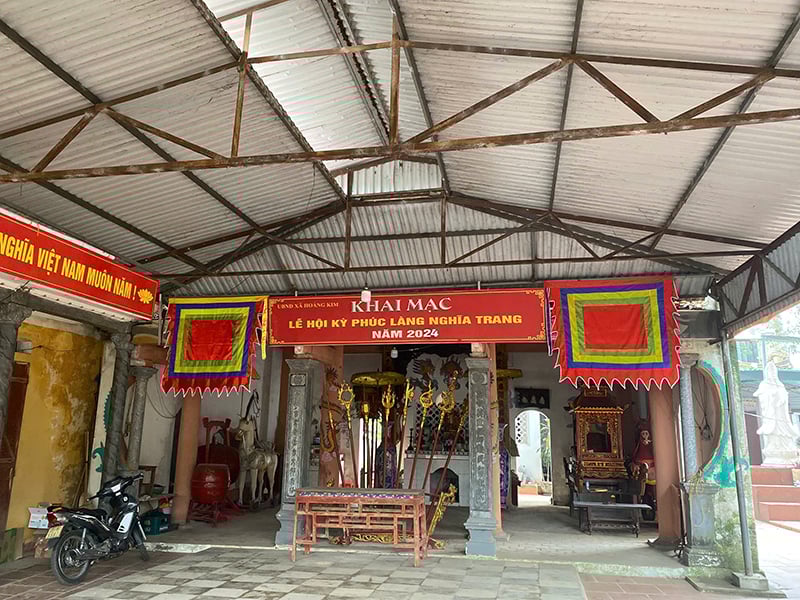
The complex of temples and shrines in Nghia Trang village, Hoang Kim commune (Hoang Hoa district).
The natural landscape of Hoang Kim is further enhanced by small mountains nestled among fields and villages, with the Tra River (also known as Au River) flowing through it. The Hoang Hoa Cultural Gazetteer describes the Tra River as follows: “If the Cung River connects the Lach Truong River with the Ma River, then the Tra River connects the Len River with the Lach Truong River. Like the Cung River, the Tra River both drains floodwaters and provides an abundant source of aquatic products for the villages along its banks.” In the past, along with the Ma River, the Tra River contributed to a very convenient waterway network for boats traveling from the Lach Truong River to Ba Bong, down the Len River, or up the Ma River to Giang Junction. Currently, the river mouth is silted up, and the river is divided into many sections, but it still reflects the image of prosperous villages with their unique historical and cultural layers.
Nghia Trang Village, also known colloquially as Gia Village, was established in the early 6th century. This peaceful village nestles on the banks of the Tra River, overlooking the majestic Son Trang mountain range, and is surrounded by Son Trinh and Nghe mountains. Generations of villagers have passed down a poem praising the village's beauty with deep pride: "Our village has a picturesque landscape / The Tra River winds like the shape of a dragon."
The village center, along the main road, had the Gia Market near the Tra River. In the past, it was bustling with boats and lively trading activities. From the market, the villagers built houses along the road, constructed market pavilions, dug market wells, and created favorable conditions for those who came to exchange goods, including those from afar who needed to stay for a few days. It can be said that the Gia Market and Nghia Trang village at that time became a thriving and famous trading center for the entire vast region from Northwest Hau Loc to North Hoang Hoa, and even across the Ma River to villages like Giang, Vom, and Tu...
The village boasts a complex of temples and shrines called Nghia Trang, which was recognized as a provincial-level historical and cultural relic in 1988. It houses shrines dedicated to the deities Bac Luong Vu De, Lien Hoa Princess, and Cao Son Thuong Dang Than. The Nghia Trang complex is situated in a beautiful location, surrounded by picturesque rivers and mountains. The temple gate was formerly a grand and beautiful entrance, with a stele inscribed with the words "dismounting." However, the current gate has a simpler design with two brick pillars on either side, and a simple opening and closing door in the middle leading to the eight-roofed stele house. The main hall is built with a five-bay structure, divided into two sections by gable walls. Although the temple and shrine architecture is not ostentatious or grand, the history of its formation and development partly reflects the cultural and spiritual life of the local people.
Compared to Nghia Trang village, My Du village is smaller in area. According to the elders in the village, My Du literally means "Rich and Abundant." From its early beginnings with only 5 to 7 households, over time, through creativity, hard work, and the lifestyle and way of thinking of the people over generations, a unique tradition and culture have been woven together. To this day, My Du village still preserves the beauty and soul of old Northern and North Central Vietnamese villages in the image of the banyan tree, the riverbank, the communal house courtyard... Historically, My Du village was once a training ground for revolutionary militia and guerrillas during the period when the government was newly established, and it was also the location of the former commune administrative committee headquarters.
The My Du temple complex is situated on a spacious plot of land, surrounded by lush green trees, with the gently flowing Tra River beside the temple. According to preserved documents, the My Du temple is a place of worship for two deities: Doc Cuoc Son Tieu and Que Hoa Princess – both deities associated with legends and myths about helping the people and the nation. Through restoration and renovation, the My Du temple still preserves many ancient artifacts such as royal decrees, genealogical records, bronze objects, and porcelain.
Legend has it that the deity Cao Son, also known as Doc Cuoc, descended to the land of My Du village: A celestial being descended to the Tho Phu area of My Du village, Son Trang commune, Duong Son district, My Hoa county, on a stormy night. The next morning, villagers went to the riverbank and climbed the Tho Phu mound, where they saw a mark more than one meter long and seven meters wide. Everyone in the village considered it strange but didn't understand its true nature. Later that night, four villagers dreamt of a high-ranking official, dressed in fine robes and a hat, descending from the sky and standing on the mound, saying loudly: "I am the god Doc Cuoc, commanded to govern this village." After saying this, the god disappeared. The next morning, the four villagers conversed and realized they had all had the same dream. Knowing the deity had descended, they instructed the villagers to set up an altar and pray. Not long after, they built a temple to worship him. Currently, the My Du shrine still preserves nine royal decrees bestowing the title upon the deity.
Regarding Princess Quế Hoa, the book "Thanh Hóa Chư Thần Lục" (Records of the Deities of Thanh Hóa) states: She was from Tây Mỗ village, born during the reign of Emperor Cảnh Hưng (1740-1786). At the age of 16, she left her village to become a nun in Bảo Tá hamlet, Nam Định. During the day, she studied Buddhist scriptures and devoted herself to asceticism; at night, she frequently visited temples dedicated to the immortal saints and observed religious precepts. At the age of 33, she passed away. On the day of her funeral, the wind blew away the dust, the rain poured down, the road was clean, pink clouds covered the burial site, and swallows flew about. Knowing she was an immortal, the people compiled a story and sent it back to her birthplace to establish a temple, which has shown many miraculous occurrences.
Revisiting the history of the formation and development of Hoang Kim through the appearance of village and hamlet names and the vitality of its historical relics reveals that: Despite the vicissitudes of time, historical upheavals, and changes in administrative boundaries and names, the land has not been lost but is etched into the memories of generations of people here, a never-ending source of affection and nostalgia. Amidst the rhythm of life today, these historical and cultural values are still being preserved and promoted, becoming a solid foundation and a sheltering shade for future generations as they continuously strive to build their homeland and country.
Text and photos: Dang Khoa
* This article uses material from the book "History of the Hoang Kim Commune Party Committee (1953-2018)", Labor Publishing House.
Source: https://baothanhhoa.vn/ben-dong-tra-giang-252113.htm


![[Photo] The 14th Party Congress discusses the Congress documents in the assembly hall.](/_next/image?url=https%3A%2F%2Fvphoto.vietnam.vn%2Fthumb%2F1200x675%2Fvietnam%2Fresource%2FIMAGE%2F2026%2F01%2F21%2F1768970813473_image.jpeg&w=3840&q=75)
































![[Image] Ho Chi Minh City simultaneously commences construction and breaks ground on 4 key projects.](https://vphoto.vietnam.vn/thumb/1200x675/vietnam/resource/IMAGE/2026/01/15/1768472922847_image.jpeg)

























Comment (0)