

A 15-YEAR JOURNEY OF COLLECTING
"It can be said that this is the largest collection of seashells ever received and displayed to the public at the Hoang Sa Exhibition House. To acquire a collection with a total of approximately 2,000 specimens belonging to 1,000 species of seashells, the owner must be a very persistent person with a deep love for the sea and islands of our homeland," commented Dr. Le Tien Cong, Director of the Hoang Sa Exhibition House. Before coming to the exhibition house, this collection of seashells belonged to Mr. Phan Thanh Toai (49 years old, residing in Hai Chau District, Da Nang City), a coach at the Da Nang City Swimming Center.
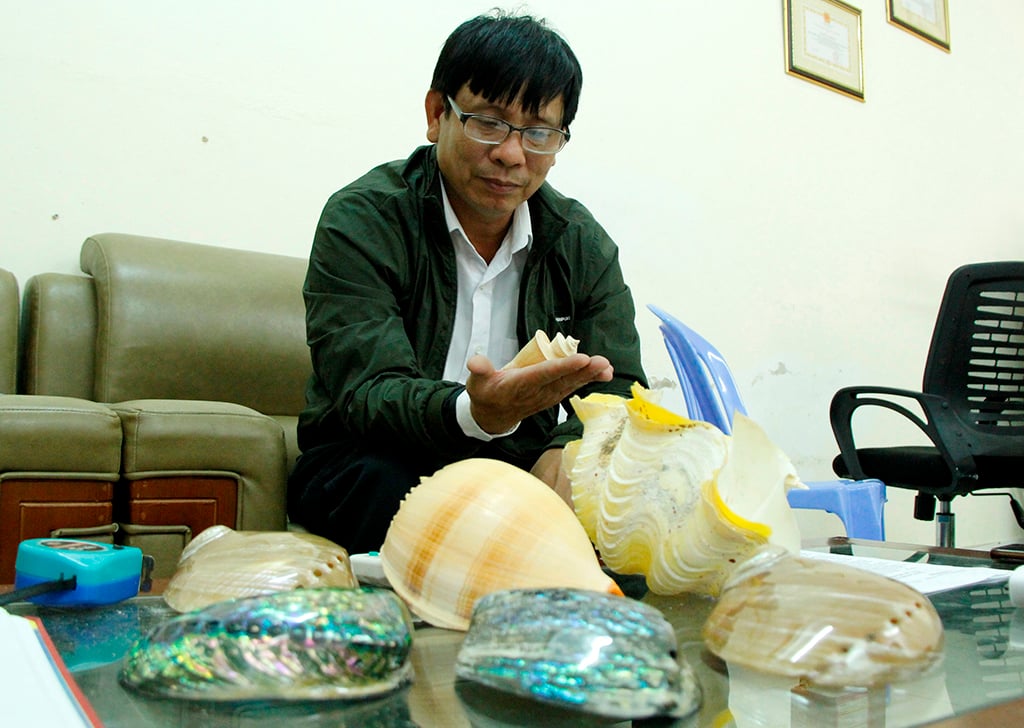
Mr. Phan Thanh Toai and his collection of rare seashells before transferring them to the Hoang Sa Exhibition House.
Mr. Toai was born and raised in Thanh Binh coastal village (Thanh Khe District, Da Nang City). Having been close to the sea since childhood, he was an excellent swimmer and later became a swimming and diving instructor. His profession gave him frequent opportunities to travel to coastal areas throughout the country for training and teaching. "In 2005, I trained with the Da Nang swimming team in China and was given a book titled 'Chinese Snails .' Reading the book, I realized that many types of snails are still present in Vietnam. From then on, I was determined to collect these snails from our own waters," Mr. Toai recounted.
While researching sea snails, he read the book "Vietnamese Sea Snails" (by Nguyen Ngoc Thach), which provided him with much knowledge about the characteristics, structure, and identification of this marine creature. In 2005, he began his journey of searching for and collecting snails, and his footprints have reached almost all coastal regions from south to north. By 2020, when his collection was transferred to the Hoang Sa Exhibition House, he had thousands of sea snail specimens. Among them were rare and valuable species that many collectors dream of, such as two nautilus fossils, orange porcelain snails, mother-of-pearl snails, and many mutated sea snail species…
UNIQUE SEA SHELLS FROM HOANG SA , TRUONG SA
Over 15 years of collecting, Mr. Toai has made many friends among shell collectors and oceanographers nationwide. In particular, with his determination to collect shell species living in the Hoang Sa and Truong Sa archipelagos, which are under Vietnamese sovereignty , he has become friends with many fishermen in Central Vietnam. He says that to own shells from these two archipelagos, only fishermen who spend their lives at sea catching seafood have the means to collect the shells and bring them back to him. "There are many valuable shells, some with high age, but fishermen don't know how to harvest and preserve them. Therefore, besides purchasing them, I also have to guide fishermen on how to preserve the shells to keep them as intact as possible," Mr. Toai said.
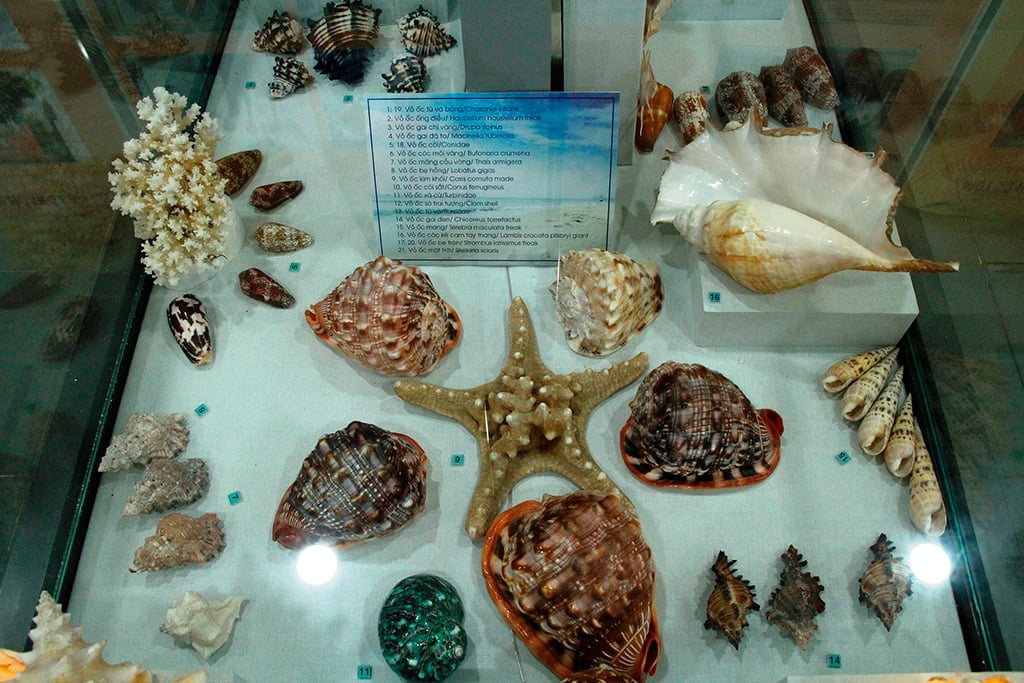
Mr. Phan Thanh Toai's collection of over 1,000 species of shellfish contributes to enriching the exhibits at the Hoang Sa Exhibition House.
Mr. Toai's passion has been rewarded as fishermen returning from the Hoang Sa and Truong Sa fishing grounds brought back many types of sea snails that only live in these two archipelagos, such as the crown snail, nautilus, paper squid snail, spiny clam, king cone snail, elephant ear snail, etc. Among them, the paper squid snail ( scientific name Aegonau argo linnaeus), found in 1758, is considered particularly rare. The largest recorded specimen in the world measured 223 mm, while Mr. Toai owns one measuring 280 mm. The nautilus is dubbed a "living fossil of modern times"... In addition to collecting sea snails, Mr. Toai has also collected 80 fossilized rock crabs from Cu Lao Cham, which are considered extremely unique.
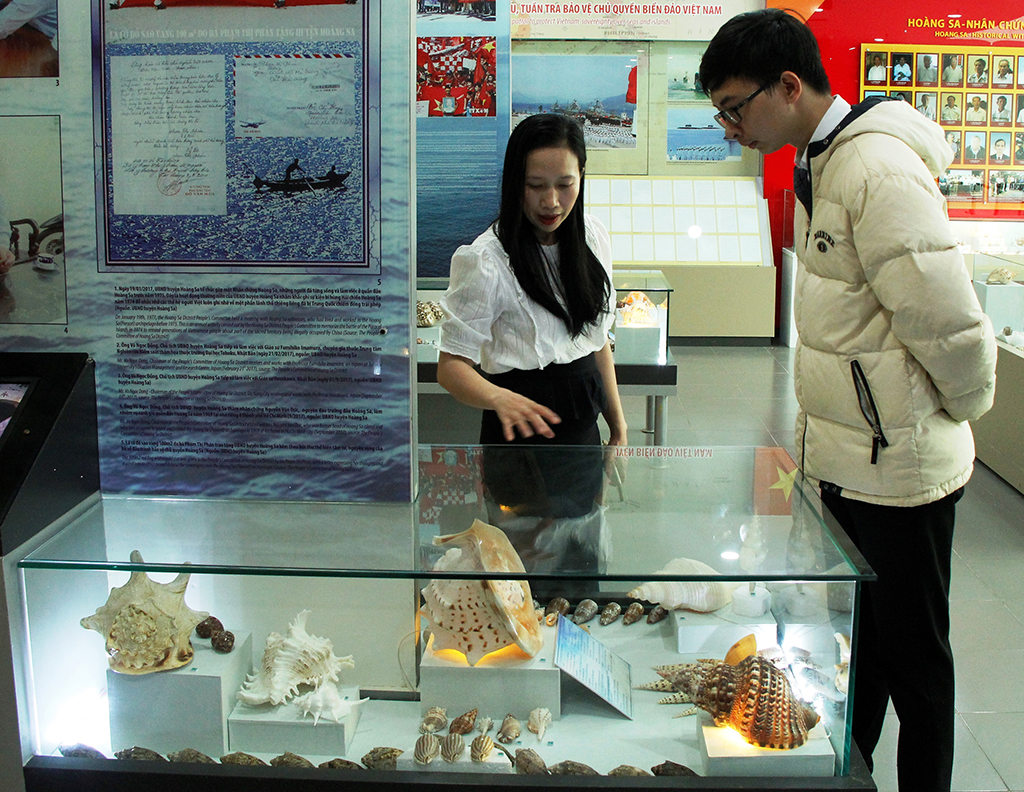
The collection of seashells attracts young people when they visit the Hoang Sa Exhibition House.
Many species of sea snails are endemic, living only in specific marine areas. In Vietnam's waters, the conditions of the sea, climate, and weather also provide suitable habitats for certain species. Therefore, Mr. Toai's collection of sea snail shells from Vietnamese waters also contributes to affirming Vietnam's sovereignty over its maritime territories. At the end of 2020, after transferring all the sea snail shells to the Hoang Sa Exhibition House, he kept only a few fossilized shells to commemorate his 15-year collecting journey. Immediately after receiving them, the exhibition house showcased many rare shells, including many that lived in the Hoang Sa and Truong Sa archipelagos. The exhibition house also designed a map of Vietnam by attaching hundreds of shells of various species, creating a unique and attractive exhibit for viewers.
Dr. Le Tien Cong, Director of the Hoang Sa Exhibition House, noted that visitors to the exhibition house not only get to see many documents and artifacts about the history of maritime sovereignty but also learn about various marine creatures. Along with marine animal specimens, the collection of seashells affirms the richness and diversity of seafood in our sovereign waters, especially in the Hoang Sa and Truong Sa archipelagos, thereby fostering love for the country's seas and islands. "The 'massive' collection of seashells donated to the exhibition house by Mr. Phan Thanh Toai is a vivid visual artifact that will make learning about maritime sovereignty at the exhibition house more interesting for young people, especially children," Dr. Cong emphasized.
Source: https://thanhnien.vn/thu-vui-suu-tam-do-doc-la-bo-vo-oc-khoi-day-niem-tu-hao-bien-dao-185240803214348692.htm







![[Video] Sunset at Lap An Lagoon – Where the sun sets over the fishing nets](https://vphoto.vietnam.vn/thumb/340x192/vietnam/resource/IMAGE/2026/05/31/1780192137701_beach-landscape-sea-water-nature-grass-745871-pxhere-com.jpeg)



























































Comment (0)