

|
Ngoa Van Pagoda is located within the Tran Dynasty historical site in Dong Trieu ( Quang Ninh ). Photo: TT |
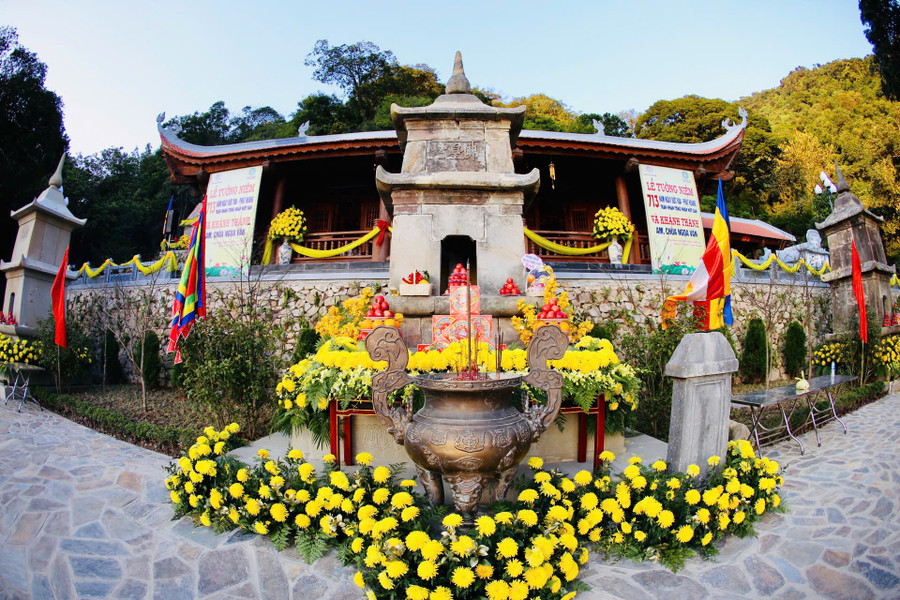
This is the result of a challenging but ultimately successful nomination process for Vietnam and the localities within the heritage region.
A journey of many efforts
The nomination dossier for Yen Tu - Vinh Nghiem - Con Son, Kiet Bac is considered a monumental scientific work, the culmination of many years of meticulous research involving hundreds of domestic and international experts and scientists.
Since 2012, Quang Ninh province has begun implementing the steps to prepare a scientific dossier to submit to UNESCO for recognition of the Yen Tu Complex of Monuments and Scenic Spots as a World Heritage Site, and sent the registration to UNESCO in 2014. This dossier was officially included in the World Heritage Centre's website as a tentative list for World Heritage site nominations.
Initially, the dossier focused on criteria 2, 3, 5, 6, and 7 according to UNESCO's criteria, with the scope of the monuments covering the two provinces of Quang Ninh and Bac Giang (formerly). Later, following a decision by the Prime Minister, monuments belonging to the province of Hai Duong (formerly) were added, requiring the dossier to be comprehensively revised and rewritten.
Since then, Quang Ninh has played a leading role in compiling dossiers and organizing numerous national and international surveys and workshops to gather expert opinions. In 2015, Mr. Pall Dingwall - an expert from the International Union for Conservation of Nature (IUCN), and Professor Hea Un Ri - an expert from the International Council on Monuments and Sites (ICOMOS), conducted field surveys in three localities with heritage sites.
Shortly thereafter, on August 18, 2015, a workshop on identifying the global values of Yen Tu was held in Quang Ninh, aiming to gather expert opinions from ICOMOS for the preparation of the World Heritage dossier. According to experts, the time required to complete a dossier typically takes 5 to 10 years, and in some countries, it takes nearly 20 years. This demonstrates the significant effort and determination of the three localities within the heritage area.
To expedite progress, in late August 2020, a national-level seminar, chaired by Quang Ninh province in coordination with the former Hai Duong and Bac Giang provinces, was held in Quang Ninh. At this seminar, leading experts in the fields of culture and heritage clearly identified the outstanding global values of the Yen Tu complex of historical sites and scenic spots.
The discussion agreed on the title of the dossier as "Yen Tu Complex of Historical Sites and Scenic Spots," selecting criteria 3, 5, and 6 for its development, and removing two criteria compared to the 2014 dossier.
In February 2021, the summary report of the official dossier was published on the UNESCO World Heritage Centre website in the nomination category. Over the two years of 2021-2022, scientists continued to conduct research on three thematic areas: cultural, historical, architectural, geological-geomorphological, and biodiversity values, to supplement the scientific documentation for the dossier. Numerous archaeological findings, maps, drawings, geological diagrams, remote sensing data, and maps showing the distribution of archaeological sites were updated.
From June 20th to July 3rd, 2022, international experts collaborated with Vietnamese researchers working with the Departments of Culture, Sports and Tourism of the three localities, the management boards of historical sites, and conducting field surveys of the entire heritage area. On June 29th, 2022, an international scientific conference was held in Hanoi with the participation of nearly 70 domestic and international delegates, aiming to evaluate the documents and agree on the criteria expected to be met for the dossier.
On July 19, 2022, the Ministry of Culture, Sports and Tourism decided to rename the dossier to "Yen Tu - Vinh Nghiem - Con Son, Kiet Bac Complex of Historical Sites and Scenic Spots," while retaining criteria 3, 5, and 6 for dossier preparation.
In January 2024, the official dossier was completed and submitted to UNESCO. After receiving feedback from ICOMOS, the dossier was adjusted from 20 to 12 sites, retaining 2 criteria (3 and 6). In August 2024, ICOMOS experts conducted a field assessment. On February 28, 2025, the dossier was further supplemented and resubmitted to the World Heritage Centre and ICOMOS. Quang Ninh also actively participated in expert-level dialogue delegations with ICOMOS and attended the 221st Session of the UNESCO Executive Board in France from April 6-9, 2025.
Ms. Nguyen Thi Hanh, Vice Chairwoman of the Quang Ninh Provincial People's Committee and Deputy Head of the Steering Committee for the Yen Tu - Vinh Nghiem - Con Son - Kiet Bac dossier preparation, stated that most recently, from June 10-17, 2025, Quang Ninh organized a working group led by provincial leaders to participate with the delegation of the Vietnam National UNESCO Committee in a trip to the Republic of France to conduct legal advocacy for the nomination dossier of the heritage complex.
The event promoting the cultural and spiritual values of the heritage site was held at the Vietnam Cultural Center in France. The delegation worked directly with UNESCO Director-General Audrey Azoulay, World Heritage Centre Director Lazare Eloundou Assomo, ICOMOS Director-General Marie Laure Lavenir, as well as meeting separately with 20 ambassadors and heads of delegations from member countries of the World Heritage Committee and the representative of Bulgaria - the Chair of the session - to request support for the inscription.
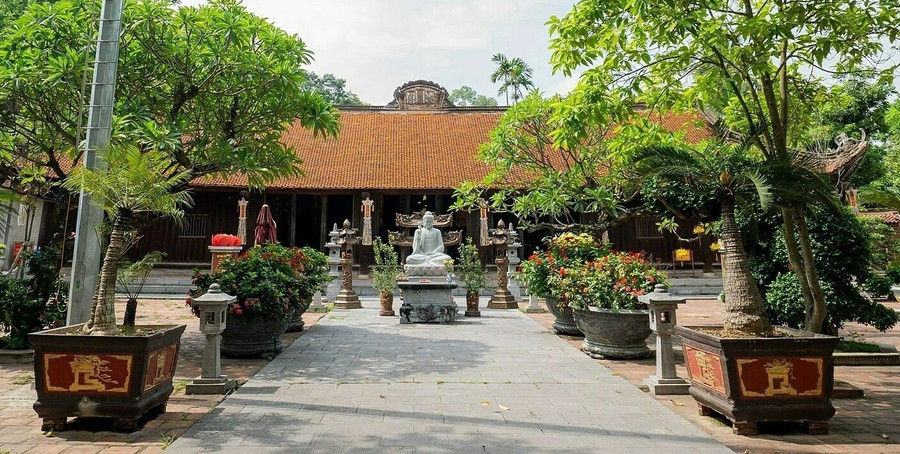
Vinh Nghiem Pagoda, also known as Duc La Pagoda (formerly in Bac Giang province), is now located in Tan An commune, Bac Ninh province. Photo: HG
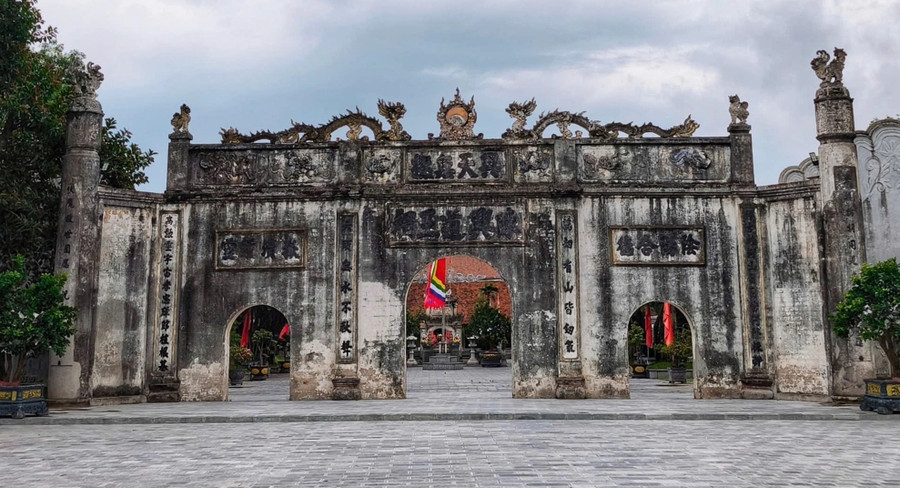
Kiet Bac Temple is currently located in Tran Hung Dao Ward, Hai Phong City (formerly part of Chi Linh City, Hai Duong Province). Photo: TT
Overwhelming joy
At 1:02 PM on July 12, 2025 (Paris time), which is 6:02 PM Vietnam time, at the 47th session of the UNESCO World Heritage Committee held in Paris (France), Professor Nikolay Nenov (Bulgaria) - Chairman of the session - officially declared the Yen Tu - Vinh Nghiem - Con Son - Kiet Bac complex of historical sites and scenic spots as a World Cultural Heritage site. This is Vietnam's 9th World Heritage site, and the second inter-provincial heritage site after Ha Long Bay - Cat Ba Archipelago.
The complex comprises 12 historical sites spread across three localities: Quang Ninh, Hai Phong, and Bac Ninh; with a core area of 525.75 hectares and a buffer zone of 4,380.19 hectares. Notable sites include: Thai Mieu Temple, Hoa Yen Pagoda, Lan Pagoda, Ngoa Van Pagoda, Yen Giang stake field (Quang Ninh); Con Son Pagoda, Kiet Bac Temple, Thanh Mai Pagoda, Kinh Chu Cave, Nham Duong Pagoda (Hai Phong); Vinh Nghiem Pagoda, Bo Da Pagoda (Bac Ninh).
At the heart of the heritage is Truc Lam Buddhism – a Vietnamese Zen Buddhist sect founded by Emperor Tran Nhan Tong in the 13th century. Truc Lam Buddhism created a philosophical system and spirit of tolerance and harmony between Buddhism, Confucianism, Taoism, and indigenous beliefs, making a significant contribution to the cultural heritage of humanity.
The Yên Tử - Vĩnh Nghiêm - Côn Sơn - Kiếp Bạc complex of historical sites and scenic spots, with Trúc Lâm Buddhism as its core, was established in the 13th century by the Trần dynasty kings, especially the role of Emperor Trần Nhân Tông. Trúc Lâm Buddhism has created many values and made special and lasting contributions to the cultural and spiritual heritage of humanity.
Originating from the sacred mountain landscape of Yen Tu, Truc Lam Buddhism represents a philosophical system and the spirit of tolerance and altruism within Buddhism. Truc Lam Buddhism also exemplifies the harmonious blend of Mahayana Buddhism with Confucian ethics, Taoist cosmology, and indigenous Vietnamese beliefs.
The ideological and cultural values of Truc Lam Buddhism regarding reconciliation, harmony, and peace are entirely consistent with UNESCO's fundamental goal of maintaining and enriching the common values of humanity: education, building a culture of peace; a spirit of self-reliance, harmonious integration between humanity and the natural world, and respect for the laws of nature.
Through temples, hermitages, pilgrimage routes, stone steles, woodblock prints, and meticulously preserved relics distributed across a vast area from Yen Tu to Vinh Nghiem and Con Son - Kiet Bac, the heritage fully reflects the stages of development of Truc Lam Buddhism: from its establishment and institutionalization to its revival and continued dissemination of creative and humanistic values.
These historical sites, formed centuries ago, consistently demonstrate continuous development, serving as centers of religion, culture, and spirituality, and attracting millions of tourists each year.

Experts from various countries came to congratulate the Vietnamese delegation. Photo: INT.
The Yen Tu - Vinh Nghiem - Con Son, Kiet Bac complex of historical sites and scenic spots is recognized according to criteria (iii) and (vi): Criterion (iii): Demonstrates the harmonious combination of the State, religion and the local community in the sacred land of Yen Tu, forming a unique cultural tradition with global significance, contributing to shaping national identity and promoting regional peace; Criterion (vi): Reflects the profound influence of Truc Lam Buddhism - the only Zen school in Asia founded by a king who abdicated to become a monk, combining various beliefs, contributing to promoting the development of secular society, and ensuring regional peace and cooperation.
This community is directly related to the creation and dissemination of the creative and humanistic values of Truc Lam Buddhism. The continuous organization of rituals, festivals, propagation of Buddhist teachings, and pilgrimages to historical sites—both in Vietnam and through international Truc Lam Buddhist organizations—demonstrates the enduring global relevance of its philosophy of life, values, social community spirit, harmony with nature, love of peace, and compassion.
The official recognition of the Yen Tu - Vinh Nghiem - Con Son - Kiet Bac complex of historical sites and scenic spots as a World Cultural Heritage site by UNESCO is a great source of pride not only for the localities within the heritage area but also for the entire nation. Vietnam's heritage has now become known, admired, and honored by the world. Quang Ninh will continue to implement projects to preserve, restore, and promote the value of the heritage in a sustainable manner. At the same time, it will closely coordinate with Hai Phong and Bac Ninh to build a unified heritage space, ensuring full implementation of the World Heritage Convention, linked to sustainable development, contributing to promoting the beauty of Vietnam and its people to the world. (Ms. Nguyen Thi Hanh, Vice Chairman of the People's Committee of Quang Ninh Province)
Source: https://giaoducthoidai.vn/hanh-trinh-tro-thanh-di-san-van-hoa-the-gioi-cua-quan-the-yen-tu-vinh-nghiem-con-son-kiep-bac-post744213.html













































































Comment (0)