

High income thanks to new crops.
Ms. Nguyen Thi Gai's family in Dong Thinh village, Bao Dai commune, owns 3 acres of rice fields. This area is low-lying, so it gets flooded every rainy season. Therefore, in 2018, the family switched to growing taro. She shared: “The new crop has yielded outstanding results and higher economic value than before. Thanks to applying the right cultivation techniques, the taro produces large, uniform tubers, consistently yielding 8-10 tons per acre. Last year, taro fetched a good price (20-25 thousand VND/kg), and traders came directly to the fields to buy it as soon as it was harvested.” After 7 months of cultivation, the family earned a profit of 260 million VND.
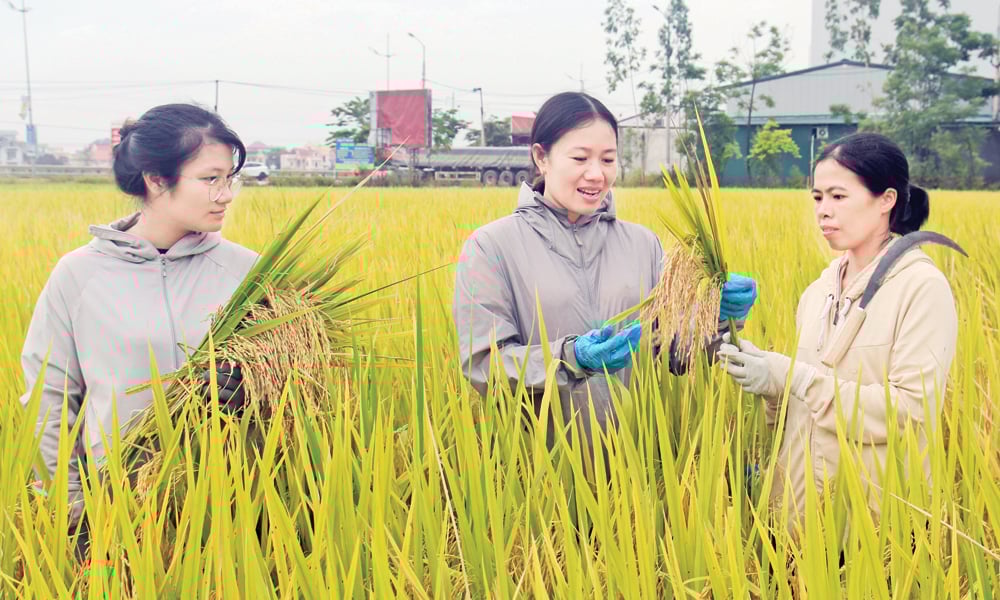 |
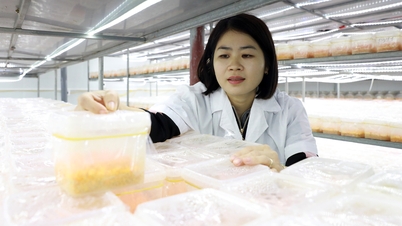
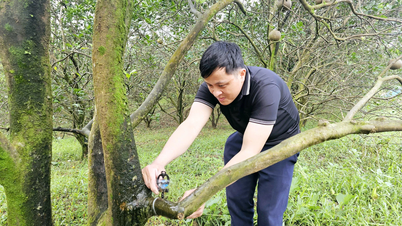
Staff at the Tan Dinh Plant Breeding Research and Testing Center are researching and developing new rice varieties. |
Currently, Mrs. Gai's family cultivates one crop of onions and one crop of sweet potatoes in their entire rice paddies, with the rest intercropped with Artemisia annua and other vegetables; after deducting expenses, they earn over 300 million VND in profit each year. Like Mrs. Gai's family, most households with rice paddies in Dong Thinh village have switched from low-yield rice to growing taro, onions, cucumbers, and some flowers (peach blossoms, lilies, gladioli, peonies). Since the beginning of the year, many crops have yielded good harvests and fetched good prices, further boosting the morale of the farmers.
In Xuan Cam commune, the low-lying rice and corn fields along the Cau River, which were previously cultivated, have now been mostly converted to peach orchards. From just a few small households growing peaches, after 10 years, Xuan Cam has become a renowned peach-growing area with over 300 participating households, covering a total area of approximately 30 hectares. Now, during each Tet peach harvest season, many households earn 800-900 million VND, many times higher than other crops. Due to the expansion of the peach growing area, the Xuan Cam Commune People's Committee has planned the growing zone and expanded transportation routes to allow traders to bring their vehicles directly to the orchards for purchasing.
| By the end of 2024, the production value per cultivated unit in Bac Giang province reached 138 million VND/ha/year; in Bac Ninh province (formerly), it was 131.3 million VND/ha/year. In many areas, specialized farming zones for rice, vegetables, and high-yield fruit trees have been established, bringing in profits ranging from several hundred million to billions of VND per year. |
By the end of 2024, the production value per cultivated unit in Bac Giang province reached 138 million VND/ha/year; in Bac Ninh province (formerly), it was 131.3 million VND/ha/year. In many areas, specialized high-yield rice, vegetable, and fruit growing zones have been established, bringing in profits ranging from several hundred million to billions of VND per year.
A significant contribution to the added value of the agricultural sector is due to the active involvement of various sectors and localities in guiding people to shift from low-yield rice cultivation to other crops with higher economic value, making good use of existing land resources. In Bac Giang province, the total area of land converted from rice cultivation during the 2017-2024 period is 10,000 hectares, mainly to perennial crops, with the remainder being planted with annual crops or rice cultivation combined with aquaculture. In Bac Ninh province (formerly), due to limited agricultural land, the province has always focused on producing high-economic-value crops. Field surveys show that in low-lying areas of Gia Binh and Luong Tai communes, inefficient rice fields have been converted by farmers to growing fruit trees, flowers, and ornamental plants.
Overall, agricultural products not only meet local consumption needs but also supply large quantities to neighboring provinces and cities, and are exported to many demanding markets such as Japan, South Korea, the United States, and EU countries.
Ensuring structural balance and compliance with regulations.
Following the merger of the two provinces, opportunities to develop a diverse and modern agricultural sector, maximizing its value, are receiving increasing attention. The differences in topography and current crop structures will create diversity but also pose a risk of inconsistency in planning and difficulty in controlling the conversion process if the province lacks strict management mechanisms and policies. In some areas, there have been cases of people arbitrarily planting forestry trees on rice land, violating regulations for that land type.
According to this year's plan, the entire province will convert more than 507 hectares of land previously used for rice cultivation and single-crop rice farming to annual crops, perennial crops, and rice cultivation combined with aquaculture. Depending on the conditions and land availability in each area, the province will have appropriate conversion directions. Specifically, communes such as Son Dong, Yen The, Lang Giang, and Xuan Cam will mainly convert low-yield rice land to perennial crops or rice cultivation combined with aquaculture. Meanwhile, communes like Luong Tai, Gia Binh, and Que Vo will focus on converting land to annual crops.
According to Government Decree No. 112/2024/ND-CP, starting this year, the conversion of crop structure must adhere to certain principles, including the following: people are only allowed to convert from rice cultivation land to perennial crops on other rice cultivation land; conversion of crops and livestock on rice cultivation land in areas planned for high-yield, high-quality rice cultivation is prohibited; and it must be consistent with the provincial plan and not cause pollution or land degradation.
According to Mr. Dang Van Tang, Head of the Crop Production and Plant Protection Sub-Department (Department of Agriculture and Environment), the newly issued regulations place higher responsibilities on state management for the industry and localities. On the other hand, with the merger of the two provinces, the expanded area and enhanced potential and advantages necessitate a sustainable agricultural development strategy that effectively utilizes existing land resources while expanding new production models applying high technology. The industry will research, review, and update the agricultural land use plan throughout Bac Ninh province, thereby advising on the development of specialized crop cultivation maps, zoning for forestry, fruit trees, food crops, short-term industrial crops, medicinal plants, and vegetables. For example, the northwestern region of the province will continue to develop specialized cultivation areas for lychees, oranges, pomelos, passion fruit, longan, and grapes – aiming for export.
The Duong River delta region is expanding the area for growing high-quality rice, safe vegetables, and organic vegetables. Potential wards and communes such as Que Vo and Tien Du are developing flowers and ornamental plants (orchids, chrysanthemums, sunflowers, etc.), medicinal herbs (ginger, turmeric, Polygonum multiflorum), combined with rural tourism and traditional craft villages. Continued attention is given to promoting regional linkages and value chains from production to processing and consumption. Attention is also paid to developing agricultural land use plans for each region. Priority is given to expanding the area for concentrated safe vegetable cultivation, flower cultivation, developing high-tech agricultural models, and growing ornamental plants.
Source: https://baobacninhtv.vn/chuyen-doi-co-cau-cay-trong-khai-thac-loi-the-nang-cao-hieu-qua-postid421416.bbg

![[Photo] Prime Minister Pham Minh Chinh receives Lao Minister of Education and Sports Thongsalith Mangnormek](/_next/image?url=https%3A%2F%2Fvphoto.vietnam.vn%2Fthumb%2F1200x675%2Fvietnam%2Fresource%2FIMAGE%2F2025%2F12%2F16%2F1765876834721_dsc-7519-jpg.webp&w=3840&q=75)
![[Photo] Prime Minister Pham Minh Chinh receives the Governor of Tochigi Province (Japan)](/_next/image?url=https%3A%2F%2Fvphoto.vietnam.vn%2Fthumb%2F1200x675%2Fvietnam%2Fresource%2FIMAGE%2F2025%2F12%2F16%2F1765892133176_dsc-8082-6425-jpg.webp&w=3840&q=75)

![[Live] 2025 Community Action Awards Gala](/_next/image?url=https%3A%2F%2Fvphoto.vietnam.vn%2Fthumb%2F1200x675%2Fvietnam%2Fresource%2FIMAGE%2F2025%2F12%2F16%2F1765899631650_ndo_tr_z7334013144784-9f9fe10a6d63584c85aff40f2957c250-jpg.webp&w=3840&q=75)
![[Image] Leaked images ahead of the 2025 Community Action Awards gala.](/_next/image?url=https%3A%2F%2Fvphoto.vietnam.vn%2Fthumb%2F1200x675%2Fvietnam%2Fresource%2FIMAGE%2F2025%2F12%2F16%2F1765882828720_ndo_br_thiet-ke-chua-co-ten-45-png.webp&w=3840&q=75)





































![[Live] Closing Ceremony and Award Presentation for the "Impressive Vietnam Tourism" Video/Clip Creation Contest 2025](https://vphoto.vietnam.vn/thumb/402x226/vietnam/resource/IMAGE/2025/12/17/1765974650260_z7273498850699-00d2fd6b0972cb39494cfa2559bf85ac-1765959338756946072104-627-0-1338-1138-crop-1765959347256801551121.jpeg)


















Comment (0)