

|
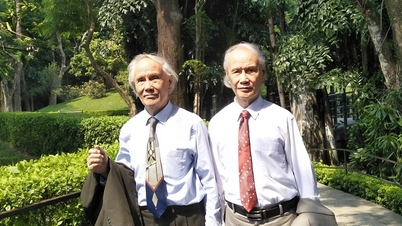
Mr. Ho Quoc Phu (seated) and the author |
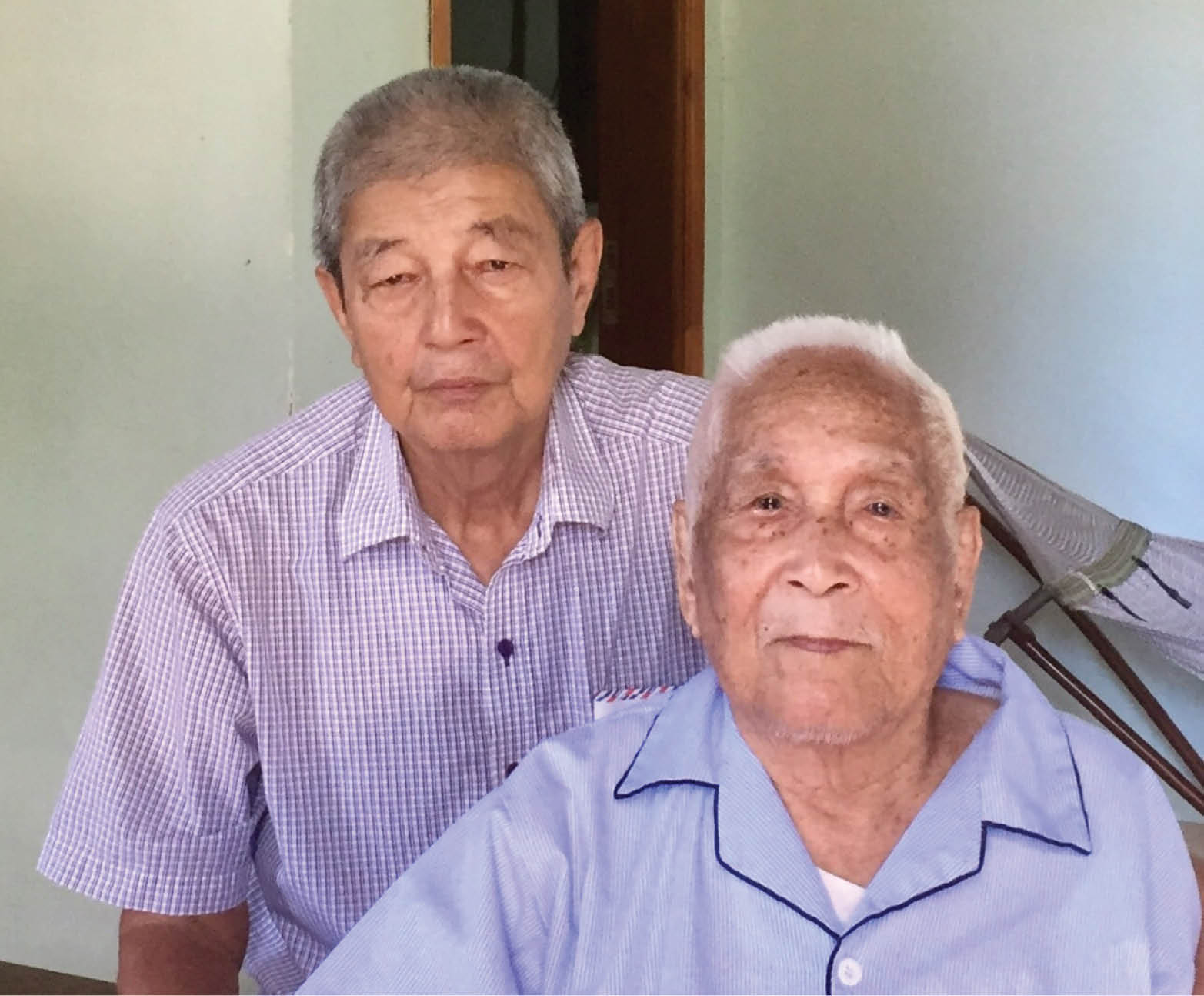
Mr. Ho Quoc Phu (real name Ho Dac Huyen), born in 1927, was from Dien Loc, now part of Loc An commune, Hue city. In 1947, when the French returned to invade our country, he joined the guerrilla forces, and later left to become a platoon leader in Company C321, commanded by Mr. Than Trong Mot.
In accordance with the 1954 Geneva Agreement, he relocated to the North and returned after the Party's historic Resolution 15 was issued. Back in his hometown, he and his comrades built up the force. From an initial armed propaganda team, it developed into a district-level military unit.
Although still very young, the emergence of the first armed forces during the anti-American war was a significant historical event. From this point on, Phu Loc gained a new element to combine two forces, two forms of struggle: political and military, creating a combined strength, signaling the revolutionary movement's shift from passive to active attack against the enemy.
Overcoming countless difficulties and hardships, the local armed forces, led by District Commander Ho Quoc Phu and Political Commissar Hoang Bien (Pham Huu Xuan, Deputy Secretary of the District Party Committee), infiltrated the delta, built bases, and became a core force in eliminating evil and supporting the people's struggle against the tyrannical regime backed by the US.
To signal the arrival of the revolution, on the night of January 6, 1960, he and Political Commissar Hoang Bien directly commanded the attack on the Truoi Bridge. After a deafening explosion, two sections of the iron bridge collapsed. The vital Hue-Da Nang transportation route was disrupted for many days. Local military history records this as the battle that initiated the armed struggle in Thua Thien Hue province, signaling that after years of oppression and terror, under the leadership of the Party, our army and people resolutely fought against the puppet regime in the South.
Implementing the US "Special War" strategy, the Ngo Dinh Diem government implemented the "Strategic Hamlet" policy, gathering people into concentration camps to "separate the fish from the water," essentially depriving the revolution of its support base. Simultaneously, they established a system of blockades, including the Mo Lung outpost located at KM3, outpost number 8, on the road connecting Cau Hai town with the Bach Ma mountain range. Here, the enemy deployed a commando platoon and two security squads to take turns searching for the revolutionary base, guarding it, and patrolling to prevent the revolutionary forces from infiltrating the delta.
On the night of May 1, 1962, under the command of District Commander Ho Quoc Phu and Political Commissar Hoang Bien, the armed forces of Phu Loc secretly and unexpectedly launched an attack, killing 28 commandos and 24 security guards stationed at Mo Lung.
Fearing the strategic hamlet would be destroyed, the Phu Loc District Military Command deployed the Security and Civil Defense Brigade to Loc Vinh to forcibly clear the bushes in the Ru Ron area – to prevent revolutionary cadres and soldiers from having a place to hide.
To thwart this plot, on July 18, 1962, the Phu Loc District Military Command dispatched a platoon to coordinate with the Vinh Loc guerrillas to launch an attack. Caught by surprise in broad daylight, the soldiers of the Security and Civil Defense Brigade panicked and fled.
After commanding a unit that coordinated with guerrillas to destroy most of the strategic hamlets in Phu Loc, in early 1964, Mr. Ho Quoc Phu was transferred to Battalion 810 (abbreviated as K10).
In 1965, in Thua Thien Hue, after establishing military bases, American and Saigon soldiers launched joint "search and destroy" operations and carried out "rural pacification," causing the revolutionary movement to face countless difficulties and challenges.
To respond to the situation, the Tri Thien Military Region was established in 1966. At this time, K10 and K4 were officially transferred to the Thua Thien Provincial Military Command.
In coordination with the southern delta region, in February 1966, the Thua Thien Provincial Party Committee issued a resolution to liberate the three communes of Ninh, Hoa, and Dai (now part of Quang Dien and Dan Dien communes) in order to bring the revolutionary movement closer to the outskirts of Hue city. Along with the civilian and district forces and the guerrillas of the three aforementioned communes, K10, under the command of Battalion Commander Ho Quoc Phu and Political Commissar Phan Dung, became the core of the uprising.
While K10 was attacking Nghia Lo and Lai Ha outposts, on the afternoon of June 11, 1966, the Ninh-Hoa-Dai task forces launched a popular uprising, forcing the enemy to deploy the 3rd Regiment (1st Infantry Division) in coordination with the Black Panther Company and local militia forces, supported by aircraft and tanks, to continuously launch operations to retake areas that had fallen into the hands of the revolutionaries. After 150 days and nights of tenacious resistance and counterattacks, by November 1966, the Ninh-Hoa-Dai communes were liberated, creating a continuous link with the remote Phong Dien area and opening up territory for the task forces of Huong Tra and Hue to establish a foothold and build up their forces. Before they could fully enjoy the joy of Ninh-Hoa-Dai's liberation, in mid-August 1966, while commanding a counterattack in Niem Pho village (now part of Quang Dien commune), Battalion Commander Ho Quoc Phu and Political Commissar Phan Dung were both wounded and captured.
After more than two years of imprisonment, in early 1969, Mr. Ho Quoc Phu escaped from Phu Quoc prison.
When he was taken to Phu Quoc prison, they confined him to cell number 13 in section B2. The cell housed 21 people, most of whom were officers before their arrest and were considered "stubborn" by the prison guards. Thanks to his previous experience digging a tunnel to escape from Non Nuoc prison in Da Nang, Ho Quoc Phu was assigned by the Party cell to directly supervise the tunnel construction for escaping Phu Quoc prison.
The tunnel was planned to be dug about 1.5 meters below the surface, more than 0.5 meters wide, and about 120 meters long; ventilation holes would be dug less than 10 meters apart. Based on each person's physical condition, he divided them into three groups. Those who were weak and sickly would pretend to have tuberculosis and sit together to cover the tunnel entrance; another group would be responsible for keeping watch; and the healthier ones would participate in digging.
Utilizing readily available materials such as rice spoons, can lids, and barbed wire, groups of three prisoners took turns digging and scooping soil into bags at night. The third person would pull the bag out and pour the soil into half a barrel—the prisoner's toilet, as they were not allowed outside. The next morning, before defecating, each prisoner would quickly take soil from the barrel and put it in their pants pocket, then quickly dump it into the garbage pit or toilet. The remaining soil would be secretly carried onto the corrugated iron roof at night and scattered, hoping the rain would wash it away.
The soil collapsed, causing the toilet to become clogged. Using this as an excuse, the prisoners in cell 13 requested permission to dig a drainage ditch to clear the blockage and to cultivate vegetables themselves, creating a scene to "conceal" the excavated soil. While digging, they used razor blades dipped in water to determine direction and used two pointed glass syringes for balance. To avoid the risk of the tunnel collapsing at the section with the road, instead of digging straight, they dug in a zigzag (Z) shape. After nearly half a year of persistent work, the planned tunnel was completed. In the early hours of January 21, 1969, the escape began. Following the secret tunnel, 21 prisoners from cell 13 in Sub-division B2 escaped from Phu Quoc prison and returned to the revolutionary cause...
Source: https://huengaynay.vn/chinh-polit-xa-hoi/chuyen-ke-ve-vi-huyen-doi-truong-dau-tien-cua-phu-loc-160948.html
![[Image] Leaked images ahead of the 2025 Community Action Awards gala.](/_next/image?url=https%3A%2F%2Fvphoto.vietnam.vn%2Fthumb%2F1200x675%2Fvietnam%2Fresource%2FIMAGE%2F2025%2F12%2F16%2F1765882828720_ndo_br_thiet-ke-chua-co-ten-45-png.webp&w=3840&q=75)
![[Photo] Prime Minister Pham Minh Chinh receives the Governor of Tochigi Province (Japan)](/_next/image?url=https%3A%2F%2Fvphoto.vietnam.vn%2Fthumb%2F1200x675%2Fvietnam%2Fresource%2FIMAGE%2F2025%2F12%2F16%2F1765892133176_dsc-8082-6425-jpg.webp&w=3840&q=75)
![[Photo] Prime Minister Pham Minh Chinh receives Lao Minister of Education and Sports Thongsalith Mangnormek](/_next/image?url=https%3A%2F%2Fvphoto.vietnam.vn%2Fthumb%2F1200x675%2Fvietnam%2Fresource%2FIMAGE%2F2025%2F12%2F16%2F1765876834721_dsc-7519-jpg.webp&w=3840&q=75)

![[Live] 2025 Community Action Awards Gala](/_next/image?url=https%3A%2F%2Fvphoto.vietnam.vn%2Fthumb%2F1200x675%2Fvietnam%2Fresource%2FIMAGE%2F2025%2F12%2F16%2F1765899631650_ndo_tr_z7334013144784-9f9fe10a6d63584c85aff40f2957c250-jpg.webp&w=3840&q=75)




































![[Photo] Prime Minister Pham Minh Chinh attends the Vietnam Economic Forum 2025](https://vphoto.vietnam.vn/thumb/402x226/vietnam/resource/IMAGE/2025/12/16/1765893035503_ndo_br_dsc-8043-jpg.webp)



















Comment (0)