

Amidst the historic days of August, we had the opportunity to meet and chat with Mr. Tran Hau Ngoc (80 years old, residing in Nam Ha ward, Ha Tinh city) - the son of pre-revolutionary cadre Tran Hau Xuong - to reminisce about the glorious days of the August Revolution in Ha Tinh.
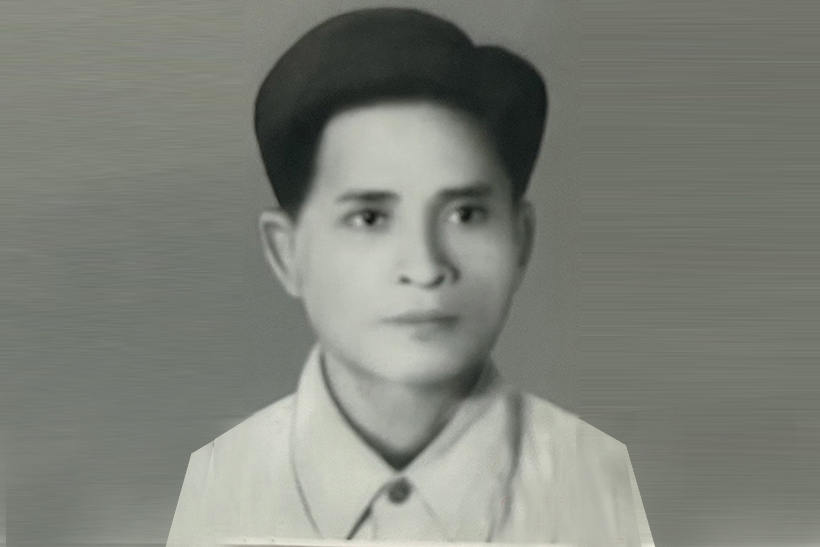
Portrait of Trần Hậu Xương, a pre-revolutionary cadre.
People who participated in organizing the uprising in Thach Ha
Mr. Tran Hau Xuong was born in 1913 into a family with a tradition of patriotism and revolution in Van Yen village, Trung Tiet commune, Thach Ha district (now Van Yen ward, Ha Tinh city). In 1929, at the young age of 16, Mr. Tran Hau Xuong quickly embraced the revolutionary cause and was admitted to the Tan Viet Revolutionary Party. Later, he became a member of the Communist Party of Vietnam , active in the Trung Tiet commune branch. After a short time, he was appointed Secretary of the Trung Tiet commune branch.
In November 1931, Mr. Tran Hau Xuong, as the head of the Mass Mobilization Committee, gave speeches in Thach Tri commune (Thach Ha district). He and the people demonstrated, distributed leaflets, hung flags, and posted slogans: "Down with the French colonialists and their exploitative lackeys!" Afterward, he was arrested by the French colonialists, subjected to brutal torture, and imprisoned in Ha Tinh prison, where he was sentenced to three years. In the French colonial prison, despite torture, shackles, hunger, cold, and disease, he and his comrades remained steadfastly loyal to the Party and waged a hunger strike.
In January 1933, after serving his prison sentence, Mr. Tran Hau Xuong was released and returned home to practice traditional medicine, including pulse diagnosis, herbal remedies, and acupuncture. During this time, Mr. Tran Hau Xuong continued his revolutionary activities, preparing himself and his forces to rise up with the entire population to seize power for the people when the opportunity arose.
On April 10, 1945, he contacted Viet Minh cadres in the province and held a meeting in Ha Tinh town (the location of Phan Dinh Phung High School, Ha Tinh City today) to discuss preparations for the general uprising. Later, on August 7, 1945, he participated in an important meeting in Phu Viet commune (Thach Ha district), receiving instructions from the Viet Minh Front to prepare for the general uprising. On August 9, 1945, Mr. Tran Hau Xuong and his comrades in the Thach Ha district Viet Minh Front discussed and planned to hold a rally in Phu Viet commune, from which to arrange the uprising group to move to Ha Tinh town. The history of the Dong Mon commune Party Committee still records images and revolutionary activities in the commune and Thach Ha and Can Loc districts from August 16-18, 1945, in which Mr. Tran Hau Xuong played an organizational role. He worked diligently, continuously, and tirelessly alongside the Viet Minh Front to lead the uprising, quickly seizing power for the people and achieving victory.
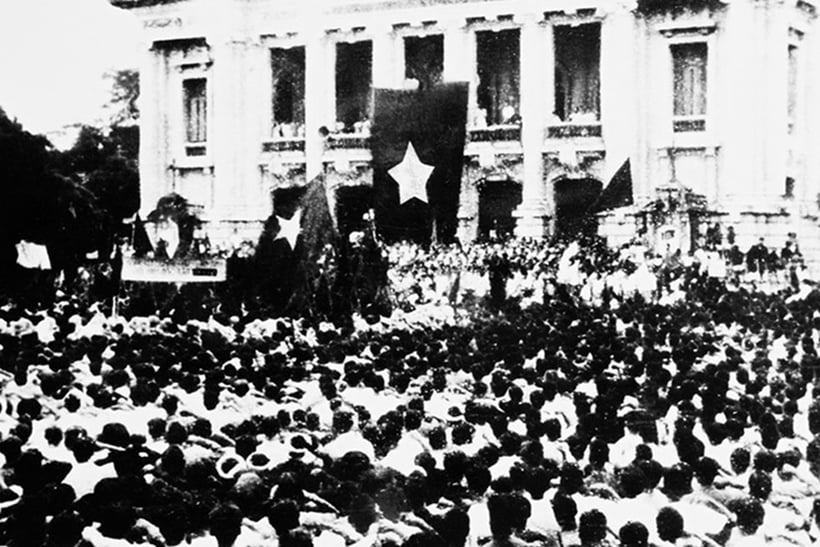
Along with the rest of the country, the uprising to seize power in Ha Tinh contributed to the victory of the August Revolution. In the photo: Hundreds of thousands of people from Hanoi and neighboring provinces streamed along various roads to the Hanoi Grand Theatre Square to attend an unprecedented mass rally of revolutionary people, responding to the General Uprising to seize power on the morning of August 19, 1945 ( Photo courtesy of VNA ).
According to the History of the Ha Tinh Party Committee (1930-1945), on August 17, 1945, upon receiving the order for the uprising from the inter-provincial Viet Minh, the Southern Ha Sub-district Uprising Committee ordered the uprising committees of Thach Ha and Cam Xuyen districts to launch an uprising to seize power, providing support for seizing power in the provincial capital the following day (page 136). Thousands of people, young and old, men and women, participated in the demonstration. The revolutionary spirit was fervent, and the morale of the masses was overwhelming. Loud slogans rang out such as: "Down with the French colonialists and their exploitative lackeys!", "Long live independent Vietnam!"... The massive demonstration marched straight to seize power in Trung Tiet commune and Thach Ha district.
Subsequently, protest groups from neighboring communes converged on the demonstration to seize power in Ha Tinh town. The revolutionary spirit was fervent, and the morale of the masses soared. The uprising to seize power in the province ended victoriously on August 18, 1945, with the establishment of provisional revolutionary governments at all levels, from commune to district to province. Self-defense teams were formed in villages throughout Thach Ha district, with Mr. Tran Hau Xuong assigned to military command.
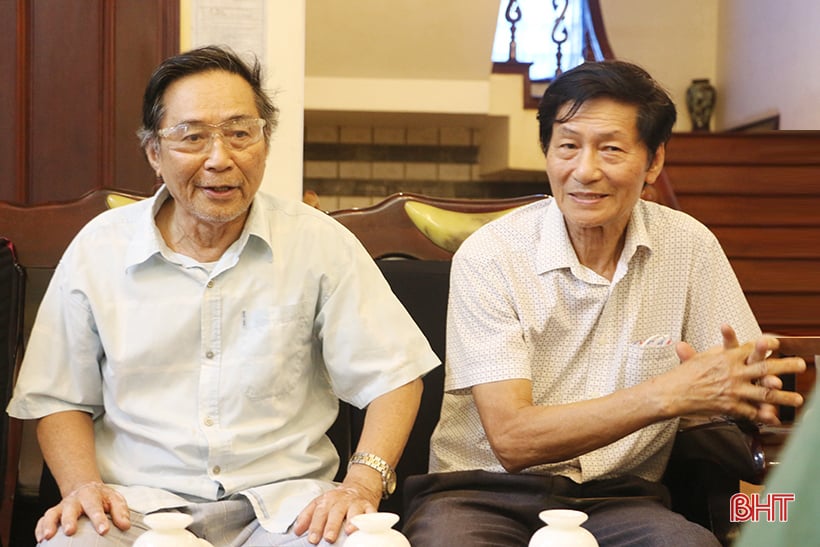
Mr. Le Nghi (on the left) reminisces about the resistance war period with Mr. Tran Hau Ngoc.
Mr. Le Nghi (87 years old), residing in Tien Phong residential area, Thach Quy ward, a witness from that period, recounted: “I was only 8 years old at the time, but I still remember everything clearly. My maternal grandfather was the village headman of Trung Tiet commune, holding the commune's seal. One autumn morning, when it wasn't sunny, I saw a group of four people (I only learned later that one of them was Mr. Tran Hau Xuong) come to our house to ask my grandfather to hand over the seal and other documents to the new government. Mr. Xuong was in charge of military affairs, wearing a long sword and riding a horse, probably confiscated from the Japanese army. They spoke calmly and politely. My maternal grandfather handed everything over to the new government.”
After seizing power for a period, Mr. Tran Hau Xuong joined the army, fighting in Na Pe (Laos), Dien Bien Phu, and also studied traditional medicine in China. He served in the military for a time. He passed away in 1970 in Nam Ha ward. He received many medals, commendations, and certificates from the army and was recognized by the Ha Tinh Provincial Party Committee as a revolutionary activist who died before January 1, 1945.
The fathers' generation comes first, the sons' generation follows...
After listening to Mr. Tran Hau Ngoc recount the revolutionary activities of Mr. Tran Hau Xuong, we accompanied him and his family to visit Ha Tinh Prison (Tan Giang Ward, Ha Tinh City), where the communist Tran Hau Xuong, along with countless patriotic scholars and revolutionary fighters, was imprisoned.
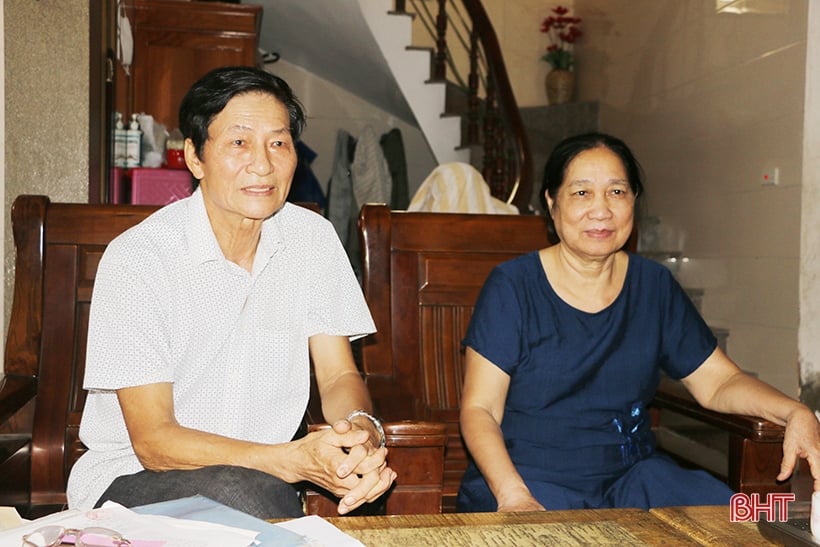
Mr. Tran Hau Ngoc and his wife always reminded each other to guide their children and grandchildren to live and study according to revolutionary ideals.
Touched by the moment he placed his hand on the memorial plaque at Ha Tinh Prison, Mr. Ngoc shared: “My father fought steadfastly for the independence and freedom of the nation throughout his life. We are extremely proud of our family tradition. My father's revolutionary spirit will forever be carried on and preserved by his descendants and future generations of the people of Ha Tinh.”
Following in his father's footsteps, Mr. Tran Hau Ngoc also joined the army, fighting in the Central Highlands battlefield. He was admitted to the Party while in the military and is now retired, residing in Nam Ha ward, Ha Tinh city. He is a Party member for 55 years. His wife, Mrs. Bui Thi Xuan, after serving in the military, transferred to work at the Provincial Labor Union before retiring. Mrs. Xuan is also a Party member for 50 years. Their family lives peacefully and happily with their children and grandchildren.
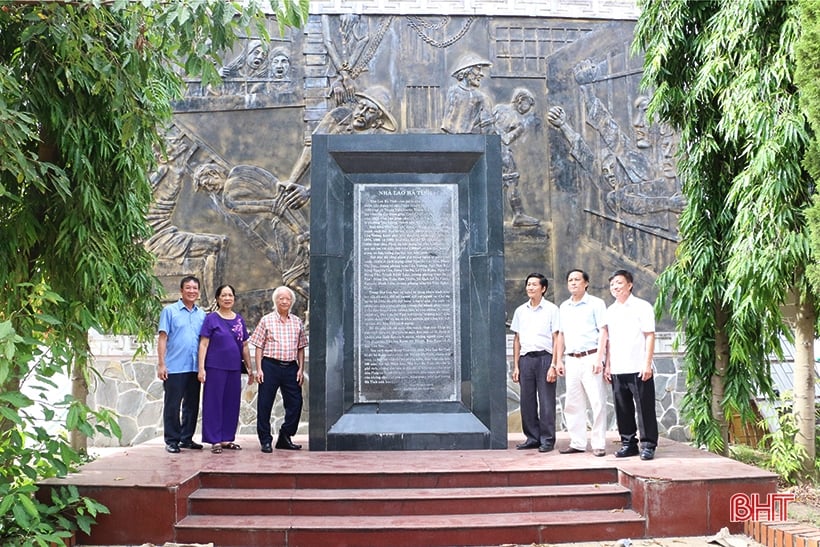
The descendants and relatives of Mr. Tran Hau Xuong stand beside the memorial plaque at Ha Tinh Prison - where Mr. Tran Hau Xuong and other patriotic intellectuals and revolutionary fighters were imprisoned.
During a visit to the Ha Tinh Prison one early autumn morning, besides Mr. and Mrs. Ngoc's family, there were also the grandchildren and relatives of Mr. Tran Hau Xuong. Mr. Tran Hau Hai and Mr. Tran Hau Tam, two grandchildren who are also businessmen in Ha Tinh, proudly introduced us to Mr. Xuong's cousin, Mr. Tran Hau Tung, a staunch communist who had participated in revolutionary activities since 1929. In early 1930, he was sentenced to prison and exiled to Buon Ma Thuot with prisoner number F1407, and was recognized as a pre-revolution cadre. And also beneath the bas-relief depicting the spirit of patriotic communists, we met Mr. Tran Thanh Giap - the squad leader of the Suicide Squad that cleared mines and magnetic bombs in Cua Hoi (Nghi Xuan), Mr. Xuong's nephew. After the mine-clearing operation on February 26, 1972, Mr. Giap was the only one of eight survivors, severely wounded.
The stories of the fathers, grandfathers, and relatives of a large family with a revolutionary tradition will continue to be told by their descendants today, reminding them to live up to the legacy of their ancestors.
Minh Hue - Anh Thuy
Source
![[Live] 2025 Community Action Awards Gala](/_next/image?url=https%3A%2F%2Fvphoto.vietnam.vn%2Fthumb%2F1200x675%2Fvietnam%2Fresource%2FIMAGE%2F2025%2F12%2F16%2F1765899631650_ndo_tr_z7334013144784-9f9fe10a6d63584c85aff40f2957c250-jpg.webp&w=3840&q=75)
![[Image] Leaked images ahead of the 2025 Community Action Awards gala.](/_next/image?url=https%3A%2F%2Fvphoto.vietnam.vn%2Fthumb%2F1200x675%2Fvietnam%2Fresource%2FIMAGE%2F2025%2F12%2F16%2F1765882828720_ndo_br_thiet-ke-chua-co-ten-45-png.webp&w=3840&q=75)


![[Photo] Prime Minister Pham Minh Chinh receives the Governor of Tochigi Province (Japan)](/_next/image?url=https%3A%2F%2Fvphoto.vietnam.vn%2Fthumb%2F1200x675%2Fvietnam%2Fresource%2FIMAGE%2F2025%2F12%2F16%2F1765892133176_dsc-8082-6425-jpg.webp&w=3840&q=75)
![[Photo] Prime Minister Pham Minh Chinh receives Lao Minister of Education and Sports Thongsalith Mangnormek](/_next/image?url=https%3A%2F%2Fvphoto.vietnam.vn%2Fthumb%2F1200x675%2Fvietnam%2Fresource%2FIMAGE%2F2025%2F12%2F16%2F1765876834721_dsc-7519-jpg.webp&w=3840&q=75)



































![[Live] Closing Ceremony and Award Presentation for the "Impressive Vietnam Tourism" Video/Clip Creation Contest 2025](https://vphoto.vietnam.vn/thumb/402x226/vietnam/resource/IMAGE/2025/12/17/1765974650260_z7273498850699-00d2fd6b0972cb39494cfa2559bf85ac-1765959338756946072104-627-0-1338-1138-crop-1765959347256801551121.jpeg)

















Comment (0)